Band 5.0 IELTS Writing Task 1 Model Answer
Overall Band Score: 5.0 · IELTS Last Minute Nov 2026 · 2026-11-22
IELTS Writing Task 1 question
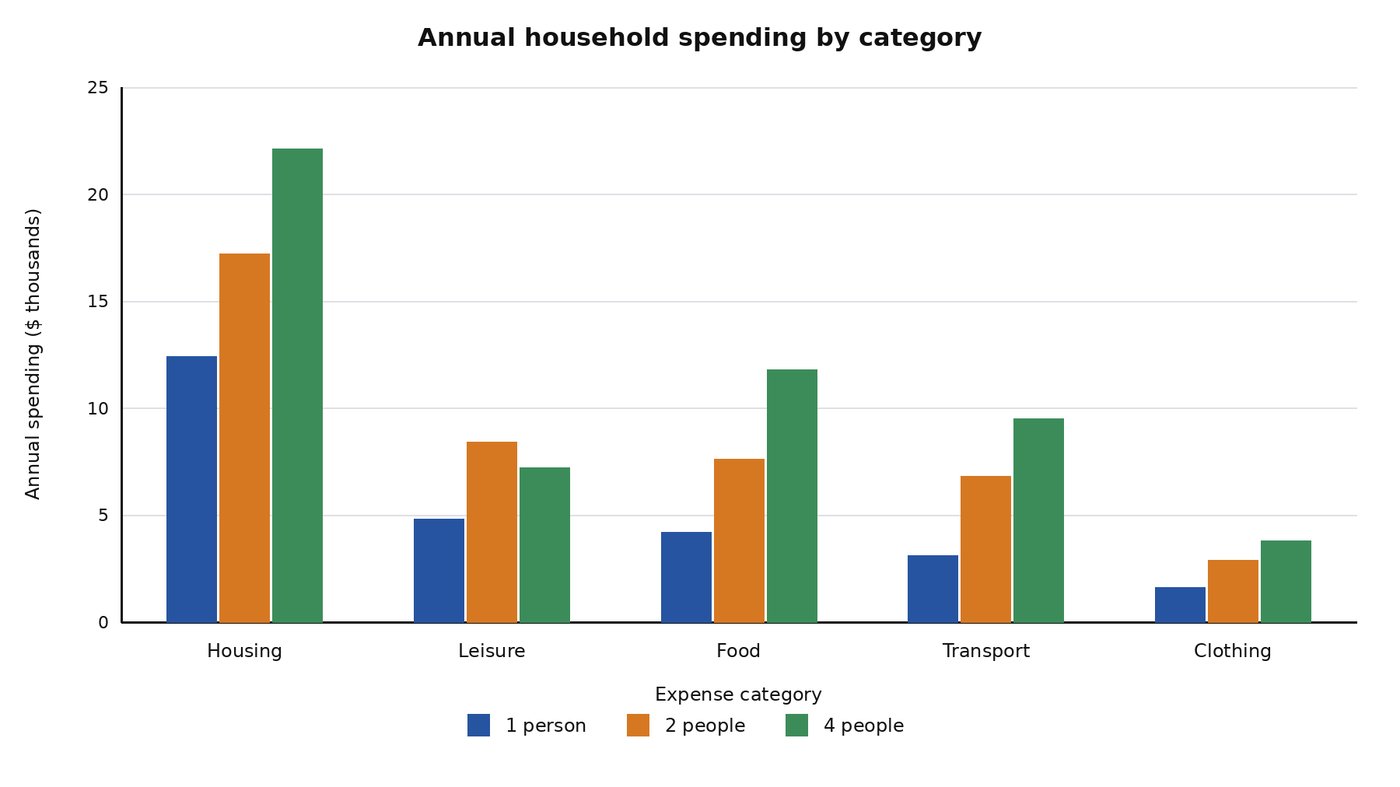
The chart below shows annual spending by households of three different sizes on five categories in one country.
Summarise the information by selecting and reporting the main features, and make comparisons where relevant.
Student answer (Band 5.0)
The graph represents the annual household spending of three different sizes on five categories. Overall, the chart shows that most of the people spend their time on housing. On the contrary, households spend least of their time on clothing.
Also, the figure shows that the annual spending on all four category like housing, food, transport and clothing are moving towards upward direction. Though, amount used on leisure time is not constant where, a number of people who spent most is 2.
In addition to this, among all these category households spend smallest amount on clothing which is not even 5% of the total income. Most of their money has been spent by four peoples where a single person barely spend.
This chart illustrates, four people expenses is huge rather than two or a single person.
AI examiner evaluation
| Criterion | Band |
|---|---|
| Task Achievement / Task Response | 4.5 |
| Coherence and Cohesion | 4.5 |
| Lexical Resource | 5.0 |
| Grammatical Range and Accuracy | 5.0 |
| Overall | 5.0 |
Task Achievement / Task Response: Band 4.5
You identify the chart’s main categories and correctly note that housing is the largest expense and clothing the smallest. However, the overview is not consistently accurate: spending on leisure does not simply rise, since it increases from one-person to two-person households and then falls for four people. The claim that clothing is “not even 5% of the total income” is unsupported by the chart, which gives spending amounts rather than income shares. The response also omits useful comparisons, such as four-person households spending most on food after housing, and two-person households spending more on leisure than four-person households. It is 15 words below the required minimum, further limiting the detail reported.
Coherence and Cohesion: Band 4.5
There is a basic attempt to organise the response, beginning with an introduction and overview and then adding further observations. However, the ideas do not develop in a clear sequence: the points about clothing and total spending are repeated, while the comparison of leisure is inserted without being clearly connected to the overview. Linking phrases such as “On the contrary,” “Also,” and “In addition to this” are used, but some do not express the relationship accurately; “On the contrary” does not establish a contrast between housing and clothing. The final sentence largely repeats the point that four-person households spend more. Group the overview first, then compare the main categories and household sizes in a logical order.
Lexical Resource: Band 5.0
The response uses enough basic vocabulary to identify the subject and categories, including “annual spending,” “housing,” “leisure,” and “clothing.” However, the range is limited and several word choices or collocations are unsuitable for describing a chart. For example, “spend their time on housing” confuses time with money, and “amount used on leisure time” is not a natural way to describe expenditure. “Moving towards upward direction” is also awkward, while “four peoples” and “expenses is huge” show imprecise word forms and phrasing. Use a consistent vocabulary of spending, such as “expenditure,” “spent,” and “amount,” and choose verbs that accurately describe changes, such as “rose” or “fell.”
Grammatical Range and Accuracy: Band 5.0
You attempt some longer sentence forms, including “Though, amount used on leisure time is not constant where…” and “Most of their money has been spent by four peoples…”. However, these constructions are often faulty, and the response relies mainly on simple statements rather than a controlled range of sentence patterns. Errors include missing articles and plural forms in “all four category,” subject–verb disagreement in “four people expenses is huge,” and an unclear clause structure in the sentence about leisure. Punctuation also interrupts meaning, as in “where, a number of people…”. These errors sometimes make the intended comparison difficult to follow. Practise accurate comparative sentences, for example, “Four-person households spent more on food than the other groups.”
See this exact question answered at other band scores. The same prompt compared across bands.
Browse more IELTS Writing model answers or get your own writing scored by the same AI examiner.