Band 5.0 IELTS Writing Task 1 Model Answer
Overall Band Score: 5.0 · IELTS Last Minute Nov 2026 · 2026-11-26
IELTS Writing Task 1 question
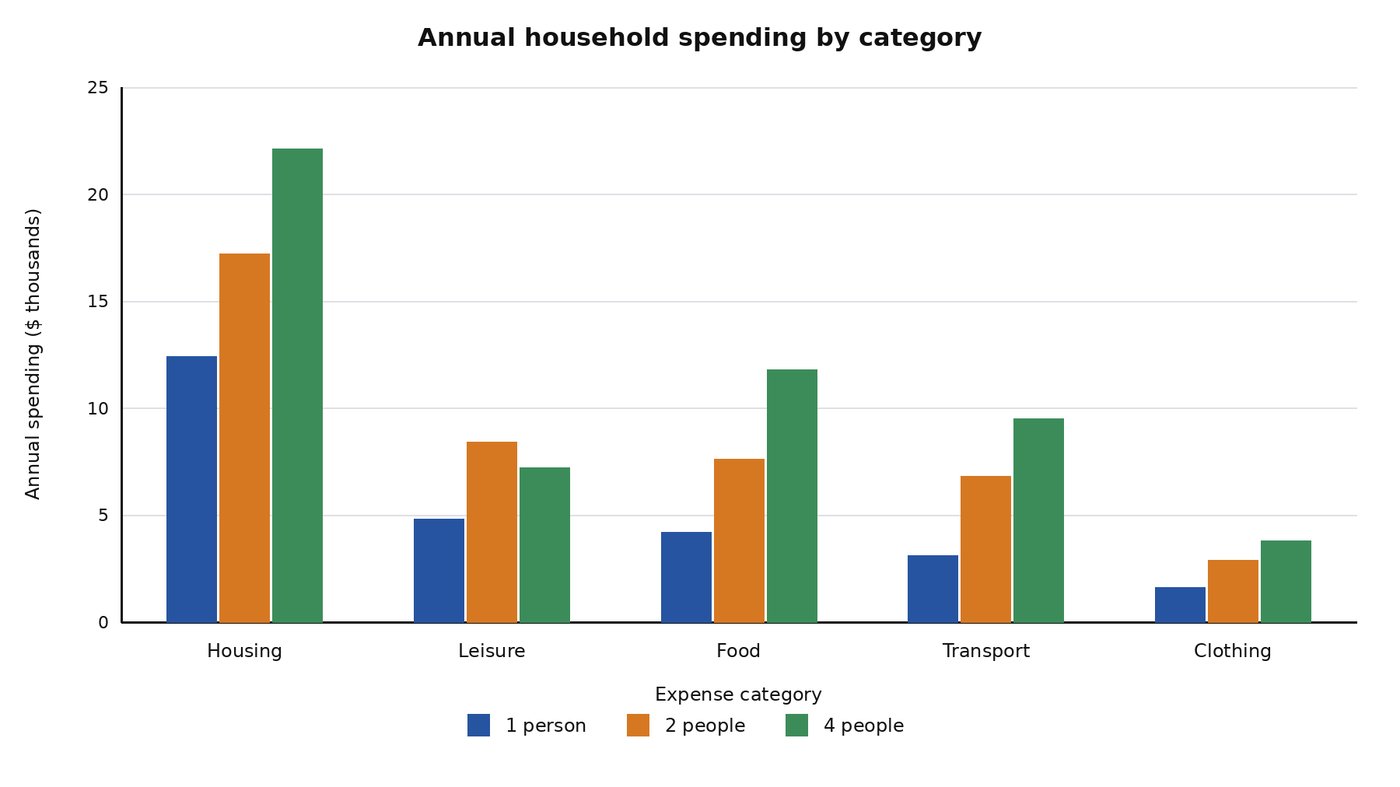
The chart below shows annual spending by households of three different sizes on five categories in one country.
Summarise the information by selecting and reporting the main features, and make comparisons where relevant.
Student answer (Band 5.0)
The bar chart demonstrates annual spending by households of three different sizes on five categories in one country.
Overall, housing accounts for the largest proportion of annual expenditure across all three household sizes. While, clothing consistenly represents the lowest spendind.
First of all, housing accounts for largest proportion of annul spending. For a single person households the annual spending is around $12500 and two people households spending is approximately $17000 annually. While, for four people total expenditure of households is around $23000 annually. Leisure annual spending of single person is approximately $4000 and for two people is around $8000 annually. subsequently, for four people is approximately $7000 per year. Thereafter, for food four people households spend most and is around $13000 annually and for two people households for food is $75000. While, for single person is around $4000 annual spending. And clothing is lowest spending across all three sizes. And the transport for single person hous
AI examiner evaluation
| Criterion | Band |
|---|---|
| Task Achievement / Task Response | 4.5 |
| Coherence and Cohesion | 4.0 |
| Lexical Resource | 5.5 |
| Grammatical Range and Accuracy | 5.0 |
| Overall | 5.0 |
Task Achievement / Task Response: Band 4.5
You identify the main overall pattern correctly: housing is the highest-spending category for all household sizes, and clothing is the lowest. You also make relevant comparisons for housing, leisure and food. However, the report is incomplete and only partially covers the chart: the transport discussion stops mid-sentence, and clothing is identified as lowest without any figures. There is also a major data error: two-person households spend about $7,600 on food, not $75,000. The overview is brief, and the response does not fully select and report the key comparisons. It is also 8 words below the 150-word minimum, which further limits the task coverage. Check figures carefully and complete the comparison across all five categories.
Coherence and Cohesion: Band 4.0
The response has a basic overall shape, beginning with an introduction and overview before moving into category details. This gives the reader some sense of the chart’s subject and main pattern. However, the body is presented as one long paragraph, and the sequence of information is difficult to follow. Connectors such as “First of all,” “While,” “subsequently,” and “Thereafter” are used mechanically or create sentence fragments, rather than clearly showing relationships between complete ideas. Repeated statements about housing and clothing also interrupt progression, while the final transport point is cut off. Use separate overview and detail paragraphs, group related comparisons, and connect complete sentences more clearly.
Lexical Resource: Band 5.5
You use relevant chart vocabulary, including “annual spending,” “expenditure,” “accounts for,” and “approximately,” and the reader can generally understand the categories being compared. There is some variation in how you describe spending, but several spelling and word-choice errors reduce precision: “spendind,” “annul,” and “consistenly” are noticeable, while “largest proportion” is not the most accurate description of dollar amounts. Phrases such as “for food four people households spend most” are also awkward and make the comparison less clear. Aim for accurate, natural collocations and check spelling. More precise terms such as “highest expenditure” and “spent around” would suit this chart well.
Grammatical Range and Accuracy: Band 5.0
You attempt both simple statements and longer sentences, and the opening sentence communicates the chart’s subject clearly. However, the range is limited, and errors recur in sentence construction, agreement, articles and punctuation. For example, “While, clothing consistenly represents” is an incomplete contrast clause, and “for a single person households” has a mismatch between the article and plural noun. The sentence beginning “Thereafter, for food…” combines several comparisons without a clear grammatical structure. Some sentences also begin with “And” or “While” as fragments, and the final sentence is unfinished. Practise forming complete comparison sentences, checking singular and plural forms, and using punctuation to separate ideas.
See this exact question answered at other band scores. The same prompt compared across bands.
Browse more IELTS Writing model answers or get your own writing scored by the same AI examiner.