Band 5.5 IELTS Writing Task 1 Model Answer
Overall Band Score: 5.5 · IELTS Predictions Nov 2026 · 2026-11-19
IELTS Writing Task 1 question
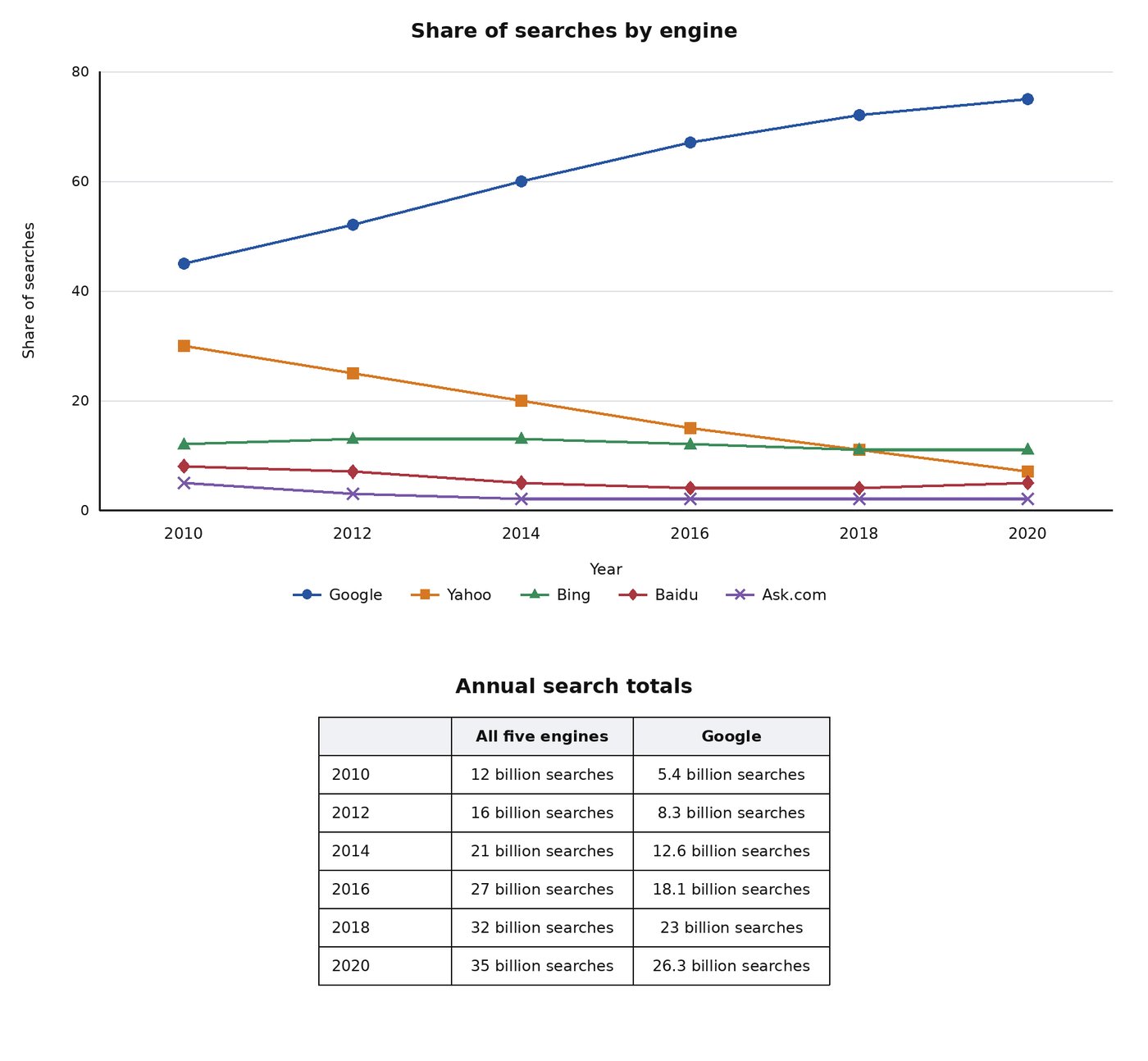
The line graph and table below show the percentage shares of five search engines and annual search totals in one country between 2010 and 2020.
Summarise the information by selecting and reporting the main features, and make comparisons where relevant.
Student answer (Band 5.5)
THE LINE GRAPH ILLUSTRATES THE SHARE OF FIVE SEARCH ENGINES AND TABLE SHOWS THE TOTAL ANNUAL SEARCH IN ONE COUNTRY BETWEEN 2010 AND 2020.
OVERALL, THE TREND FOR BING, BAIDU AND ASK.COM ARE SIMILAR. WHILE GOOGLE IS MOST SEARCH BY ENGINE AND YAHOO EXPERIENCED A DROP. IN TABLE, THE RATIO FOR 2020 IS HIGHER FROM ALL YEARS.
IN LINE GRAGH, BING, BAIDU AND ASK.COM SHARES SAME POSITION UNDER 20%. BY FOLLOWING YEARS THE PRECENTAGE FOR THESE GOES SAME WITH MINOR CHANGES ON BING WHICH SEEMS A RISE IN TREND. WHILE, YAHOO IS ALMOST ON 30% IN 2010. THEN FALL BY FOLLOWING YERS WITH GAP OF ALMOST 5%, TO UNDER 20% IN LAST YEAR. MEANWHILE, GOOGLE SHARED THE HIGHEST TREND. STARTS FROM ALMOST 43% TO RISE AT 60% IN 2014 THEN GOES UP AND STOPS CLOSE TO 80% IN 2020.
IN TABLE, TOTAL ANNUAL SEARCH IN 2010 IS 12 BILLION, 16 BILLION IN 2012 AND 21 BILLION IN 2014. 5% UP FROM 2016 THEN IN 2018 32 BILLION. GOES TO 35 BILLION IN 2020. MEANWHILE, FOR GOOGLE, 5.4 BILLION SHARES IN 2010. RISE TO 12.6 BILLION IN 2014 AND STOPS AT 26.3 BILLION SEARCHES IN 2020.
AI examiner evaluation
| Criterion | Band |
|---|---|
| Task Achievement / Task Response | 6.0 |
| Coherence and Cohesion | 6.0 |
| Lexical Resource | 5.0 |
| Grammatical Range and Accuracy | 5.0 |
| Overall | 5.5 |
Task Achievement / Task Response: Band 6.0
You cover both visuals and identify the main contrast: Google’s share and search volume rise, while Yahoo’s share falls. The overview also notes that the other three engines remain below 20%, which is a relevant broad feature. Several figures are accurate, including the 2010 total and Google’s 2020 volume. However, some details are unclear or imprecise: Google starts at about 45%, not 43%, and reaches 75% in 2020 rather than “close to 80%.” The table’s 2016 total is described as “5% up,” although it is 27 billion searches; Google’s 2016 and 2018 figures are also omitted. Develop the comparisons more fully and distinguish percentage share from search totals to make the report more precise.
Coherence and Cohesion: Band 6.0
The response has a recognisable structure: an introduction, an overview, a paragraph on the line graph and one on the table. This gives the reader a coherent overall route through the information. However, progression within paragraphs is sometimes difficult to follow, particularly in “By following years the percentage for these goes same” and “5% up from 2016 then in 2018 32 billion.” The repeated use of “Meanwhile,” “then” and “in” creates a mechanical sequence, and some references such as “these” are not immediately clear. Use clearer topic sentences and connect comparisons explicitly—for example, contrast Google’s growth with Yahoo’s decline, then group the smaller engines by their broadly stable shares. This would make the organisation more fluent without changing the useful paragraph structure.
Lexical Resource: Band 5.0
You use relevant task vocabulary such as “share,” “trend,” “drop” and “annual search,” so the topic is generally understandable. There are also attempts to describe movement, including “rise” and “fall.” However, several word choices and collocations are inaccurate or awkward, such as “Google is most search by engine,” “the ratio for 2020 is higher from all years” and “Google shared the highest trend.” Spelling errors, including “gragh,” “precantage” and “yers,” also reduce precision. Build a more reliable set of chart-description phrases and use them consistently: say that a share “increased,” “declined” or “remained broadly stable,” and describe totals as “searches” rather than “shares.” Proofreading spelling and word forms would make the information easier to interpret.
Grammatical Range and Accuracy: Band 5.0
You attempt both simple statements and longer sentences, including a contrast with “While Google…” and a sequence describing changes over time. However, sentence control is uneven, and several clauses are incomplete or have faulty verb forms. For example, “Then fall by following yers” lacks a clear subject and finite verb, while “Starts from almost 43% to rise at 60%” does not form a complete, accurate sentence. Agreement is also inconsistent in “the trend … are similar,” and articles are missing in the introduction (“the share of five search engines and table”). Use complete subject–verb sentences, maintain past-tense forms for the historical data, and check singular/plural agreement. A few well-controlled complex sentences would help express comparisons more clearly.
See this exact question answered at other band scores. The same prompt compared across bands.
Browse more IELTS Writing model answers or get your own writing scored by the same AI examiner.