Band 5.0 IELTS Writing Task 1 Model Answer
Overall Band Score: 5.0 · IELTS Predictions Nov 2026 · 2026-11-21
IELTS Writing Task 1 question
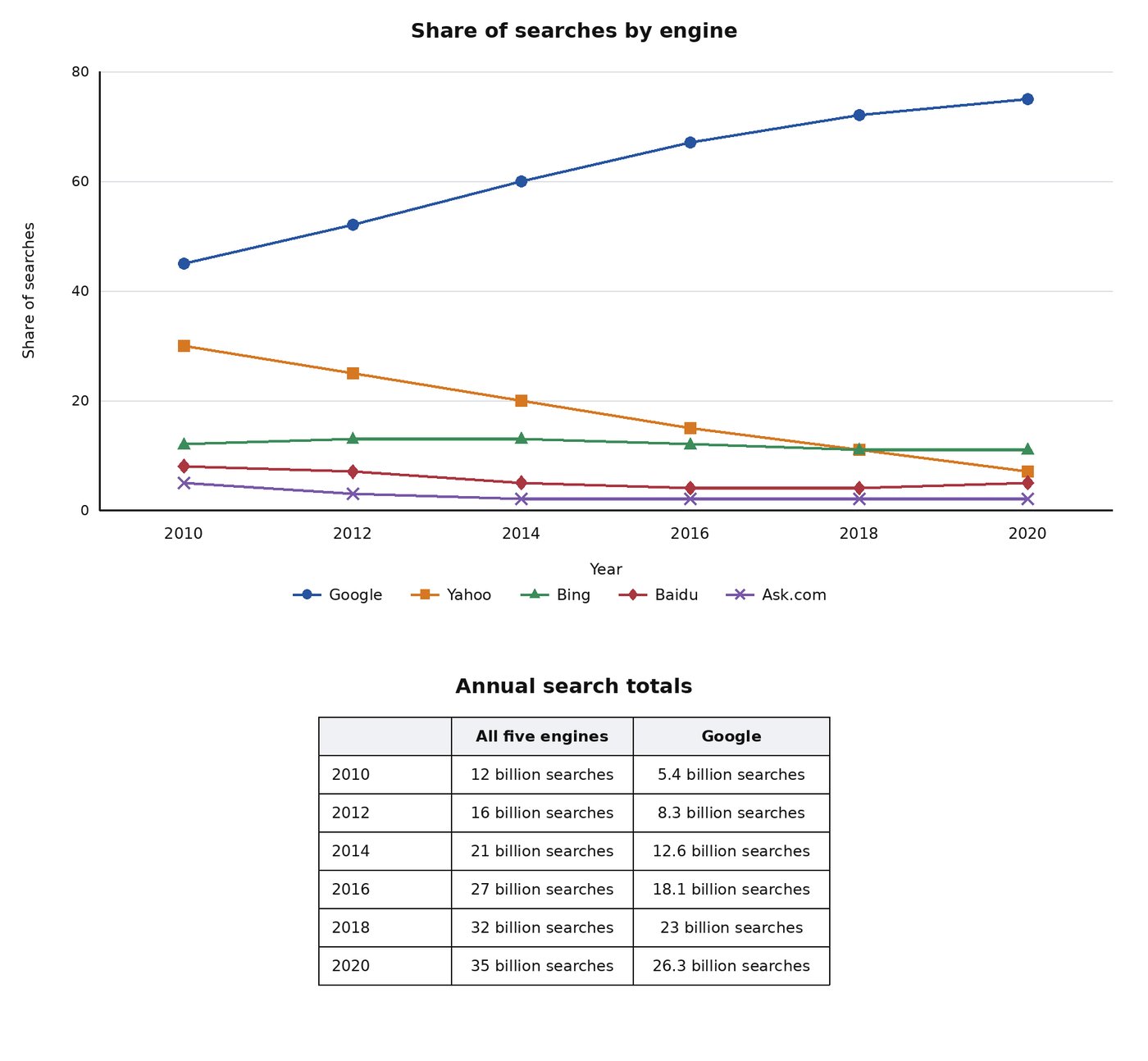
The line graph and table below show the percentage shares of five search engines and annual search totals in one country between 2010 and 2020.
Summarise the information by selecting and reporting the main features, and make comparisons where relevant.
Student answer (Band 5.0)
The line graph and table show the percentage of five search engines and annual search totals in a single country from 2010 to 2020.
Overall, the picture illustrates five huge companies, such as Google, Yahoo, Bing, Baidu and Ask.com, their fluctuations over the years and the total of annual search.
First, the line graph shows us an increase in Google searches over the years, which has started from around 40% in the year 2010, up to 80% in 2020.
Yahoo searches have declined in percentage, with a percentage of just under 40 in 2010, followed by a decline over the years, up to below 20 in 2020.
The other engines' searches remained at almost the same insignificant level over these 6 years, which is below 20%.
The annual search total summarises Google
AI examiner evaluation
| Criterion | Band |
|---|---|
| Task Achievement / Task Response | 4.0 |
| Coherence and Cohesion | 5.0 |
| Lexical Resource | 5.5 |
| Grammatical Range and Accuracy | 5.5 |
| Overall | 5.0 |
Task Achievement / Task Response: Band 4.0
You identify the topic and report the broad contrast between Google’s growth and Yahoo’s decline, which are central features. However, the account is incomplete: the overview calls the companies’ trends “fluctuations” rather than clearly summarising the dominant rise in Google’s share and the falls in Yahoo and the smaller engines. Some figures are imprecise or misleading: Google is about 45% in 2010 and 75% in 2020, not around 40% and 80%; Yahoo falls from 30% to 7%, not from just under 40% to below 20%. The statement that the other engines stayed at an “almost the same” level overlooks changes, and the table is left unfinished after “The annual search total summarises Google”. The response is also below the 150-word minimum, limiting coverage further.
Coherence and Cohesion: Band 5.0
The response has a basic sequence: an introduction, an overview, then comments on the graph and table. Connectors such as “Overall” and “First” help signal this structure, and the reader can follow the main points about Google and Yahoo. However, progression is limited: “First” is not followed by a clear set of subsequent stages, and the final sentence stops abruptly, leaving the table information undeveloped. The overview also combines several ideas without establishing a clear hierarchy of the main trends. Use separate, purposeful paragraphs for the overview, key line-graph comparisons, and table figures, and link each comparison explicitly—for example, contrast Google’s rising share with Yahoo’s decline before describing the smaller engines.
Lexical Resource: Band 5.5
You use relevant topic vocabulary, including “percentage”, “declined”, “annual search total” and “over the years”, so the subject is generally clear. There is some variation in how trends are described, but several choices are imprecise or unsuitable for an objective data summary. “Five huge companies” is an unsupported description, while “insignificant level” is evaluative and understates the other engines’ shares. “The picture illustrates” and “shows us” are less natural in formal report writing, and “the total of annual search” is awkward. Aim for precise terms such as “market share”, “accounted for”, “rose steadily” and “remained comparatively low”. More accurate vocabulary for describing proportions and changes would make the comparisons clearer and more formal.
Grammatical Range and Accuracy: Band 5.5
You produce several understandable sentence forms, including the complex clause “which has started from around 40% … up to 80%”. The main trends can usually be understood, and basic past-tense reporting is attempted. However, control is uneven. In that clause, “has started” does not fit the completed 2010–2020 period, and “up to” is not correctly integrated with the verb; a clearer form is “Google’s share rose from about 45% in 2010 to 75% in 2020.” The phrase “with a percentage of just under 40 in 2010, followed by a decline” is also an awkward, incomplete construction. The final sentence is unfinished, so it cannot communicate a complete table comparison. Practise complete, well-formed sentences and consistent past-tense descriptions.
See this exact question answered at other band scores. The same prompt compared across bands.
Browse more IELTS Writing model answers or get your own writing scored by the same AI examiner.