Band 6.0 IELTS Writing Task 1 Model Answer
Overall Band Score: 6.0 · IELTS Last Minute Nov 2026 · 2026-11-19
IELTS Writing Task 1 question
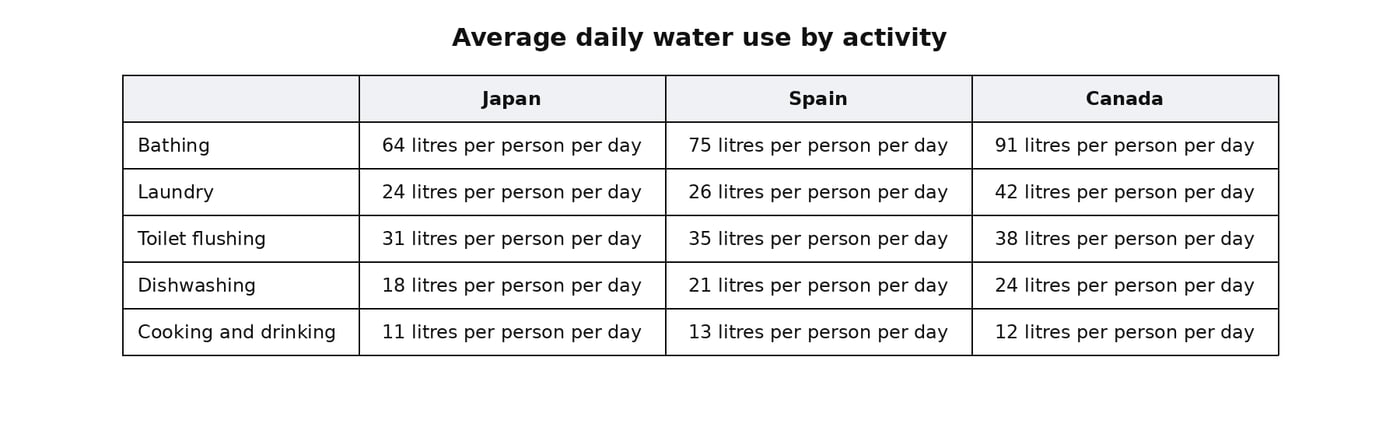
The table below shows the mean volume of water consumed per person per day for five household activities in three countries.
Summarise the information by selecting and reporting the main features, and make comparisons where relevant.
Student answer (Band 6.0)
The given tabular chart outlines the data about the consumption of water per person per day for different household activites in Japan, Spain and Canada.
Turning on the details, it is manifest that the average daily water use for bathing is 64 litre per person in Japan, however the use of water is increased with 7 litre per eprsoon in Spain.The consumption of water for bathing is the highest with 91 litre per person in Canada. The daily consumption of water is 24 litre per person in Japan ,26 litre per person Spain ,42 litre per person in Canada. Thereafter, 31 litre per person water is used for toilet flushing in Japan, the average daily water use for the same activity is approximately the same with 38 litre per person in Spain and Canada.
The daily water use for dishwashing is 18 litre per person in Japan , 21 litre per person in Spain, 24litre per person in Canada respectively . The daily consumption of water for cooking and drinking is between 11 litre per person and 13 litre per person in Japan, Spain and Canada.
To sum up, the average daily water use is the maximum for bathing in the given countries.
AI examiner evaluation
| Criterion | Band |
|---|---|
| Task Achievement / Task Response | 6.0 |
| Coherence and Cohesion | 6.0 |
| Lexical Resource | 5.5 |
| Grammatical Range and Accuracy | 5.5 |
| Overall | 6.0 |
Task Achievement / Task Response: Band 6.0
You identify the main overall feature accurately: bathing uses the most water in all three countries, and you report several figures for bathing, laundry and dishwashing correctly. The response also covers all five activities, so the reader can understand the broad pattern. However, some comparisons are incomplete or inaccurate. For toilet flushing, the figures are 31 litres in Japan, 35 in Spain and 38 in Canada; describing Spain and Canada as “approximately the same” obscures the steady increase. The bathing comparison says Spain is 7 litres higher than Japan but omits the actual Spanish figure, and the cooking-and-drinking range is not clearly assigned to each country. A clearer overview of the country-level patterns and more precise reporting of these details would strengthen the summary.
Coherence and Cohesion: Band 6.0
The response has a recognisable structure: an introduction, two paragraphs of data, and a concluding summary. Grouping bathing and laundry before the remaining activities gives the information a generally coherent order. However, progression within the first body paragraph is somewhat mechanical, with repeated openings such as “The daily consumption of water” and “The consumption of water.” Some linking expressions are also awkward or do not show the relationship clearly: “Turning on the details” is not a natural transition, while “Thereafter” suggests a sequence that is not present in the table. The toilet-flushing comparison is difficult to follow because the figures are not matched clearly to Spain and Canada. Use simpler transitions and organise comparisons consistently by activity or by country.
Lexical Resource: Band 5.5
You use relevant vocabulary for describing the table, including “consumption,” “average daily water use,” “bathing,” and “toilet flushing,” and the meaning is generally clear. However, the range is repetitive, especially through repeated use of “daily consumption of water” and “per person.” Several word choices or collocations are unnatural, such as “Turning on the details,” “the use of water is increased with,” and “the highest with 91 litre.” There are also spelling and spacing slips, including “activites” and “eprsoon.” These do not prevent understanding, but they reduce precision and fluency. Aim for natural reporting phrases such as “rose to,” “was highest at,” and “used for,” and check spelling and unit forms carefully.
Grammatical Range and Accuracy: Band 5.5
You attempt both simple statements and more complex structures, including a contrast with “however” and a concluding sentence, and most of the data remains understandable. Some grammatical errors nevertheless affect accuracy. For example, “64 litre per person” and “24 litre per person” need plural agreement (“litres”), while “26 litre per person Spain” is missing the preposition “in.” The sentence beginning “the use of water is increased with 7 litre” has an awkward passive construction and unclear comparison; a direct form such as “Spain used 75 litres, 11 more than Japan” would be clearer. Punctuation is also inconsistent, with missing spaces after full stops and spaces before commas. Practise accurate comparative sentence patterns and proofread agreement and punctuation.
See this exact question answered at other band scores. The same prompt compared across bands.
Browse more IELTS Writing model answers or get your own writing scored by the same AI examiner.