Band 5.0 IELTS Writing Task 1 Model Answer
Overall Band Score: 5.0 · IELTS Last Minute Nov 2026 · 2026-11-20
IELTS Writing Task 1 question
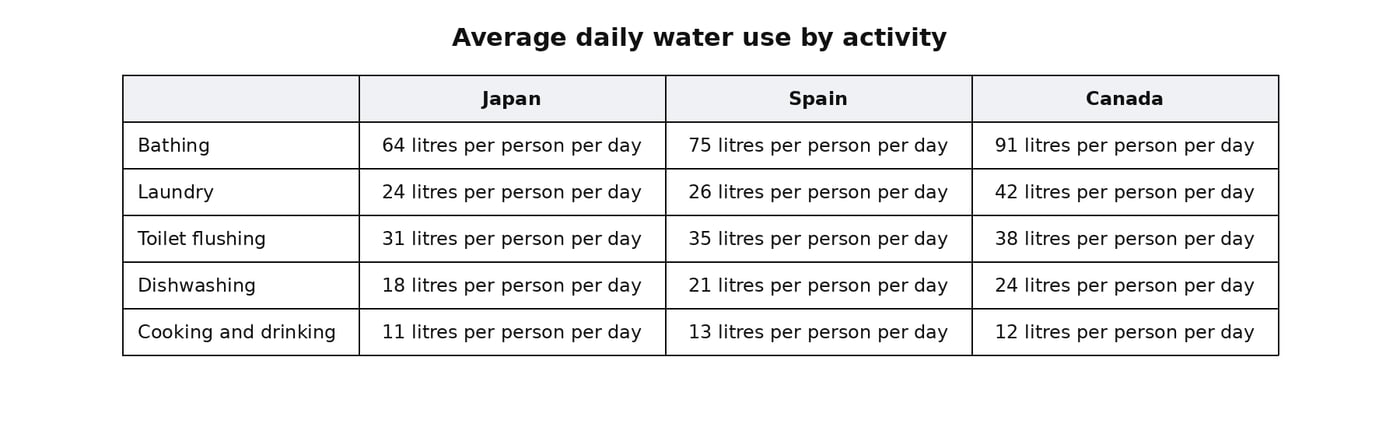
The table below shows the mean volume of water consumed per person per day for five household activities in three countries.
Summarise the information by selecting and reporting the main features, and make comparisons where relevant.
Student answer (Band 5.0)
The table illustrates the mean daily consumption per person in Japan, Spain, and Canada across five household activities. Overall, bathing is the highest in all countries, followed by toilet flushing. Cooking and drinking are the lowest in all.
In Japan, bathing water consumption is the highest, with 64 litres per person per day, and toilet flushing is the second highest consumption, with 31 litres per person per day. Laundry daily water use is 24 litres per person per day. Dishwashing and cooking and drinking are the trough of all with 18% for dishwashing and 11% for other. Canada is the secong highest in all with servings of 91 litres for bathing and becoming the highest in all countries, laundry is the second highest with 42 litres. Others are 38% for toilet flushing, 24% for dishwashing, 12 for cooking and drinking.
Spain is the lowest of three countries with 75% for bathing, 26% for laundry, 35% for toilet and flushing,
AI examiner evaluation
| Criterion | Band |
|---|---|
| Task Achievement / Task Response | 4.5 |
| Coherence and Cohesion | 4.5 |
| Lexical Resource | 5.5 |
| Grammatical Range and Accuracy | 5.0 |
| Overall | 5.0 |
Task Achievement / Task Response: Band 4.5
You identify the table’s subject and give a useful overview that bathing is the largest category and cooking/drinking the smallest. Several figures are also reported accurately, including Japan’s bathing and toilet use and Canada’s bathing and laundry use. However, the response only partially covers the data: the Spain paragraph stops before reporting dishwashing and cooking/drinking, and the comparison that Canada is “the second highest in all” is inaccurate because Canada has the highest figures in most categories. The use of “18%” and “38%” also misrepresents litre values as percentages. To make the summary more complete and clear, report the remaining Spanish figures and compare the countries accurately across the main categories.
Coherence and Cohesion: Band 4.5
The response has a basic overall structure: an introduction and overview are followed by country-based paragraphs. This gives the reader some sense of how the information is organised, and the transitions “In Japan” and “Spain” help signal changes in focus. However, progression is uneven: the Canada information is inserted into the Japan paragraph, while the Spain paragraph ends abruptly after three figures. The phrase “Others are” does not clearly identify which activities are being listed, and the overview’s sequence is not consistently reflected in the details. Organise the body paragraphs consistently—by country or by activity—and use clear links and references so each comparison is easy to follow.
Lexical Resource: Band 5.5
You use relevant vocabulary for describing the table, including “mean daily consumption,” “household activities,” and “highest,” and the reader can generally understand the intended comparisons. There is some variety in how you refer to water use. However, several choices are inaccurate or awkward for this task: “the trough of all” is not a natural way to describe the lowest figures, “servings” does not fit water consumption, and “18%” and “38%” use the wrong unit. “The second highest in all” is also unclear and imprecise. Use standard data-reporting collocations such as “the lowest figures,” “litres per person per day,” and “recorded the highest use.” Check spelling, including “secong,” as well.
Grammatical Range and Accuracy: Band 5.0
You produce some clear simple sentences, such as “The table illustrates the mean daily consumption per person in Japan, Spain, and Canada across five household activities.” You also attempt longer structures to combine figures and comparisons. However, control becomes unreliable in sentences such as “Canada is the secong highest in all with servings of 91 litres for bathing and becoming the highest in all countries, laundry is the second highest,” where clauses are joined without a clear grammatical structure. The final Spain sentence is incomplete, and “Dishwashing and cooking and drinking are the trough of all” has an awkward construction. Aim for complete sentences with one clear comparison at a time, and check clause boundaries, articles, and punctuation.
See this exact question answered at other band scores. The same prompt compared across bands.
Browse more IELTS Writing model answers or get your own writing scored by the same AI examiner.