Band 5.5 IELTS Writing Task 1 Model Answer
Overall Band Score: 5.5 · IELTS Last Minute Nov 2026 · 2026-11-20
IELTS Writing Task 1 question
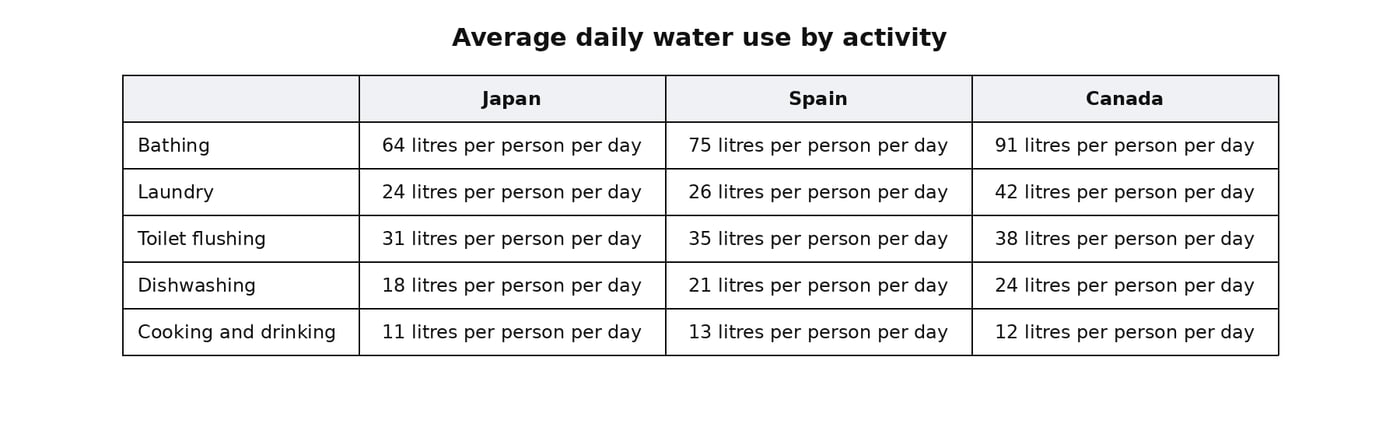
The table below shows the mean volume of water consumed per person per day for five household activities in three countries.
Summarise the information by selecting and reporting the main features, and make comparisons where relevant.
Student answer (Band 5.5)
The given table compares the water consumption by the every citizen of three different countries while performing activities like bathing, laundary, toilet flushing, dishwashing, cooking and drinking. For bathing purpose the consumption of water is higher than as compared to other activities.
Canadian people uses more water to performs these activities as compared to Spain and Japan citizens, while spain's citizens consumes more water per activities as compared to Japan's citizens.
In all three countries, highest litres of water is uses for bathing purpose as compares to laundary, toilet flushing, dishwashing, cooking and drinking purposes. The use of water per litres for cooking and drinking purposes is least as compares to other activities.
For toilet flushing purposes, Japan's citizens are using 31 litres per person, Spain's citizens are using 35 litres per person, Canadian people are using 38 litres per person, which is second highest water consumption activity after bathing in all three countries.
AI examiner evaluation
| Criterion | Band |
|---|---|
| Task Achievement / Task Response | 6.0 |
| Coherence and Cohesion | 5.5 |
| Lexical Resource | 5.5 |
| Grammatical Range and Accuracy | 5.5 |
| Overall | 5.5 |
Task Achievement / Task Response: Band 6.0
You identify the main pattern accurately: bathing uses the most water in all three countries, while cooking and drinking use the least. You also report the toilet-flushing figures correctly and note that Canada generally has the highest consumption, with Spain above Japan. These are relevant comparisons and provide a clear overview. However, the overview is not fully precise: Canada does not lead in every activity, since Spain’s cooking-and-drinking figure is 13 litres compared with Canada’s 12. The response also gives little detail about the other activities, particularly the substantial difference in laundry use between Canada and the two other countries. Selecting and comparing a few more key figures would make the summary more complete and developed.
Coherence and Cohesion: Band 5.5
The response has a generally understandable order: it introduces the table, gives broad comparisons, and then focuses on toilet flushing. The ideas are relevant, and phrases such as “while” help signal contrast. However, the progression is somewhat repetitive: the points that bathing is highest and cooking and drinking are lowest are repeated in the third paragraph after being introduced earlier. The response would be easier to follow if it used a clearer overview followed by grouped comparisons—for example, bathing and laundry together, then the remaining activities. Some references, such as “these activities,” are broad and do not specify which figures are being compared. More deliberate paragraphing and less repetition would strengthen the organisation.
Lexical Resource: Band 5.5
You use relevant vocabulary for describing the table, including “water consumption,” “per person,” “highest,” and “least,” so the topic remains clear. However, several word-choice, collocation, and spelling problems make the language less natural. For example, “laundary” is misspelled, and “water is higher than as compared to” is an awkward way to express a comparison. Phrases such as “for bathing purpose” and “per activities” are also imprecise. Repeating “citizens” and “uses water” limits the range of expression. Aim for concise, accurate phrases such as “water use for bathing” and “consumption by activity,” and check spelling carefully.
Grammatical Range and Accuracy: Band 5.5
You attempt both simple statements and longer sentences with comparisons, and the main meaning is usually understandable. However, some errors in agreement, verb forms, articles, and sentence construction remain. For example, “Canadian people uses” should use a plural verb, while “to performs” should be “to perform.” In “the water consumption by the every citizen,” the article pattern is incorrect, and “the highest litres of water is uses” combines an incorrect noun phrase with an incorrect verb form. The sentence beginning “For toilet flushing purposes” communicates the figures, but its repeated clauses could be joined more smoothly. Practise accurate subject–verb agreement and build comparisons using simpler, reliable grammatical patterns before adding complexity.
See this exact question answered at other band scores. The same prompt compared across bands.
Browse more IELTS Writing model answers or get your own writing scored by the same AI examiner.