Band 6.0 IELTS Writing Task 1 Model Answer
Overall Band Score: 6.0 · IELTS Last Minute Nov 2026 · 2026-11-22
IELTS Writing Task 1 question
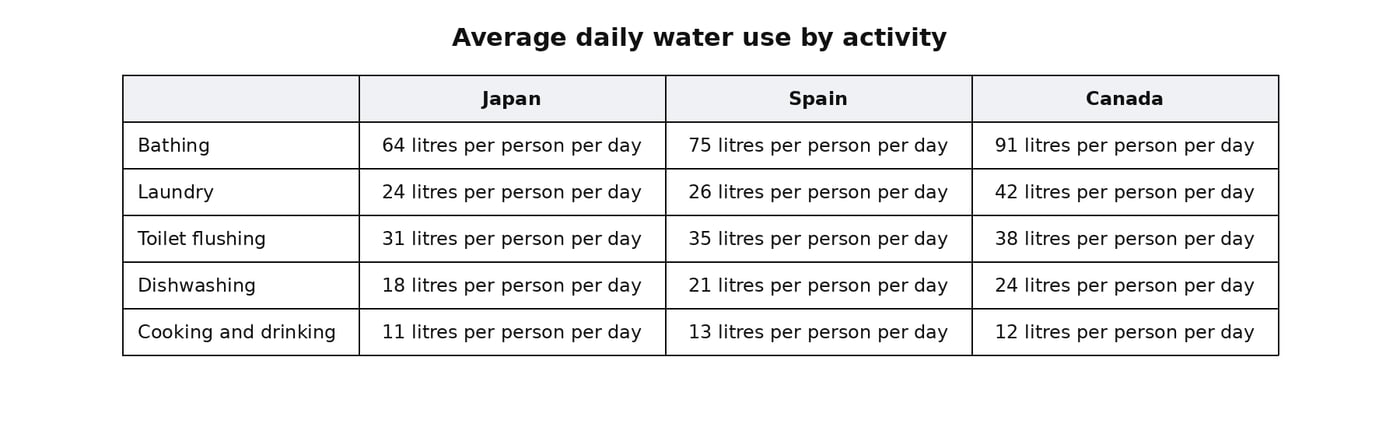
The table below shows the mean volume of water consumed per person per day for five household activities in three countries.
Summarise the information by selecting and reporting the main features, and make comparisons where relevant.
Student answer (Band 6.0)
The table illustrates the average daily use of water per person for five different activities in three different countries.
Overall, the activity which accounts for the most water usage is bathing. Cooking and drinking is the only activity among all countries where daily average water consumption per person is less.
People use 64 liters of water daily on bathing in Japan, 75 liters of water in Spain, and 91 liters of water in Canada. The avearge daily use of water per person in Japan is 24 liters which is consumed on laundary, 75L in Spain, and 42L in Canada. Everyday each person utilizes 31L water on toilet flushing in Japan, 35L in Spain, and 38L in Canada. In Japan, dishwasing consumes 18L of water, and each person spends 11L of water on cooking and drinking. In Spain, 21L of water is used by each person on dishwashing and 13L on cooking and drinking. In Canada, every person spends 24L and 12L on dishwashing and cooking and drinking respectively.
AI examiner evaluation
| Criterion | Band |
|---|---|
| Task Achievement / Task Response | 5.5 |
| Coherence and Cohesion | 5.5 |
| Lexical Resource | 6.0 |
| Grammatical Range and Accuracy | 6.0 |
| Overall | 6.0 |
Task Achievement / Task Response: Band 5.5
You identify the main pattern that bathing uses the most water, and you report figures for all five activities across the three countries. Most values are accurate, including bathing, toilet flushing, dishwashing and cooking/drinking. However, the laundry figures for Spain are seriously misreported: the table gives 26 litres, not 75. The overview also says cooking and drinking is the activity with the least consumption, but this is not true across all countries: in Japan it is lowest, while in Spain and Canada it is also the lowest, so the claim is broadly correct but should be expressed more precisely as the lowest-use activity in each country. The response would be stronger with a clearer overview of country-level patterns and a more accurate comparison of the data.
Coherence and Cohesion: Band 5.5
The response has a recognisable structure: an introduction, an overview and a body that reports the figures by activity and country. This makes the information generally easy to follow. However, the body reads largely as a sequence of separate data statements, with limited grouping or comparison between countries. The repeated pattern “in Japan… in Spain… in Canada” and repeated use of “water” make the progression somewhat mechanical. The overview’s second sentence is also awkwardly phrased, which weakens the link between the main feature and the detailed figures. Grouping the largest uses together, then comparing the smaller activities, and using clearer transitions such as “by contrast” or “similarly” would create a more coherent progression.
Lexical Resource: Band 6.0
You use an adequate range of task-related vocabulary, including “average daily use,” “consumption,” “utilizes,” and “accounts for,” and the meaning is generally clear. There is some variation in how you describe the figures, such as “is consumed on” and “is used by each person.” However, several choices are unnatural or imprecise: “spends 11L of water” suggests expenditure rather than use, and “the activity which accounts for the most water usage” is wordy. Spelling errors such as “avearge,” “laundary,” and “dishwasing” also reduce accuracy. Aim for concise, natural collocations such as “uses 11 litres” and check spelling carefully; this would make the vocabulary more precise and fluent.
Grammatical Range and Accuracy: Band 6.0
You use a mix of simple statements and some more developed structures, including the relative clause in “the activity which accounts for the most water usage.” Most sentences communicate the intended figures, and errors do not generally prevent understanding. Some grammatical choices are less controlled, however. In “Cooking and drinking is the only activity among all countries where daily average water consumption per person is less,” the clause structure is awkward and the comparison is unclear. “The average daily use of water per person in Japan is 24 litres which is consumed on laundry” also has an unclear relative clause and would be clearer as “In Japan, 24 litres per person are used for laundry.” Use a wider range of accurate comparison structures and check clause attachment and punctuation to improve control.
See this exact question answered at other band scores. The same prompt compared across bands.
Browse more IELTS Writing model answers or get your own writing scored by the same AI examiner.