Band 5.5 IELTS Writing Task 1 Model Answer
Overall Band Score: 5.5 · IELTS Last Minute Nov 2026 · 2026-11-20
IELTS Writing Task 1 question
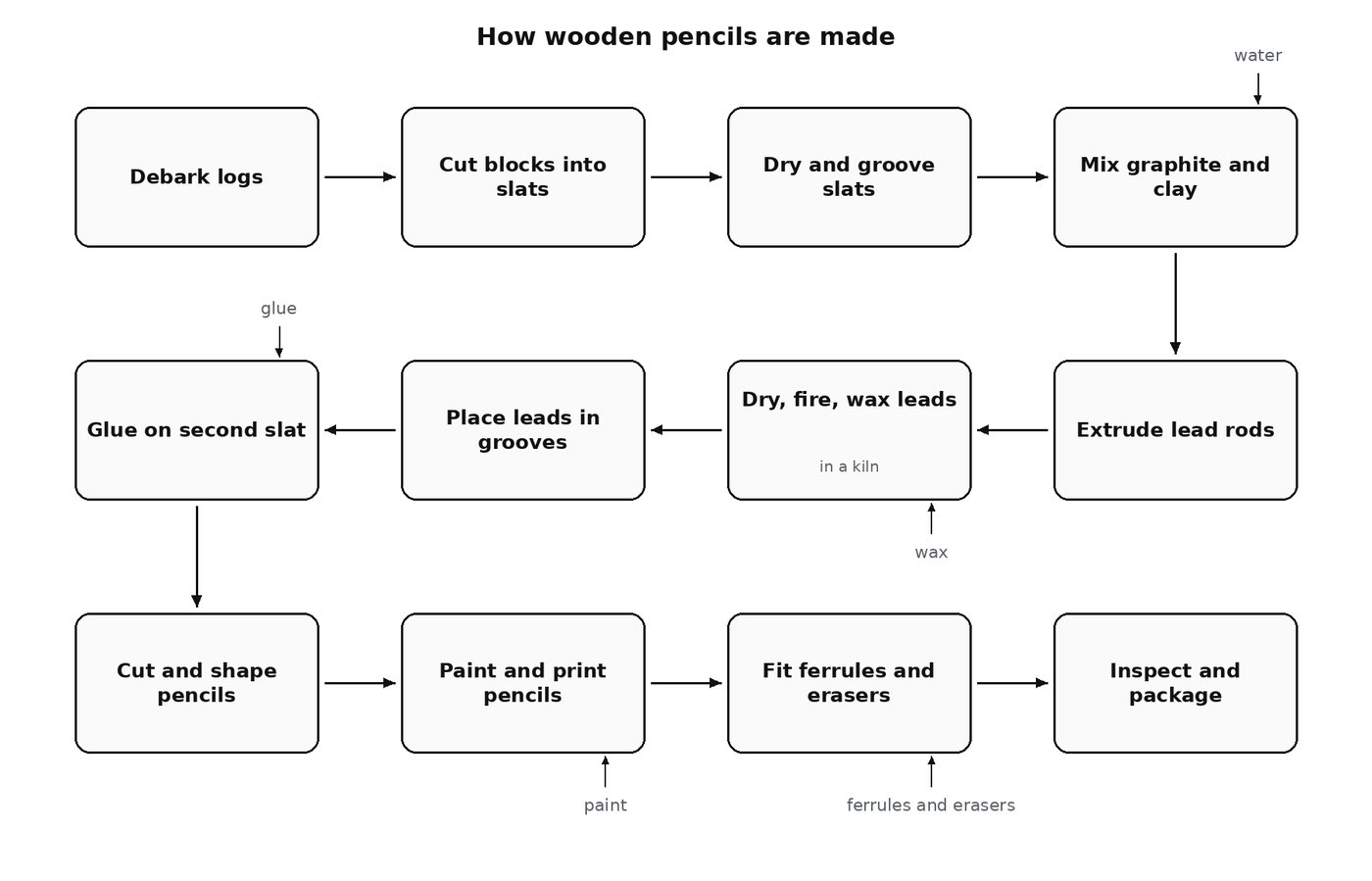
The diagram below shows how wooden pencils are made, from getting the wood and graphite ready to making and packing the finished pencils.
Summarise the information by selecting and reporting the main features, and make comparisons where relevant.
Student answer (Band 5.5)
The given diagram illustrates the wooden pencil making process, from collecting of wood logs to manufacturing and finding the end product.
The process innvolves 12 steps from collecting logs to heating the slats and insecting for the packag
Firstly, a pencil making process starts with accumulation of debarked logs, which are cut into slats and later these slats are converted into dry and grooved slats. Then water is added to mix graphite and clay, which later turns in lead rods. In a klin, lead rods are dried by the flames and due to addition wax, lead rods become wax leads. Then wax leads are later placed into the groove of slats. Afterwards, glue is added on the second slat to stick it with the first slat. Furthermore, they are given the shape of a pencil by cutting and painting. On the second last step, a ferrule is added at the end of the pencil to fit the eraser. At the last step, the end product is checked for the final quality control and then the packaging is completed for the final release from the factory.
AI examiner evaluation
| Criterion | Band |
|---|---|
| Task Achievement / Task Response | 5.0 |
| Coherence and Cohesion | 6.0 |
| Lexical Resource | 5.5 |
| Grammatical Range and Accuracy | 5.5 |
| Overall | 5.5 |
Task Achievement / Task Response: Band 5.0
You identify the process as a sequence and include many of its main stages, from preparing the wood and making the leads through to inspection and packaging. However, the account does not provide a clear, accurate overview of how the two components are prepared separately and then brought together. The opening also says the process begins with “collecting” logs, whereas the diagram begins with debarking them. Some details are inaccurate or incomplete: the leads are dried, fired and waxed in a kiln, not simply dried “by the flames,” and the painting and printing stage is not clearly reported. The description of fitting a ferrule and eraser is also imprecise. A concise overview and more exact coverage of the stages would make the response more complete.
Coherence and Cohesion: Band 6.0
The stages are generally presented in a sensible order, and paragraphing separates the introduction from the process description. Sequencing expressions such as “Firstly,” “Then,” “Afterwards,” and “At the last step” help the reader follow the production line. However, the second paragraph is incomplete, ending with “packag,” and the main process is placed in one long paragraph, making the progression less easy to scan. Some links are mechanical or repetitive, particularly the repeated use of “Then” and “later.” The reference in “they are given the shape” is also not fully clear. Grouping the stages into wood preparation, lead preparation and final assembly, and using more varied, precise transitions, would improve cohesion.
Lexical Resource: Band 5.5
You use relevant process vocabulary, including “slats,” “graphite,” “groove,” “ferrule,” and “quality control,” which helps convey the manufacturing sequence. There are also attempts at more formal wording, such as “illustrates” and “end product.” However, several choices are inaccurate or unnatural: “accumulation of debarked logs” is not a natural description of the first stage, “turns in lead rods” is unclear, and “final release from the factory” adds an idea not shown in the diagram. Spelling errors such as “innvolves,” “insecting,” and “klin” are noticeable. Use the diagram’s precise verbs—such as “extrude,” “fire,” “wax,” and “inspect”—and check spelling and collocations to make the description clearer and more controlled.
Grammatical Range and Accuracy: Band 5.5
The response includes both simple sentences and longer clauses, for example, “Then water is added to mix graphite and clay, which later turns in lead rods.” This shows an attempt to connect stages in more complex sentences. However, some structures are faulty or awkward, and the errors sometimes make relationships unclear. In “which later turns in lead rods,” the relative clause does not clearly refer to the intended material; “due to addition wax” is missing grammatical elements; and “a ferrule is added at the end of the pencil to fit the eraser” has an unclear construction. The opening process sentence also has an incomplete final word. Aim for clear passive forms and check articles, verb forms and clause references, especially when combining several stages in one sentence.
See this exact question answered at other band scores. The same prompt compared across bands.
Browse more IELTS Writing model answers or get your own writing scored by the same AI examiner.