Band 5.5 IELTS Writing Task 1 Model Answer
Overall Band Score: 5.5 · IELTS Last Minute Nov 2026 · 2026-11-21
IELTS Writing Task 1 question
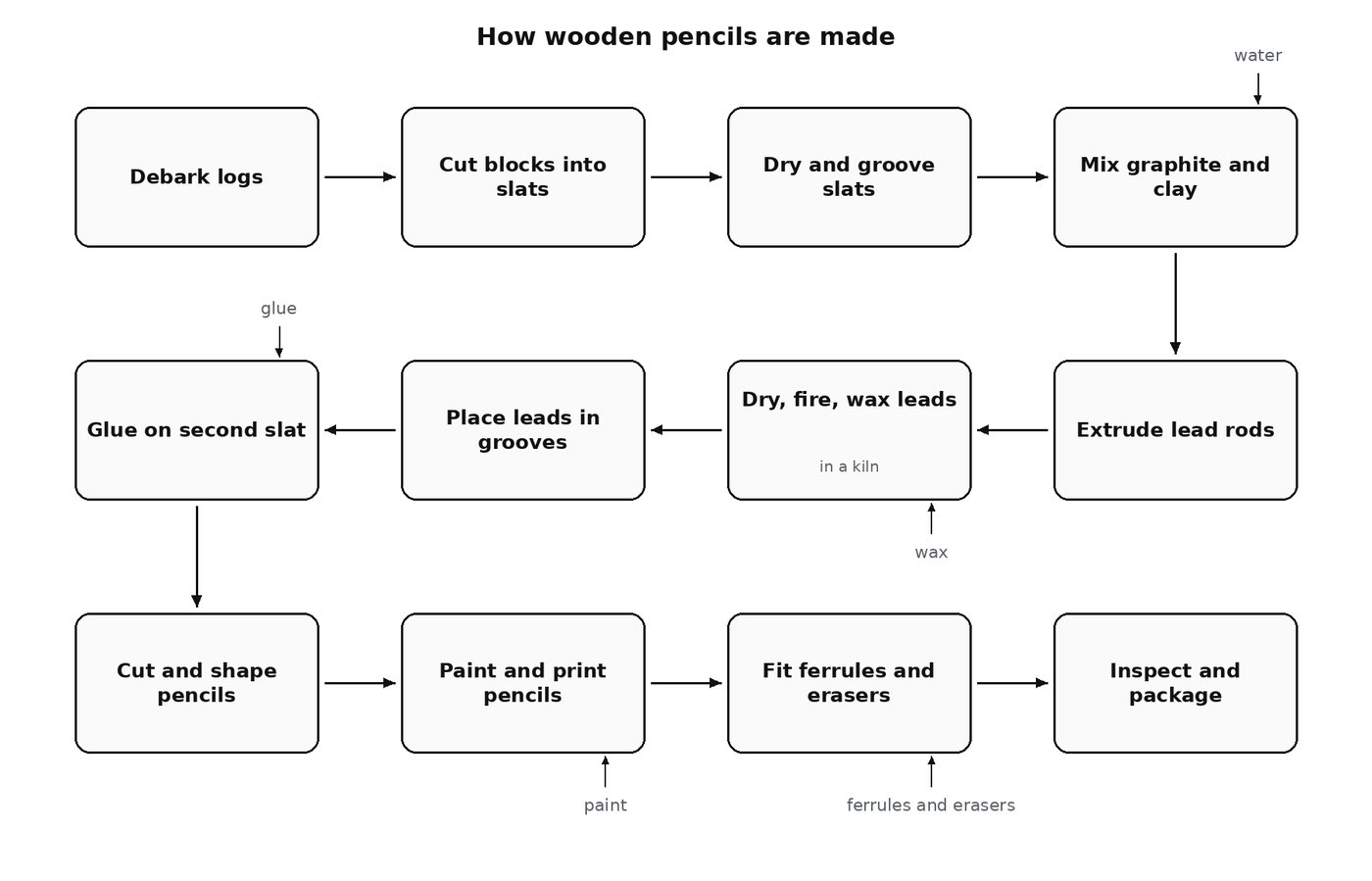
The diagram below shows how wooden pencils are made, from getting the wood and graphite ready to making and packing the finished pencils.
Summarise the information by selecting and reporting the main features, and make comparisons where relevant.
Student answer (Band 5.5)
The diagram below illustrates how wooden pencils are manufacture, from getting the wood and graphite ready to making and packing the finished pencils.
Overall, it is clear that wooden pencils are made in 12 different steps. Starting with debark logs, mixing it with graphite and to the final process of inspecting it and packaging.
Looking at the first step, debark logs where blocks are cut into slabs. After that, they are dry along with groove slats are mixed with graphite, clay and water. In addition, extrude lead rods are dry and put on fire where wax is added and the wax leads.
Turning to place leads in grooves, where glue is added on second slat. It is cut and shape into pencils. In the final steps, it is painted and printed as pencils. In second last step, eraser is fit with ferrules on pencils. Consequently, it is inspected and packed.
AI examiner evaluation
| Criterion | Band |
|---|---|
| Task Achievement / Task Response | 5.0 |
| Coherence and Cohesion | 6.0 |
| Lexical Resource | 5.5 |
| Grammatical Range and Accuracy | 5.0 |
| Overall | 5.5 |
Task Achievement / Task Response: Band 5.0
You identify the process as having 12 steps and include its starting point and final inspection and packaging, so the reader gets the broad subject. However, the overview is unclear: “Starting with debark logs, mixing it with graphite” does not accurately summarise the sequence, which begins with debarking logs and later prepares the graphite mixture as a separate strand. Several stages are compressed or misreported, including “blocks are cut into slabs” (the diagram says slats) and the drying, grooving and lead-treatment stages. The response also contains 136 words, below the required 150, which limits the detail reported. To improve, give a clear overview of the two materials being prepared and then describe the stages in their correct order with more precise detail.
Coherence and Cohesion: Band 6.0
The response has a recognisable overall sequence, moving from the initial wood preparation through assembly and finishing to packaging. Paragraphing also separates the introduction and overview from the process details. However, progression is sometimes difficult to follow because several stages are joined together in unclear sentences, such as “After that, they are dry along with groove slats are mixed with graphite, clay and water.” The transitions “Turning to” and “Consequently” do not always clarify the relationship between steps, and “In second last step” interrupts the otherwise chronological account. Use one sentence for each logical group of stages and connect them with straightforward sequencing language such as “Next,” “Once this is complete,” and “Finally.” Make references such as “it” explicit so the reader can follow the process without guessing.
Lexical Resource: Band 5.5
You use some relevant process vocabulary, including “extrude lead rods,” “grooves,” “wax,” “painted,” and “packaged,” which helps communicate the general subject. However, the range is limited and several word choices or forms are inaccurate for describing the diagram. For example, “slabs” is used where the diagram shows “slats,” and “put on fire” is an imprecise way to describe firing the leads in a kiln. “The wax leads” is also unclear, while “fit with ferrules” does not express the fitting stage naturally. Aim for precise process collocations and use the diagram’s terminology consistently. This will make the account clearer and more suitable for an academic process description.
Grammatical Range and Accuracy: Band 5.0
You attempt both simple and more complex sentence forms, and the overall meaning can usually be understood. However, control is uneven, particularly when describing several actions in one sentence. The opening says pencils “are manufacture,” and “Starting with debark logs, mixing it with graphite” is a sentence fragment rather than a complete overview. In “they are dry along with groove slats are mixed,” the verb forms and clause structure make the sequence difficult to interpret. There are also problems with agreement and passive forms in “it is painted” and “eraser is fit,” where the subject and process are not expressed accurately. Practise complete passive constructions, for example, “The slats are dried and grooved,” and check that each sentence has a clear subject and correctly formed verb.
See this exact question answered at other band scores. The same prompt compared across bands.
Browse more IELTS Writing model answers or get your own writing scored by the same AI examiner.