Band 6.0 IELTS Writing Task 1 Model Answer
Overall Band Score: 6.0 · IELTS Predictions Nov 2026 · 2026-11-23
IELTS Writing Task 1 question
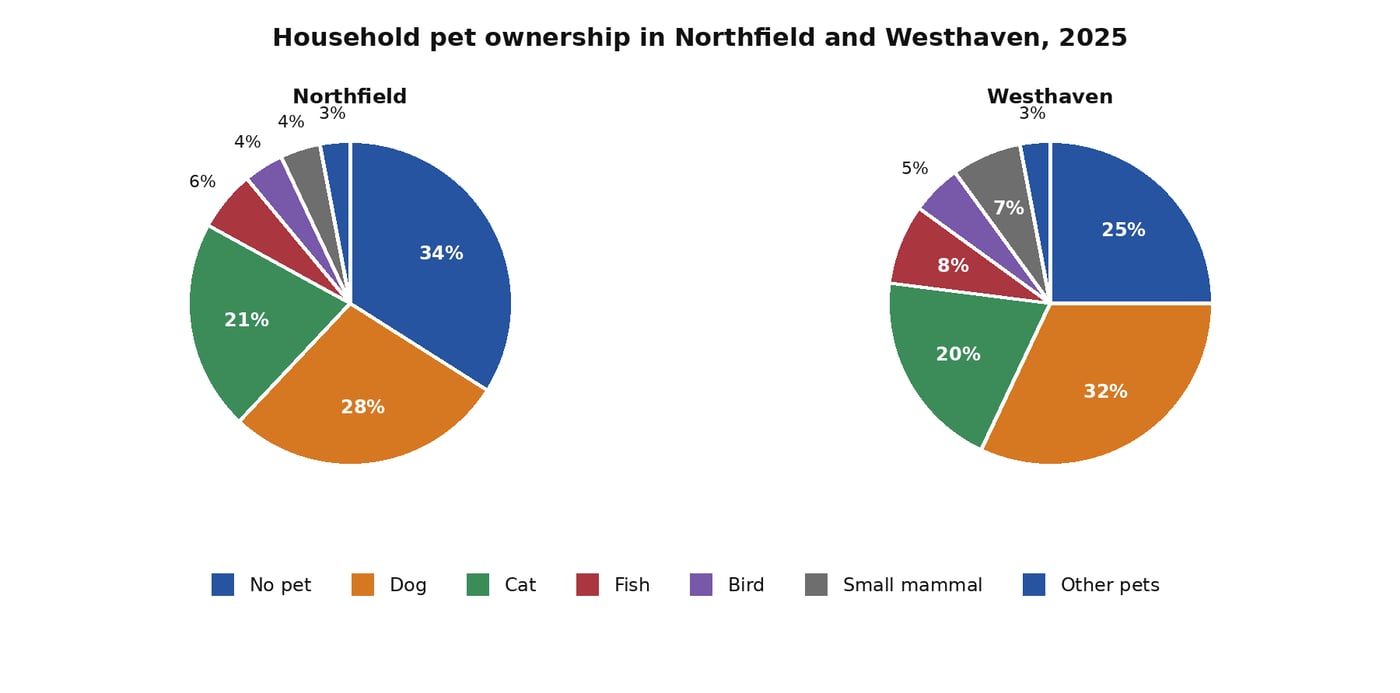
The charts below show the percentage of households in Northfield and Westhaven by the main type of pet they keep in 2025.
Summarise the information by selecting and reporting the main features, and make comparisons where relevant.
Student answer (Band 6.0)
The pie chart compares the percentage of households in Northfield and Westhaven by the main type of pet they kept in the year 2025.
Overall, Dog is the favorite animal to pet for both Northfield and Westhaven whereas cat is the second most popular animal to pet among both the states. On the other hand, a big percentage of population does not have a pet in both the states.
The people in Westhaven are a little more fond of having dog as a pet than the people in Northfield with a 32% of pet ownership in comparison to 28% in Northfield. Cat ownership approximately same for both Northfield and Westhaven with 21% and 20%. Whereas 34% of Northfield public does not have any pet and 25% of Westhaven people does not own any pet.
Animals such as fish, bird, small mammals and other pets constitutes a small proportion of the population of pet with percentage of 6%, 4%, 4% and 3% in Northfield and 8%, 5%, 7% and 3% in Westhaven.
AI examiner evaluation
| Criterion | Band |
|---|---|
| Task Achievement / Task Response | 7.0 |
| Coherence and Cohesion | 6.0 |
| Lexical Resource | 6.0 |
| Grammatical Range and Accuracy | 5.5 |
| Overall | 6.0 |
Task Achievement / Task Response: Band 7.0
You cover the main categories and make relevant comparisons, including the higher dog ownership in Westhaven (32% versus 28%) and the larger no-pet share in Northfield (34% versus 25%). Your overview identifies dogs and cats as the leading pets, although it would be more accurate to note that households with no pet form the largest single category in Northfield. The figures for the less common pets are also reported accurately. To strengthen the response, make the overview more precise and distinguish clearly between the most common pet and the largest overall category. The phrase “a big percentage of population” is also broad; the exact contrast between the two locations would make this feature clearer and better supported.
Coherence and Cohesion: Band 6.0
The response has a clear overall structure: an introduction, an overview, comparisons of the main categories, and a final sentence covering the less common pets. This makes the information easy to follow. However, some links between ideas are mechanical or incomplete. For example, “Whereas 34% of Northfield public…” is a dependent clause presented as a sentence, and the final paragraph compresses four categories and eight figures into one long sentence. Use complete sentences and group related comparisons more deliberately—for instance, compare the two no-pet figures in one sentence, then summarise the smaller categories. More varied linking and clearer reference to the locations would improve the flow.
Lexical Resource: Band 6.0
You use enough topic vocabulary to describe the chart, including “pet ownership,” “percentage,” and “proportion,” and the meaning is generally clear. Some choices are unnatural or imprecise, however: “favorite animal to pet” and “fond of having dog as a pet” do not sound natural in a formal chart summary. “States” is also inaccurate for Northfield and Westhaven, while “population of pet” is unclear. Aim for concise, conventional reporting language such as “the most common pet” and “households without a pet.” Avoid repeating “pet” in several forms when a more precise term such as “ownership” or “households” is available. These improvements would make the vocabulary more accurate and appropriately formal.
Grammatical Range and Accuracy: Band 5.5
You attempt both simple and more complex sentences, and the main comparisons can usually be understood. Some grammatical errors remain, particularly with articles, agreement, and sentence boundaries. Examples include “with a 32%” (the article is unnecessary), “Cat ownership approximately same” (the verb “is” is missing), and “Animals … constitutes” (the plural subject requires “constitute”). “Whereas 34%…” is also a fragment because it does not form a complete sentence. Check singular and plural agreement, include required verbs, and connect dependent clauses to a main clause. Greater accuracy in these patterns, alongside your attempts at longer sentences, would make the report more controlled.
See this exact question answered at other band scores. The same prompt compared across bands.
Browse more IELTS Writing model answers or get your own writing scored by the same AI examiner.