Band 5.0 IELTS Writing Task 1 Model Answer
Overall Band Score: 5.0 · IELTS Predictions Nov 2026 · 2026-11-24
IELTS Writing Task 1 question
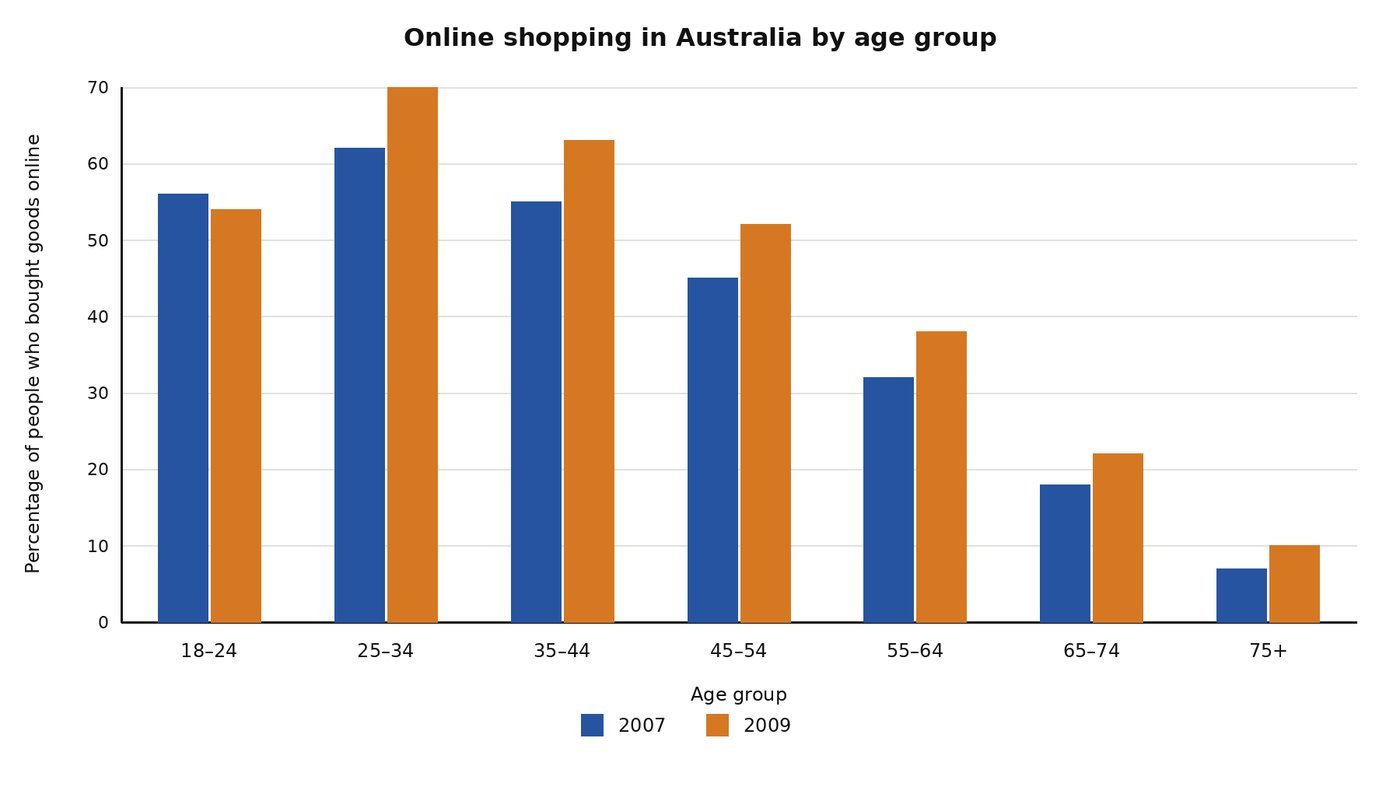
The bar chart below shows the percentages of people in seven age groups in Australia who bought goods online in 2007 and 2009.
Summarise the information by selecting and reporting the main features, and make comparisons where relevant.
Student answer (Band 5.0)
The chart shows the percentage of people aged 18-75 and over who bought goods online in year 2007 and 2009. Overall, the picture describes there are equivalent number of people in both year who prefer online shopping. Also, the people aged 25-34 are the people who held the top position in online shopping which is 62 and exactly 70% in year 2007, 2009 respectively.
Among all the aged group, it has shown that people in 2009 did excessive online shopping than in 2007. On the contrary, only the youngster from 18-24 are the one who did more online shopping in 2007. Online shopping started to decline among all the age group people in 2007 whereas, there is no any huge changes in shopping in year 2009.
People were not familiar eith buying goods online during the year 2007 where they are more attracted towards online shopping since 2009.
AI examiner evaluation
| Criterion | Band |
|---|---|
| Task Achievement / Task Response | 4.5 |
| Coherence and Cohesion | 5.0 |
| Lexical Resource | 5.5 |
| Grammatical Range and Accuracy | 5.0 |
| Overall | 5.0 |
Task Achievement / Task Response: Band 4.5
You identify the chart’s subject and give a broad comparison, including the highest group: 25–34-year-olds, at 62% in 2007 and 70% in 2009. However, the overview is unclear and partly inaccurate: “equivalent number of people in both year” does not describe the chart, and the claim that 18–24-year-olds were the only group with a higher figure in 2007 is incorrect—their rate was also lower in 2009. The statement that shopping “started to decline” in 2007 is not a clear account of the age-group pattern. The response also gives little supporting data beyond the leading group and makes an unsupported claim about people becoming more familiar with online shopping. It is two words below the required minimum. Select the main trends accurately and support them with a few representative figures.
Coherence and Cohesion: Band 5.0
The response has a basic paragraph structure: an introduction and overview are followed by further comments on the age groups and a concluding observation. Linking expressions such as “Overall” and “On the contrary” show an attempt to connect ideas. However, the progression is difficult to follow because several claims are vague or conflict with one another, particularly the claim that the figures were equivalent and the later assertion that 2009 had higher rates. “On the contrary” does not clearly introduce the comparison that follows, and the final sentence repeats a general idea rather than summarising the data. Organise the body around clear comparisons—first the overall pattern, then notable age groups—and use linking phrases only where their relationship is accurate.
Lexical Resource: Band 5.5
You use relevant topic vocabulary, including “percentage,” “age group,” “online shopping,” and “top position,” so the subject is generally recognisable. There is also some attempt to vary wording with phrases such as “decline” and “attracted towards.” However, several choices are unnatural or imprecise for describing chart data: “equivalent number” refers to counts rather than percentages, “did excessive online shopping” suggests unusually high consumption, and “held the top position” is less natural than a direct description of the highest rate. The spelling error “eith” and repeated use of “people” also limit accuracy and variety. Prefer precise reporting language such as “the proportion rose” or “recorded the highest percentage.”
Grammatical Range and Accuracy: Band 5.0
You attempt both simple and more extended sentence forms, including a comparison across years and a sentence beginning “On the contrary.” The main message can usually be understood, but errors are frequent enough to make some sentences awkward or unclear. For example, “there are equivalent number of people in both year” has problems with the verb, article, and plural form; “the people aged 25-34 are the people who held” is unnecessarily repetitive and shifts tense; and “only the youngster … are the one” has agreement errors. The sentence beginning “Online shopping started to decline … whereas” also needs clearer punctuation and structure. Practise accurate past-tense reporting and subject–verb agreement, and build shorter, controlled comparisons before adding complex clauses.
See this exact question answered at other band scores. The same prompt compared across bands.
Browse more IELTS Writing model answers or get your own writing scored by the same AI examiner.