Band 6.0 IELTS Writing Task 1 Model Answer
Overall Band Score: 6.0 · IELTS Predictions Nov 2026 · 2026-11-24
IELTS Writing Task 1 question
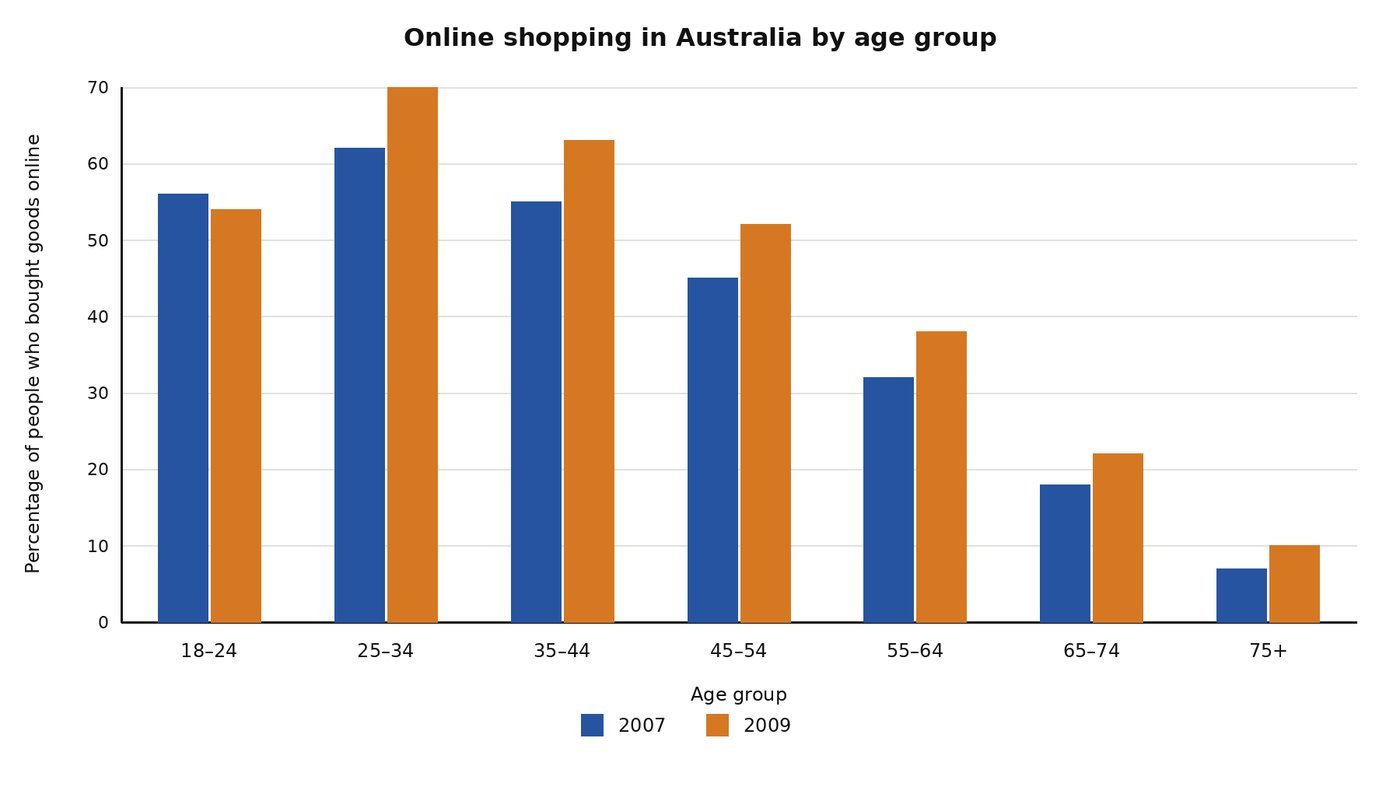
The bar chart below shows the percentages of people in seven age groups in Australia who bought goods online in 2007 and 2009.
Summarise the information by selecting and reporting the main features, and make comparisons where relevant.
Student answer (Band 6.0)
The bar chart shows the proption of people seven different ages classes that buy things online in 2007 and 2009.
Overall, it can be seen that the younger generation between age 25-34 are more interested in buying products online in both years.On the other hand , old aged groups that are above 75 are least interested in purchasing through any website.
By 2007, individual 62% of age 25 to 34 used online platforms to get their desired items in Austriala, that are higest in number while the number increase more in same age group in 2009 that goes upto 70%. Secondly, 35-44 year customers are second highest in number that is 62% in 2009 and 55% in 2007 that are similar to percentage of 18-25 year people in the uear 2007. Whereas the 18-25 years age group showed same percentage of buying things online in both year.
After 45 year till 75 people gradually decrease their interest in buying things online.However, these proportion decrease by almost 10% in all ages the people.75+ ages show less than 10% interest .
AI examiner evaluation
| Criterion | Band |
|---|---|
| Task Achievement / Task Response | 6.5 |
| Coherence and Cohesion | 6.0 |
| Lexical Resource | 5.5 |
| Grammatical Range and Accuracy | 5.0 |
| Overall | 6.0 |
Task Achievement / Task Response: Band 6.5
You identify the chart’s main pattern: the 25–34 group has the highest online-shopping rate, while people aged 75+ have the lowest, and you compare several figures across the two years. The reported values for 25–34 and 35–44 are broadly accurate. However, some details are unclear or inaccurate: the 18–24 rate was 56% in 2007 and 54% in 2009, so it did not stay the same, and the 35–44 figure in 2009 was 63%, not 62%. The statement that rates “decrease by almost 10% in all ages” is also misleading, since most older groups increased between years. Your overview is relevant, but a more precise account of the overall rise in most age groups would make the summary more complete.
Coherence and Cohesion: Band 6.0
The response has a recognisable structure, with an introduction, an overview and a paragraph of supporting comparisons. The sequence from the highest rates to older age groups is generally understandable, and linking expressions such as “Overall,” “On the other hand” and “Whereas” show an effort to connect ideas. However, some connections are awkward or unclear: “Secondly” does not clearly establish a ranking, and the final sentence about decreases conflicts with the earlier comparisons. Several ideas are crowded into one paragraph, while missing spaces after full stops make the progression harder to follow. Grouping the figures into younger and older age ranges, and using clearer links between comparisons, would improve cohesion.
Lexical Resource: Band 5.5
You use a reasonable range of topic vocabulary, including “online platforms,” “purchasing” and “percentage,” and the reader can generally understand the subject. However, word choice and spelling errors are noticeable and sometimes make the meaning less precise. Examples include “proption,” “Austriala,” “higest” and “uear”; “old aged groups” and “individual 62%” are also unnatural expressions. Repetition of “buying things online” limits flexibility, while “interest” suggests motivation rather than the chart’s measured proportion of people who made purchases. Use accurate terms such as “share,” “rate” and “online shoppers,” and check spelling and collocations carefully.
Grammatical Range and Accuracy: Band 5.0
You attempt both simple and more complex sentences, including a contrast with “On the other hand” and a clause beginning “Whereas.” However, control is inconsistent, and errors in sentence structure, agreement, articles and punctuation sometimes make relationships between ideas difficult to follow. For example, “the younger generation between age 25-34 are” has a mismatch between the singular subject and verb, while “that are higest in number” does not form a clear grammatical link to the preceding clause. The sentence beginning “After 45 year” is also incomplete in its construction. Review subject–verb agreement, plural forms and sentence boundaries, and make sure each comparison is expressed as a complete sentence.
See this exact question answered at other band scores. The same prompt compared across bands.
Browse more IELTS Writing model answers or get your own writing scored by the same AI examiner.