Band 6.0 IELTS Writing Task 1 Model Answer
Overall Band Score: 6.0 · IELTS Predictions Nov 2026 · 2026-11-24
IELTS Writing Task 1 question
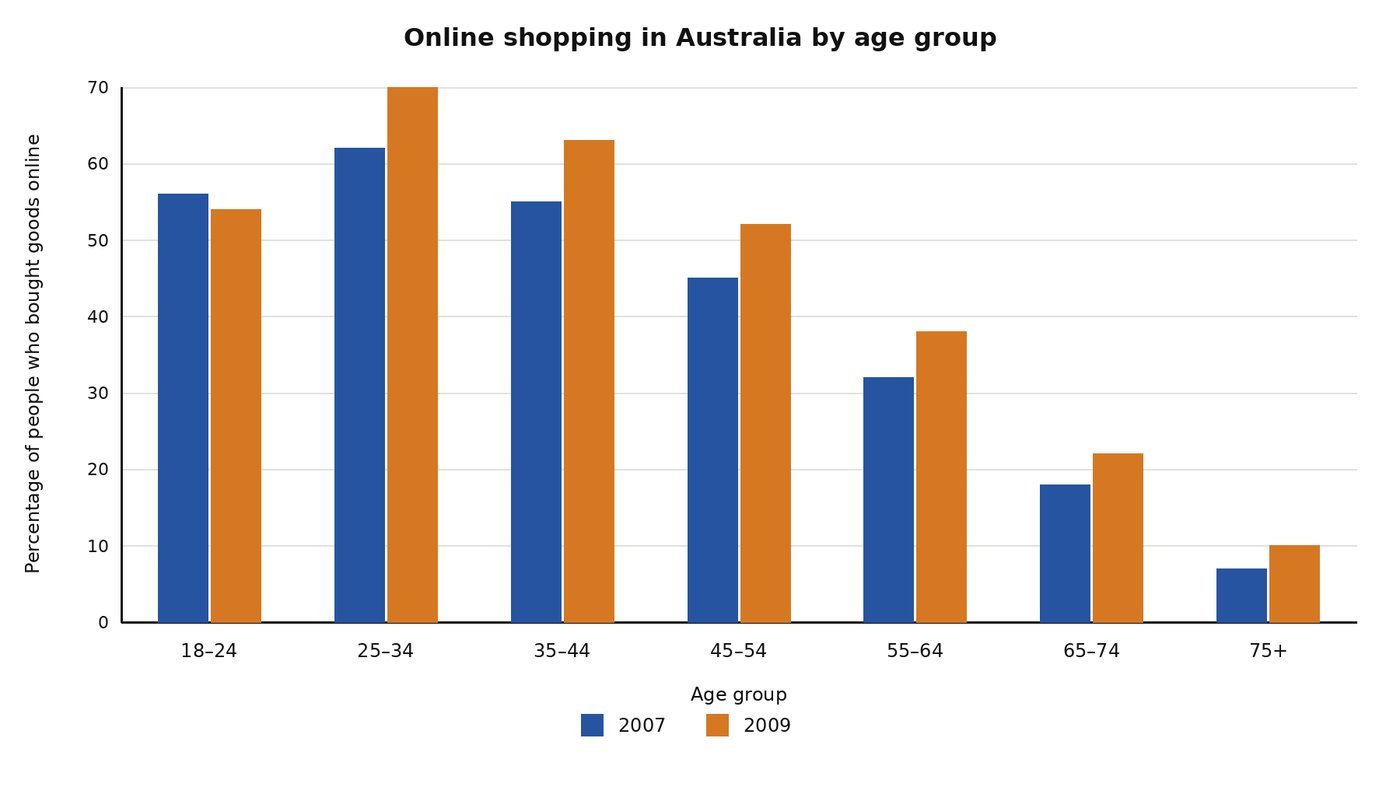
The bar chart below shows the percentages of people in seven age groups in Australia who bought goods online in 2007 and 2009.
Summarise the information by selecting and reporting the main features, and make comparisons where relevant.
Student answer (Band 6.0)
The bar chart illustrates the proportions of people in seven age groups in Australia who purchased goods online in 2007 and 2009.
Overall, the age group which has done the most online shopping is in category 25-34. People in age group of 75 above did the least shopping in both years.
In 2007, 70% of people in age group 25-34 bought goods which is the highest figure in this chart. Only 8% people of age group 75 and above purchased online products which accounts for the lowest figure. The age group of 18-24 and 35-44 reported at 57% and 56% respectively.
In 2009, the age group of 25-34 consisted of 70% people who bought products online which is on top compared to age group of 75 and above at only 10%. The percentages are 55%, 63%, and 52% for the age groups of 18-24, 35-44, and 45-54 respectively. 32% and 18% people bought products in age groups of 55-64 and 65-74 respectively.
AI examiner evaluation
| Criterion | Band |
|---|---|
| Task Achievement / Task Response | 5.5 |
| Coherence and Cohesion | 6.5 |
| Lexical Resource | 6.0 |
| Grammatical Range and Accuracy | 6.0 |
| Overall | 6.0 |
Task Achievement / Task Response: Band 5.5
You identify the main pattern that the 25–34 group had the highest participation and people aged 75+ the lowest, and you compare both years. However, several figures are assigned to the wrong year or age group: in 2007, the 25–34 figure was about 62%, not 70%, while 70% was its 2009 value. The 2009 figures for 55–64 and 65–74 are also reported as 32% and 18%, which are the 2007 values; they were about 38% and 22% in 2009. The overview is relevant but does not summarise the broad rise across most groups, nor the slight fall among 18–24-year-olds. More accurate selection and comparison of key changes would strengthen the report.
Coherence and Cohesion: Band 6.5
The response has a clear overall arrangement: an introduction, an overview, and separate paragraphs for the two years. This makes the information easy to follow, and phrases such as “In 2007” and “In 2009” provide straightforward signposting. The progression is generally logical, though the year-by-year structure leads to repeated statements about the highest and lowest groups and makes direct comparison of changes less clear. For example, the 25–34 figures could be compared together, followed by the general increases in the other age groups. Some references, such as “which is on top,” are not especially precise. Grouping related data and using clearer comparative links would make cohesion more flexible and less repetitive.
Lexical Resource: Band 6.0
You use an adequate range of task-related vocabulary, including “proportions,” “purchased,” “reported,” and “percentages,” and the meaning is generally clear. There is some variation in how you describe online buying, although “bought goods,” “purchased online products,” and “bought products” recur and could be expressed more precisely. A few choices are awkward for chart description: “the age group … consisted of 70% people” does not naturally describe a proportion, and “on top” is informal and imprecise. “75 above” is also an unclear rendering of the age category. More accurate collocations such as “accounted for,” “stood at,” and “the oldest age group” would improve precision and control without requiring unnecessarily complex vocabulary.
Grammatical Range and Accuracy: Band 6.0
You use a mix of simple statements and some more developed structures, including “which accounts for the lowest figure” and “compared to age group of 75 and above.” Most sentences remain understandable, but some grammatical errors are noticeable. For example, “People in age group of 75 above” is missing articles and has an incomplete age expression; “Only 8% people” needs “of”; and “The age group … consisted of 70% people” uses an unsuitable grammatical construction for reporting a percentage. The present-perfect wording “has done” in the overview is also less appropriate when describing completed data from 2007 and 2009. Use consistent past-tense reporting and practise article use and percentage structures, such as “70% of people in this group bought goods online.”
See this exact question answered at other band scores. The same prompt compared across bands.
Browse more IELTS Writing model answers or get your own writing scored by the same AI examiner.