Band 5.5 IELTS Writing Task 1 Model Answer
Overall Band Score: 5.5 · IELTS Predictions Nov 2026 · 2026-11-25
IELTS Writing Task 1 question
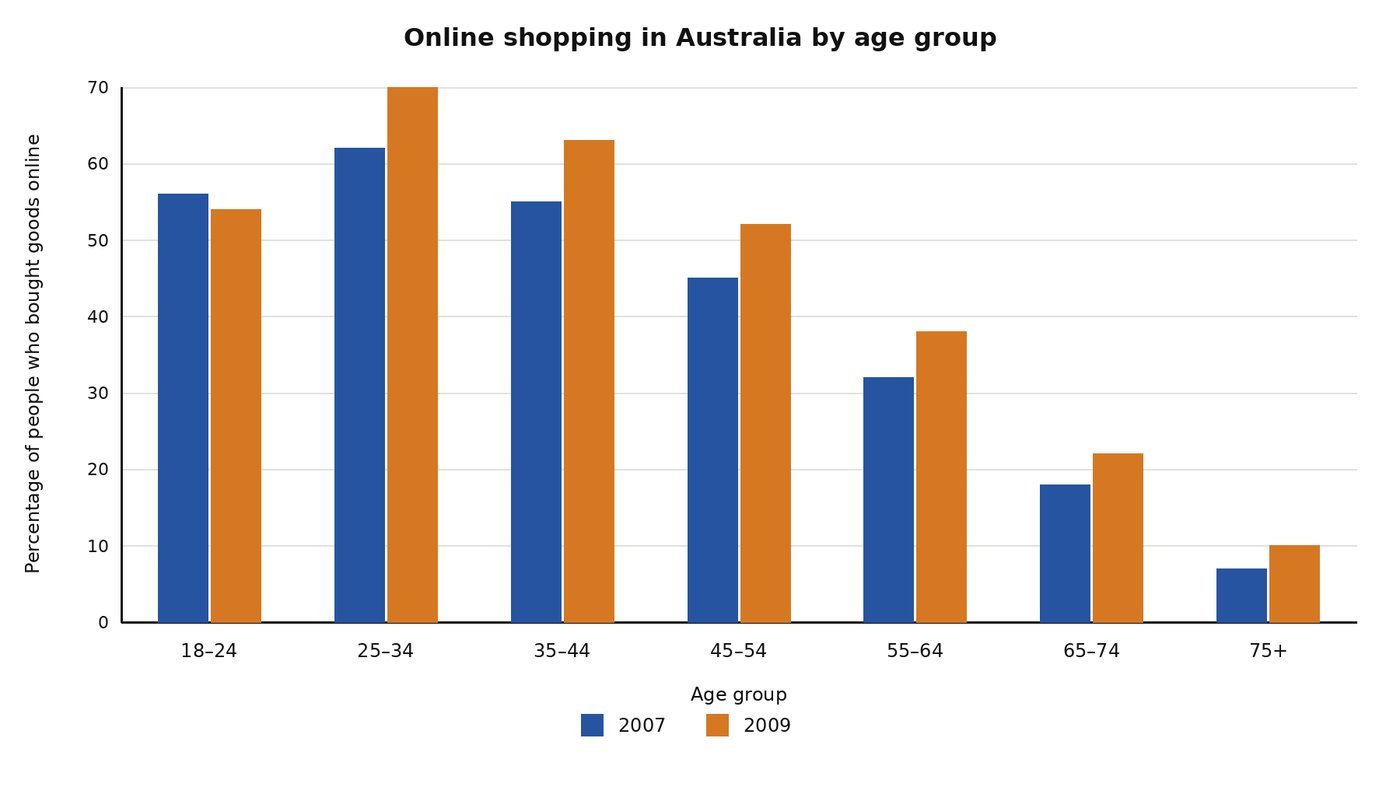
The bar chart below shows the percentages of people in seven age groups in Australia who bought goods online in 2007 and 2009.
Summarise the information by selecting and reporting the main features, and make comparisons where relevant.
Student answer (Band 5.5)
The bar chart below indicate the ratio of individuals in seven diffrenet age categories who bought Commodities online in 2007 as well as 2009.
Overall, it can be seen that young adults have the dominant in online buying products follwed by adults and respectively middle-age adults, and the rate of youth are just below the young adults .However mature adults and senior citizen has lowest intrest on web base purchasing.
In 2007 young adults has peak rates just above 60% people purchasing products online as wella syouth were just below them around 57% follwed by middle ages ranging ages between 35-44 years.while it has a significant decline in digital purchasing drop to nearly 8% as ages go went up to 75+ years.
wheares,in 2009 the number of youths drop slightly by approximately 2%.Unlike young adults have supreme rates upto 70% purchasing rate. Subsequently middle ages consumers has just below them follwed by middle-aged adult. While mature adults and senior citizens has negligible slumps nearly 3% above from the previous ratio.
AI examiner evaluation
| Criterion | Band |
|---|---|
| Task Achievement / Task Response | 5.5 |
| Coherence and Cohesion | 5.5 |
| Lexical Resource | 5.5 |
| Grammatical Range and Accuracy | 5.0 |
| Overall | 5.5 |
Task Achievement / Task Response: Band 5.5
You identify the broad pattern that online purchasing was generally more common among younger people and least common among those aged 75+, and you compare both years. However, some key details are inaccurate or unclear: in 2007 the highest figure was for 25–34-year-olds (about 62%), not young adults just above 60%, while the 18–24 group was about 56%. The overview also groups age categories imprecisely, and the claim that mature adults had the lowest interest overlooks the 75+ group. For 2009, you correctly note a slight fall among 18–24s and a peak of 70% among 25–34s, but the changes for older groups are not clearly reported. Select the main comparisons accurately and state the overall pattern more precisely.
Coherence and Cohesion: Band 5.5
The response has a basic structure: an introduction, an overview, and separate discussion of 2007 and 2009. This gives the reader some organisation, and words such as “Overall,” “whereas,” and “Unlike” show attempts to connect ideas. However, progression within the paragraphs is difficult to follow because age groups are named inconsistently and some comparisons are repeated or incomplete. For example, the 2009 sentence says “middle ages consumers” and then “middle-aged adult,” without making clear which groups or figures are being compared. Several sentences are joined with full stops or commas in ways that interrupt the flow. Group the figures into clear comparisons—such as younger versus older groups—and use linking phrases to show whether a figure rose, fell, or remained highest.
Lexical Resource: Band 5.5
You attempt a range of topic-related vocabulary, including “dominant,” “significant decline,” and “purchasing,” and the general subject remains understandable. However, word choice and spelling errors are noticeable and sometimes make the intended meaning harder to interpret. Phrases such as “have the dominant in online buying products,” “negligible slumps,” and “web base purchasing” are not natural or precise in this context. There are also repeated spelling errors, including “diffrenet,” “follwed,” and “wheares.” Use straightforward, accurate terms for chart descriptions rather than forcing uncommon expressions. Check spelling carefully and choose consistent labels for the age groups, such as “people aged 25–34” and “older adults.”
Grammatical Range and Accuracy: Band 5.0
There are attempts to use both simple and more complex sentences, including clauses beginning with “while” and “as.” However, grammatical errors occur frequently and sometimes make relationships between ideas unclear. Subject–verb agreement is inconsistent in examples such as “young adults has” and “senior citizens has,” while tense and sentence construction are also problematic in “as ages go went up to 75+ years.” Some sentences are fragments or are joined incorrectly, as in “Unlike young adults have supreme rates…” and the opening “The bar chart below indicate…”. Improve control of basic sentence patterns first: use a clear subject and verb, keep past-tense reporting consistent, and punctuate complete sentences correctly. This will make your comparisons easier to understand.
See this exact question answered at other band scores. The same prompt compared across bands.
Browse more IELTS Writing model answers or get your own writing scored by the same AI examiner.