Band 6.0 IELTS Writing Task 1 Model Answer
Overall Band Score: 6.0 · IELTS Last Minute Nov 2026 · 2026-11-24
IELTS Writing Task 1 question
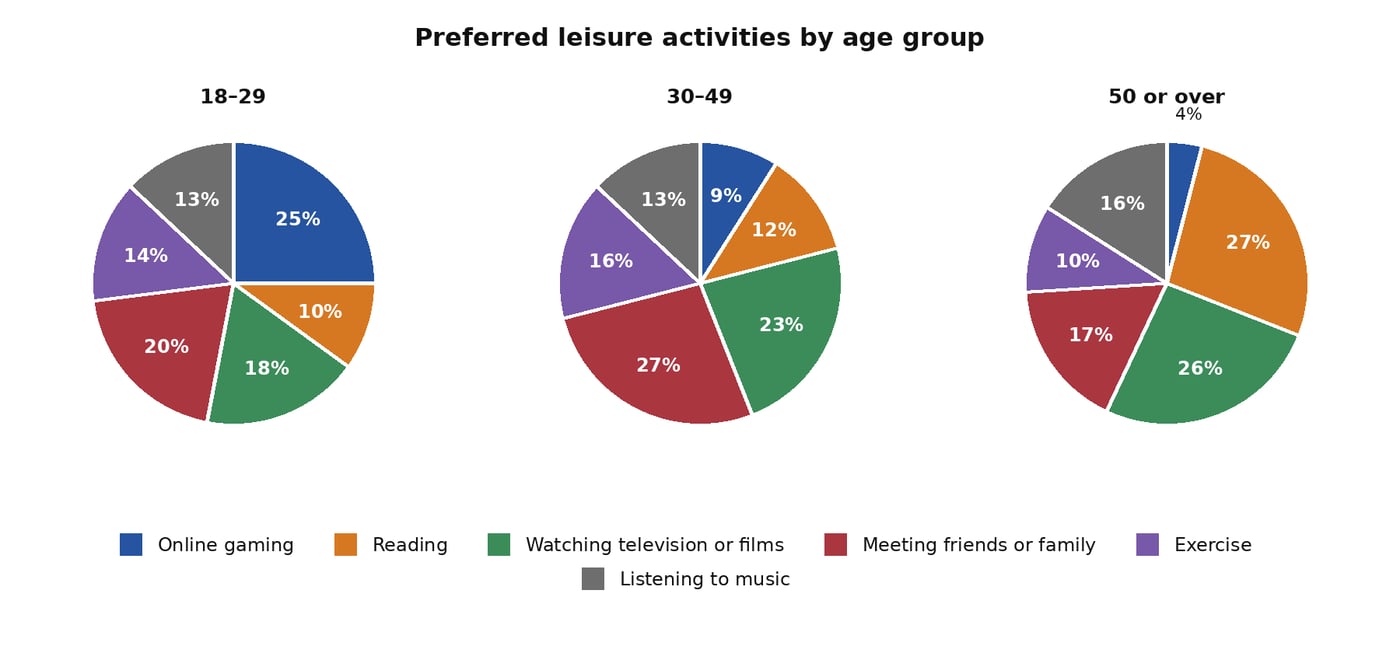
The charts below show the percentages of people in three age groups who choose each of six leisure activities.
Summarise the information by selecting and reporting the main features, and make comparisons where relevant.
Student answer (Band 6.0)
The pie charts show the percentage of six leisure activities from the people ages 18 up to 50 years and older.
Overall, online gaming was seen to dramatically decreased as people aged. Whereas, reading activity and watching television increased in older people. Somehow, meeting with friends and family members are much preferred by the middle aged groups. While listening to music and exercise is seen to be preferred in all age groups.
With an approximate 1/4 of the population in ages 18 to 29 who chose online gaming as their leisure time, it significantly decreases when the a person reaches 50 years or older with only 4% of the population plays it. Reading (27%) and watching television (26%)seems to increase as a person aged compared to younger once.
However, meeting with friends and family members seems to be popular for middle aged groups with a percentage of 27% and distinctively the highest percentage of leisure activity among the 6 types of activities. Whereas, listening to music and exercise are seen to all age groups equally.
AI examiner evaluation
| Criterion | Band |
|---|---|
| Task Achievement / Task Response | 6.0 |
| Coherence and Cohesion | 6.0 |
| Lexical Resource | 6.0 |
| Grammatical Range and Accuracy | 5.5 |
| Overall | 6.0 |
Task Achievement / Task Response: Band 6.0
You identify several important patterns accurately: online gaming falls from 25% among 18–29-year-olds to 4% among those aged 50 or over, while reading and television viewing are more popular in the oldest group. You also correctly note that meeting friends or family peaks among 30–49-year-olds at 27%. However, some comparisons are incomplete or imprecise. Reading and television do not simply “increase” across every age group: television rises to 23% in the middle group before reaching 26%, while reading changes only slightly before rising to 27%. The claim that exercise and music are preferred “equally” across all groups is not supported by their differing figures. A more precise overview and fuller reporting of these variations would make the summary more complete.
Coherence and Cohesion: Band 6.0
The response has a clear overall structure, with an introduction, an overview, and two paragraphs describing the data. The main comparisons are generally grouped sensibly, and linking expressions such as “Overall,” “However,” and “Whereas” help signal relationships between ideas. At times, though, these connectors are used awkwardly or create unclear links: “Whereas” begins a sentence without a clear contrasting clause, and “However” does not clearly connect the final paragraph to the preceding point. The overview also combines several trends in one paragraph without distinguishing the strongest patterns from less important observations. Organising the details more systematically—for example, contrasting age-related changes with activities that peak in the middle group—would improve progression and cohesion.
Lexical Resource: Band 6.0
You use an adequate range of vocabulary for describing charts, including “percentage,” “dramatically,” “significantly decreases,” and “distinctively the highest percentage.” These choices help communicate the main comparisons, and the meaning is generally clear. Some word choices and collocations are inaccurate or imprecise, however: “the percentage of six leisure activities from the people” is an unnatural description of what the charts show, while “leisure time” and “preferred in all age groups equally” do not express the data precisely. “Dramatically” also overstates the change unless supported by a clear comparison. Aim for standard chart language such as “the proportion of respondents who chose” and “was most popular among,” and choose terms that describe the figures without exaggeration.
Grammatical Range and Accuracy: Band 5.5
You attempt both simple and more complex sentence forms, including contrast structures such as “Whereas…” and clauses beginning with “With an approximate 1/4…”. The overall meaning remains understandable, but some errors in verb forms, agreement, articles, and sentence construction reduce accuracy. For example, “was seen to dramatically decreased” should use a base verb after “to,” and “only 4% of the population plays it” does not match the past-tense reporting context or the plural idea of respondents. In “as a person aged,” the verb form is incorrect, while “the a person” contains an article error. Some sentence fragments beginning with “Whereas” or “While” also need to be joined to a main clause. Check each sentence for a complete structure and consistent verb forms.
See this exact question answered at other band scores. The same prompt compared across bands.
Browse more IELTS Writing model answers or get your own writing scored by the same AI examiner.