Band 5.5 IELTS Writing Task 1 Model Answer
Overall Band Score: 5.5 · IELTS Last Minute Nov 2026 · 2026-11-24
IELTS Writing Task 1 question
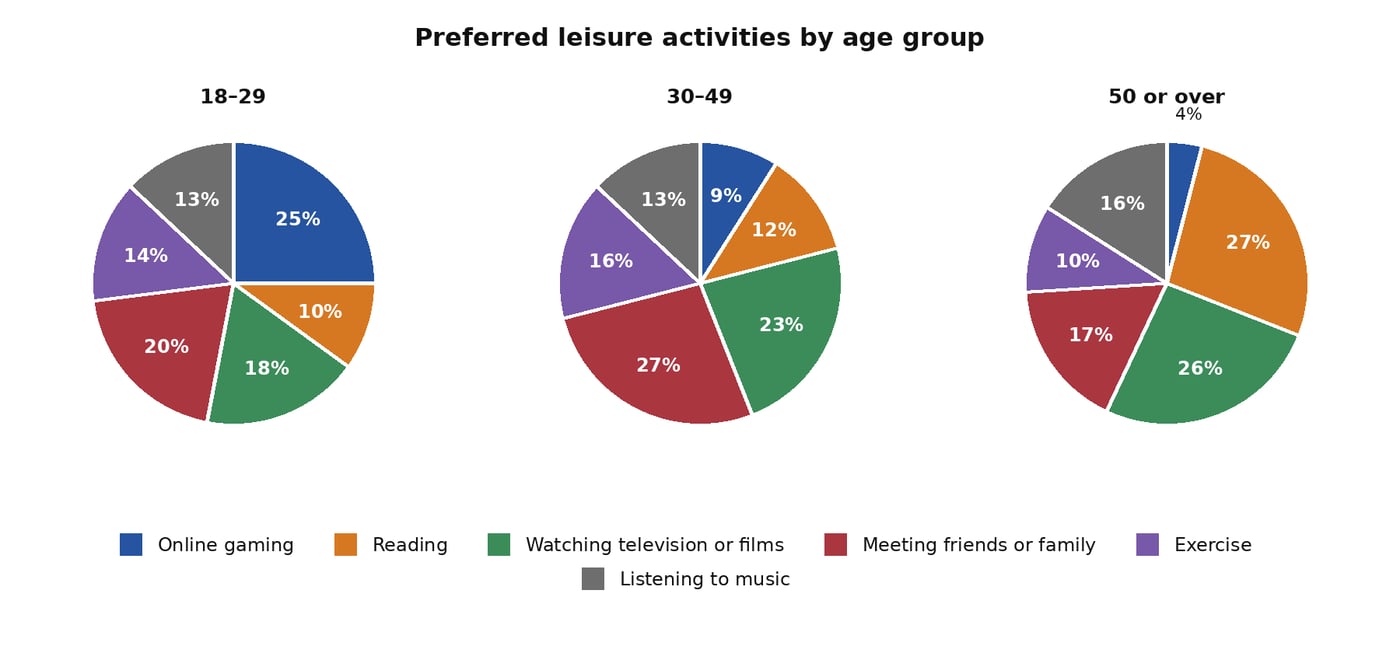
The charts below show the percentages of people in three age groups who choose each of six leisure activities.
Summarise the information by selecting and reporting the main features, and make comparisons where relevant.
Student answer (Band 5.5)
The provided diagrams provide an overview of the people proportions who select diferent activities by comparing them with three age groups.
Overall, in young age most of them are busy in playing video games then mature one's are love to meeting with their beloved one's while elderly people are enjoy reading books and watching movies on television.
The chart shows that the age group of 18 to 29 spend their most time in online gaming and have largest proportion 25% in it then comes watching television and meeting friends with 18% and 20%, while in the age of 30 to 49 they have the bigest share in these two activities of watching televison with 23% and meeting with friends 27%. Likewise, the group of age 50 or over it have largest share in reading 27% and watching movies 26%.
The main features are that proportion of exrcise and listening music are remained a quite diffrence of share in all age groups.
AI examiner evaluation
| Criterion | Band |
|---|---|
| Task Achievement / Task Response | 6.0 |
| Coherence and Cohesion | 5.5 |
| Lexical Resource | 5.5 |
| Grammatical Range and Accuracy | 5.0 |
| Overall | 5.5 |
Task Achievement / Task Response: Band 6.0
You identify several important patterns accurately: online gaming is highest among 18–29-year-olds (25%), meeting friends or family leads for the 30–49 group (27%), and reading and television/films are the top choices among those aged 50 or over (27% and 26%). The opening overview also usefully contrasts younger and older people. However, some comparisons are incomplete: for example, the response does not report the older group’s low online-gaming figure or explain how exercise and music vary. The final claim that these two activities have “a quite difference of share” is unclear and does not specify the pattern. Develop this overview with a few precise comparisons across all three groups, rather than leaving some features under-explained.
Coherence and Cohesion: Band 5.5
The response has a recognisable structure, moving from an introduction to an overview and then to supporting details. Linking expressions such as “Overall,” “while,” and “Likewise” help signal comparisons. However, progression is weakened because the final paragraph introduces exercise and music without giving figures or explaining their relationship to the earlier discussion. Some references are also difficult to follow, as in “these two activities,” which could refer to different activities in the preceding sentence. Grouping the information more deliberately—for example, contrasting age-related preferences first and then summarising the less variable activities—would make the comparisons easier to track. Use linking words to express clear relationships, not simply to begin sentences.
Lexical Resource: Band 5.5
You use relevant vocabulary for describing the chart, including “proportion,” “largest share,” “age group,” and “activities,” so the topic is generally clear. There are also attempts at varied phrasing, such as “beloved ones” and “main features,” but some choices are unnatural or imprecise for an academic report. “Busy in playing video games” and “mature ones are love to meeting” do not express the intended preferences naturally, while “a quite difference of share” is difficult to interpret. Spelling errors such as “diferent,” “bigest,” and “televison” also reduce accuracy. Aim for standard chart language and check spelling; precise phrases such as “preferred” and “accounted for” would improve clarity.
Grammatical Range and Accuracy: Band 5.0
You attempt both simple and more extended sentence forms, including comparisons joined with “while” and “then,” and the main figures can usually be understood. However, some grammatical errors affect clarity. For example, “in young age most of them are busy” lacks a natural article and structure, and “the age group of 18 to 29 spend” has subject–verb disagreement. The clause “the group of age 50 or over it have” also combines an unclear subject with incorrect agreement. In “exercise and listening music are remained,” the verb construction is faulty. Practise forming clear subjects and verbs, using consistent present-tense reporting, and checking agreement and articles. More accurate complex sentences would make your comparisons easier to read.
See this exact question answered at other band scores. The same prompt compared across bands.
Browse more IELTS Writing model answers or get your own writing scored by the same AI examiner.