Band 5.5 IELTS Writing Task 1 Model Answer
Overall Band Score: 5.5 · IELTS Last Minute Nov 2026 · 2026-11-26
IELTS Writing Task 1 question
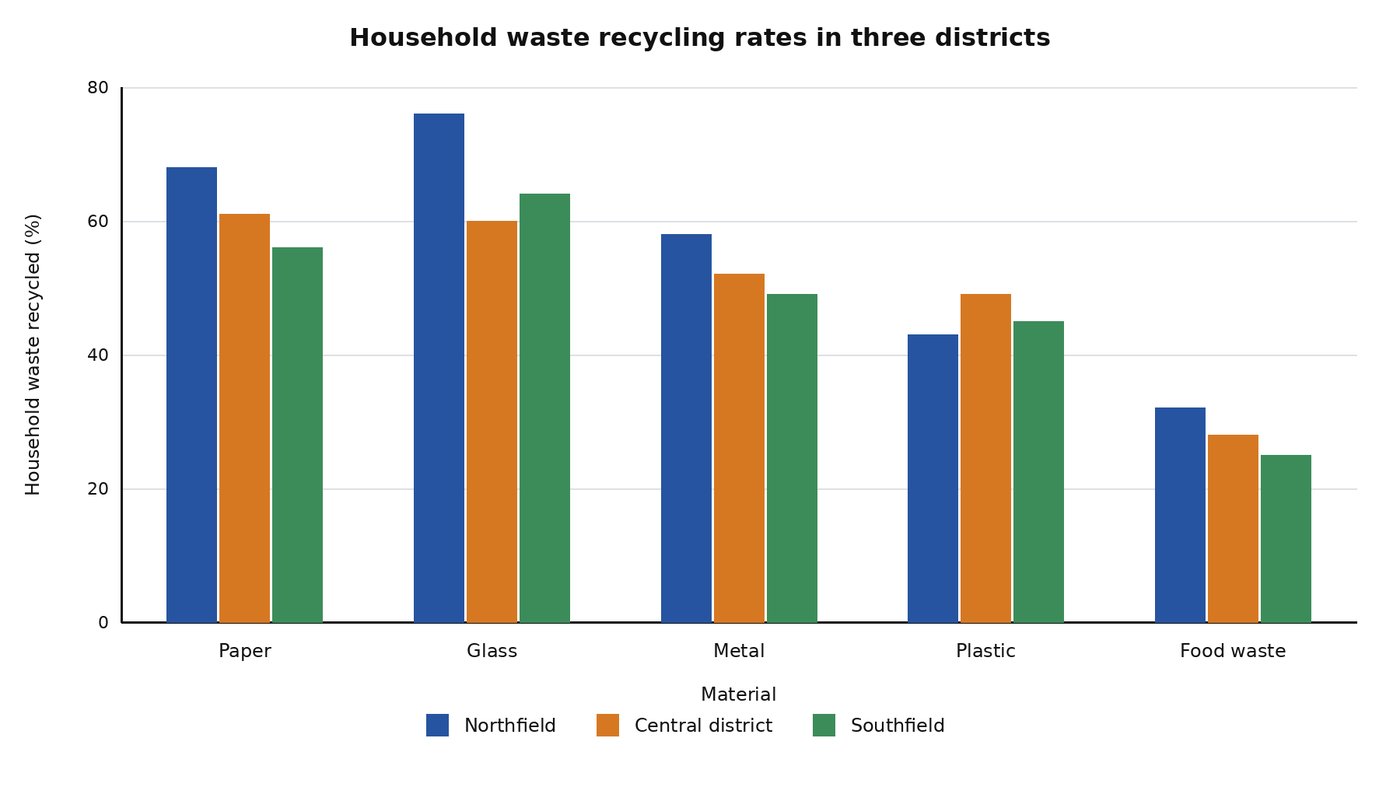
The chart below shows how much household rubbish is recycled for five materials in three districts.
Summarise the information by selecting and reporting the main features, and make comparisons where relevant.
Student answer (Band 5.5)
The given bar chart shows the percentage of household waste which recycled for paper, glass, metal, plastic and food waste in Northfield, Central district and southfield.
To begin with, the ration of paper and glass is between 60% to 80% in northfield, however, the percentage of other materials like metal, plastic and food wastage is lower than perivious items, that is 58% of metal, upto 40% of plastic and nearly 25% of waste food. Moreover, in Central district, the 61% paper recycled, also the almost same percentage of glass that is 60%. The metal and household plastic items ration is between 40% to 60%. The percentage is very less for food waste that is only 24%.
Moving further, the household waste recycling rate in Southfield, where the highest percentage of recycling is glass, it is above 60%. Although, the paper, metal and plastic wastage number is not less then 40%. The last material that is food waste, its ration only 23% approxmetly.
In conclusion, according to me, the glass percentage for recycling is highest in all three district, but, the ration is lowest for food wastage.
AI examiner evaluation
| Criterion | Band |
|---|---|
| Task Achievement / Task Response | 5.5 |
| Coherence and Cohesion | 6.5 |
| Lexical Resource | 5.0 |
| Grammatical Range and Accuracy | 5.5 |
| Overall | 5.5 |
Task Achievement / Task Response: Band 5.5
You identify the chart’s subject and cover all three districts and five materials, with relevant figures such as Northfield’s 58% for metal and Central district’s 61% for paper. Your overview also correctly notes that glass is generally the most recycled material and food waste the least. However, some details are inaccurate or imprecise: Northfield’s plastic rate is about 43%, not “upto 40%,” and Southfield’s food-waste rate is about 25%, rather than 23%. The overview would be stronger if it highlighted the clearest comparisons, such as Northfield leading in paper, glass, metal and food waste, while Central leads in plastic. Some comparisons are mentioned but not fully developed.
Coherence and Cohesion: Band 6.5
The response has a clear overall arrangement: an introduction, district-by-district paragraphs and a concluding summary. Sequencing phrases such as “To begin with” and “Moving further” help signal progression, and the reader can generally follow the comparisons. This coherent structure is a strength. However, some linking is mechanical, and the conclusion repeats the main point rather than adding a concise synthesis of the district differences. Within paragraphs, several figures are listed without clearly explaining how they compare—for example, the Central district paragraph groups metal and plastic together without giving their exact rates. More precise referencing and links between comparisons would make the progression smoother and more purposeful.
Lexical Resource: Band 5.0
You use relevant topic vocabulary, including “percentage,” “recycling rate,” “materials” and “district,” so the subject remains understandable. There is also some attempt to vary phrasing, such as “household waste recycling rate.” However, the range is limited and several word-choice, collocation and spelling problems reduce precision. “Ration” is repeatedly used where “rate” or “proportion” is intended, while “wastage” does not fit naturally when naming the material being recycled. Spellings such as “perivious” and “approxmetly” are noticeable. Aim for accurate, consistent terms for rates and materials, and avoid awkward phrases such as “the 61% paper recycled.”
Grammatical Range and Accuracy: Band 5.5
You attempt a mixture of sentence forms, including longer sentences with contrast, as in “Although, the paper, metal and plastic wastage number is not less then 40%.” However, complex constructions are often faulty, and errors occur frequently enough to make some sentences awkward or unclear. For example, “the percentage of household waste which recycled” is missing a passive verb form, and “the 61% paper recycled” lacks a grammatical structure for reporting the figure. There are also problems with articles, agreement and sentence boundaries, as in “the highest percentage of recycling is glass, it is above 60%.” Practise clear patterns such as “The recycling rate for paper was 61%” and use contrast clauses without an unnecessary comma.
See this exact question answered at other band scores. The same prompt compared across bands.
Browse more IELTS Writing model answers or get your own writing scored by the same AI examiner.