Band 5.0 IELTS Writing Task 1 Model Answer
Overall Band Score: 5.0 · IELTS Predictions Nov 2026 · 2026-11-26
IELTS Writing Task 1 question
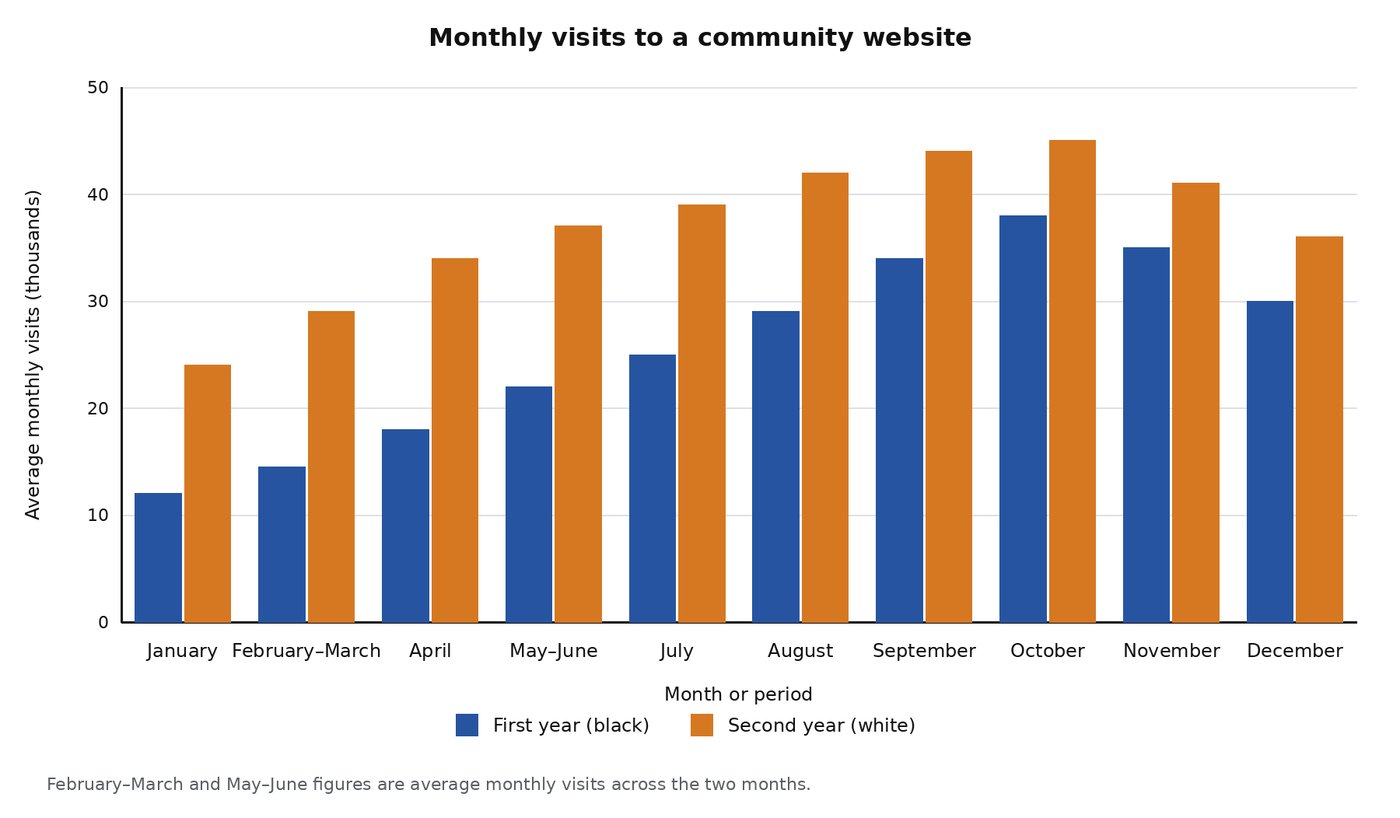
The chart below illustrates average monthly web traffic to a community website in each month or period of its first and second years after opening.
Summarise the information by selecting and reporting the main features, and make comparisons where relevant.
Student answer (Band 5.0)
The charts below illustrates the information about average monthly web traffic to a community website in each month or period of its first and second years after opening.
Overall, in sptember and october month has been high number of visit. It is clearly see that first year has been less number as compare the second year.
Looking at first year, in january, february-march and april month has 12, 14, 18 thousnds numbers respectively. In next month may-june, july and august has a 22, 25, 29 thousand. The next month september month increased slightly and reached at 34 thousnds and october month has reached at the peak. and its number is 38 thousands. The november and december month has been decreasd and reached 35 and 30 thousands.
The second year,in january ha svery less numbers. It has a 24 thousands. Another the may-june month has maximum thousands, it has 37 thousands. The october month it reached on the peak. Its number is 45 numbers.
AI examiner evaluation
| Criterion | Band |
|---|---|
| Task Achievement / Task Response | 5.0 |
| Coherence and Cohesion | 5.5 |
| Lexical Resource | 5.0 |
| Grammatical Range and Accuracy | 5.0 |
| Overall | 5.0 |
Task Achievement / Task Response: Band 5.0
You identify the broad pattern that visits were higher in the second year and report several first-year figures, including the rise to 38,000 in October and the decline afterwards. However, the overview is unclear and says September and October had the highest traffic without clearly comparing the two years. The second-year account is especially incomplete: it gives January, May–June and October, but omits the steady rise through most of the year and the fall in November and December. There is also a factual error in the first-year figures: February–March is about 14,500, not 14,000. The response is 142 words, below the 150-word minimum; the 21 words copied from the prompt are not counted. Select the main trends and compare both years more fully.
Coherence and Cohesion: Band 5.5
The response has a basic paragraph structure, with an introduction, an overview and separate descriptions of the two years. Sequencing within the first-year paragraph is generally chronological, and phrases such as “Looking at first year” and “The next month” help the reader follow the data. However, progression is uneven: the second-year paragraph jumps from January to May–June and then October, leaving the later months unexplained. Some linking is repetitive or awkward, particularly repeated uses of “month” and “and,” while the overview does not clearly guide the comparison that follows. Grouping the two years around shared patterns—overall rise, peak and year-end decline—and using clearer transitions would make the organisation more coherent.
Lexical Resource: Band 5.0
You use some relevant chart vocabulary, including “increased,” “reached,” “peak” and “decreased,” so the reader can understand the general movement. However, the range is limited and several word choices or collocations are unnatural, such as “less number,” “maximum thousands” and “reached at the peak.” Repetition of “month” and “number” also makes the description less precise. Spelling errors, including “sptember,” “thousnds” and “decreasd,” are noticeable and reduce accuracy. Aim for concise, standard expressions for describing figures and trends, and check spelling carefully. More precise terms such as “visits,” “traffic” and “rose steadily” would help you report the chart clearly without relying on repeated basic wording.
Grammatical Range and Accuracy: Band 5.0
The response mainly uses simple sentences and attempts some longer structures, but grammatical errors are frequent and sometimes make relationships between figures unclear. For example, “in january, february-march and april month has…” has problems with sentence structure and subject–verb agreement, while “The november and december month has been decreasd” does not form a clear, accurate clause. Articles and number agreement are also inconsistent, as in “has a 22, 25, 29 thousand.” Capitalisation and punctuation need attention, particularly the lower-case month names and the full stop followed by “and” in the October sentence. Practise accurate past-tense reporting and complete sentence patterns, then proofread agreement, articles and punctuation.
See this exact question answered at other band scores. The same prompt compared across bands.
Browse more IELTS Writing model answers or get your own writing scored by the same AI examiner.