Band 5.5 IELTS Writing Task 1 Model Answer
Overall Band Score: 5.5 · IELTS Last Minute Nov 2026 · 2026-11-25
IELTS Writing Task 1 question
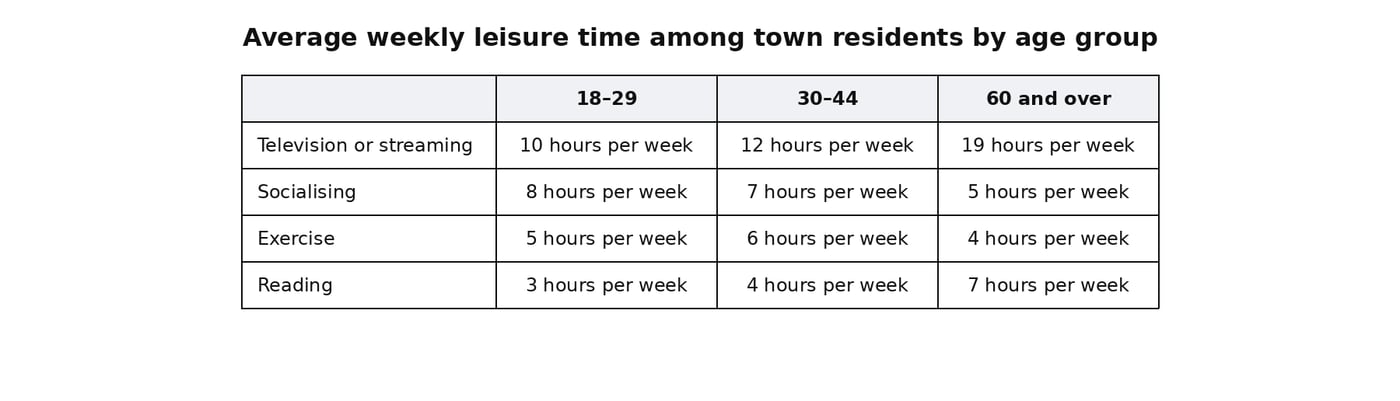
The table below compares the average weekly hours adult residents of a town spend on four leisure activities, across three age groups.
Summarise the information by selecting and reporting the main features, and make comparisons where relevant.
Student answer (Band 5.5)
The table chart shows the avarage weekly time adult residents of a town who spend on four different activities such as television or streaming, socialising, exercise and reading across three age grouos.
First of all, the age group 18-29 adults, they are spending 10 hours per week to watching television and streaming. However, this age group use only 8 hours for socialising per week and only 5 hours for doing exercise. The avarage is 3 hours oer week for reading. the other age group 30-44 spend time for televion is that 12 hours per week and for socialising, they have only 7 hours weekly. Moreover, for exercise and reading they are spending 6 and 4 hours every week.
In addition, the last age group that is 60 and over aged, they are watching more television and steaming, 19 hours in a week. for the other activities, like socialising and exercise, they have only 4 to 5 hours in week. The last reading they are spending 7 hours every week.
In the conclusion, I can see that the highest avarage of adult who watching televison and steaming in all age groups. But the lowest average for reading in first both aged adults residents.
AI examiner evaluation
| Criterion | Band |
|---|---|
| Task Achievement / Task Response | 5.5 |
| Coherence and Cohesion | 6.0 |
| Lexical Resource | 5.0 |
| Grammatical Range and Accuracy | 5.0 |
| Overall | 5.5 |
Task Achievement / Task Response: Band 5.5
You report the figures for all four activities across the three age groups, and most are accurate. You also identify the main pattern that television or streaming takes the most time in every group, with 19 hours among those aged 60 and over. However, the overview is incomplete and partly inaccurate: reading is lowest only for the two younger groups, while socialising is lowest for the oldest group. The statement that the “lowest average for reading in first both aged adults” is also unclear. A stronger response would give a concise overview of the contrasting age trends—screen time and reading rise with age, while socialising falls—and compare the groups more directly. Some details, such as the exercise figures, are listed but not interpreted.
Coherence and Cohesion: Band 6.0
The response has a generally understandable order: it describes the youngest group, then the middle group, and finally the oldest, before attempting a conclusion. Paragraph breaks help separate these sections, and phrases such as “In addition” signal a move to the final age group. However, the progression is sometimes mechanical, with repeated openings such as “First of all” and “In addition,” and the conclusion repeats information rather than drawing the comparisons together. Some links between ideas are unclear, particularly “for the other activities, like socialising and exercise, they have only 4 to 5 hours,” which makes the figures harder to match to each activity. Grouping trends across age groups would create clearer comparisons and smoother cohesion.
Lexical Resource: Band 5.0
You use relevant activity vocabulary, including “socialising,” “exercise,” “reading,” and “television or streaming,” so the topic is generally clear. However, the range of reporting language is limited, and several phrases are awkward or imprecise, such as “the age group 18-29 adults” and “the last age group that is 60 and over aged.” Repetition of “spend,” “hours,” and “only” also makes the account less flexible. There are noticeable spelling errors, including “avarage,” “grouos,” “televion,” and “steaming,” which reduce accuracy and can distract the reader. Use precise terms for age groups and vary verbs for describing time allocation and changes across groups.
Grammatical Range and Accuracy: Band 5.0
You attempt some longer sentences and use basic structures to report figures, but sentence control is inconsistent. For example, “First of all, the age group 18-29 adults, they are spending…” is a fragment followed by an unclear pronoun, while “the other age group 30-44 spend time for televion is that 12 hours” has a faulty clause structure. Verb forms and agreement are also problematic in “adults who watching” and “they are spending.” Capitalisation after full stops is inconsistent, as in “the other age group” and “for the other activities.” These errors sometimes make relationships between the activity and its figure difficult to follow. Practise complete subject–verb sentences and use a consistent present-simple pattern, such as “Adults aged 18–29 spend 10 hours watching television.”
See this exact question answered at other band scores. The same prompt compared across bands.
Browse more IELTS Writing model answers or get your own writing scored by the same AI examiner.