Band 5.5 IELTS Writing Task 1 Model Answer
Overall Band Score: 5.5 · IELTS Last Minute Nov 2026 · 2026-11-28
IELTS Writing Task 1 question
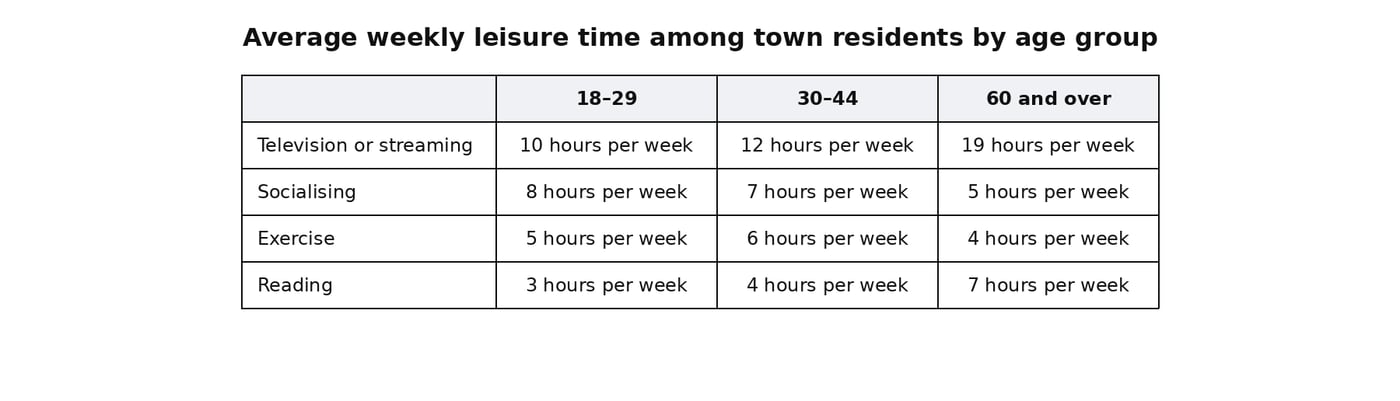
The table below compares the average weekly hours adult residents of a town spend on four leisure activities, across three age groups.
Summarise the information by selecting and reporting the main features, and make comparisons where relevant.
Student answer (Band 5.5)
The rendered table illustrates the information typical weekly hours adult citizens of a town utilised on four leisure activities , across three age groups .
Overall, it is clear that television had the highest figure, while exercise and reading recorded the lowest figure.
Looking at the details, the time utilised on television on 18 to 29 age group recorded 10 hours , compared with 12 hours for 30 to 44 age , while 60+ age group utilised 19 hours.Furthermore, the figure for socialising stood at 8 hours for 18 to 29 age group , which was higher than 60+ with 3 hours , while 30to 44 accounted for 7 hours.
Turning to the remaining age groups, 18 to 29 group, 30 to 44 and 60 above spent 5 hours, 6 hours and 4 hours on exercising .In case of reading , only 3 hours by 28 to 29 age group and its 4 time high time utilised by 60+ and 4 hours by 30 _ 44 age group.
AI examiner evaluation
| Criterion | Band |
|---|---|
| Task Achievement / Task Response | 6.0 |
| Coherence and Cohesion | 6.0 |
| Lexical Resource | 5.5 |
| Grammatical Range and Accuracy | 5.0 |
| Overall | 5.5 |
Task Achievement / Task Response: Band 6.0
You identify the table’s broad pattern that television is the most time-consuming activity, and you report several accurate figures, including television viewing (10, 12 and 19 hours) and exercise (5, 6 and 4 hours). However, the overview is incomplete: saying exercise and reading had the “lowest figure” is unclear because socialising is also relatively low, and exercise is not consistently among the lowest. There are also important data errors: socialising for the 60+ group is 5 hours, not 3, and reading for this group is 7 hours, not 4; “28 to 29” is also not the stated age group. The response covers the main categories, but these inaccuracies and the limited comparison of age-related patterns leave some information less clearly presented.
Coherence and Cohesion: Band 6.0
The response has a recognisable structure: an introduction, an overview, and two paragraphs covering the activities. Phrases such as “Overall,” “Looking at the details,” and “Turning to the remaining” help signal the stages of the report. However, progression is sometimes mechanical, and the final paragraph is difficult to follow because it combines all three age groups and reading figures in a confusing sentence. For example, “its 4 time high time utilised by 60+” does not make the comparison clear. Some references, such as “the remaining age groups,” are also imprecise. Grouping the information more consistently and using clear comparisons between age groups would make the organisation easier to follow.
Lexical Resource: Band 5.5
You use relevant vocabulary for describing a table, including “recorded,” “compared with,” “stood at,” and “accounted for.” This gives you a workable range for reporting figures. However, several choices are unnatural or imprecise: “time utilised on television” and “figure for socialising” are less suitable than direct descriptions of hours spent, while “its 4 time high time utilised” makes the reading comparison hard to understand. There are also inconsistent forms for age groups, such as “60+,” “60 above,” and “30to 44.” Aim for natural, precise collocations and use the same age-group labels throughout. This would improve clarity and show more controlled vocabulary.
Grammatical Range and Accuracy: Band 5.0
You attempt both simple statements and longer comparative sentences, for example, “which was higher than 60+ with 3 hours,” and the overall meaning is usually recoverable. However, some sentence structures are incomplete or awkwardly formed. “The time utilised on television on 18 to 29 age group recorded 10 hours” has an unclear subject and needs an article or a clearer construction, such as “People aged 18–29 spent 10 hours watching television.” The final sentence also lacks a clear grammatical structure. Punctuation and spacing are inconsistent, with missing spaces after full stops and spaces before commas. More controlled sentence patterns, accurate articles, and careful punctuation would make the comparisons clearer.
See this exact question answered at other band scores. The same prompt compared across bands.
Browse more IELTS Writing model answers or get your own writing scored by the same AI examiner.