Band 5.5 IELTS Writing Task 1 Model Answer
Overall Band Score: 5.5 · IELTS Predictions Nov 2026 · 2026-11-28
IELTS Writing Task 1 question
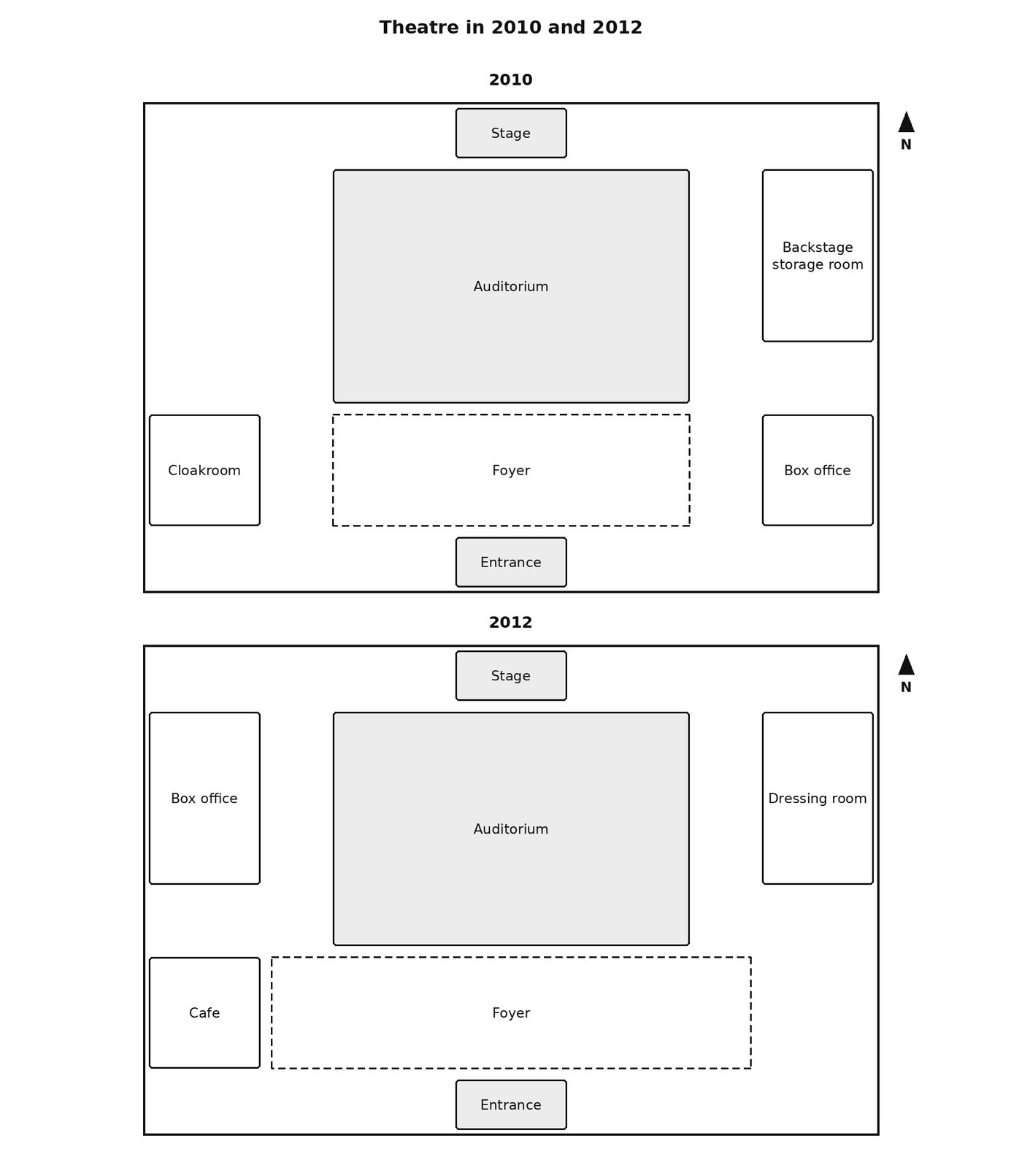
The plans below illustrate the configuration of a theatre in 2010 and 2012, including the alterations made between these years.
Summarise the information by selecting and reporting the main features, and make comparisons where relevant.
Student answer (Band 5.5)
The given two maps illustrates the configuration of a theatre 2010 and 2012 and the changes made in the theatre between the two years.
Overall, in the after map dressing room and cafe had been introduced for the convenience of the people.
In the first map, auditorium grab the lion's share and their was a stage. First thing you saw after entring was the foyer. There was a backstage storage room to kept the extra items. Furthermore, there was a cloakroom to held meetings. The box office was there to purchase tickets and for the enquiry.
In the later map, some changes had made as cafe was introduced for the convenience of the public to enjoy their meals there. In addition to it, furthur facilities had been introduced, the box office was replaced by a dressing room for changing clothes. The position of the box office had changed to west direction.
AI examiner evaluation
| Criterion | Band |
|---|---|
| Task Achievement / Task Response | 6.0 |
| Coherence and Cohesion | 6.0 |
| Lexical Resource | 5.5 |
| Grammatical Range and Accuracy | 5.0 |
| Overall | 5.5 |
Task Achievement / Task Response: Band 6.0
You identify the two years and report several relevant changes, including the introduction of a café and dressing room and the relocation of the box office. The overview also recognises that new facilities were added. However, some details are inaccurate or unclear: the box office was not replaced by the dressing room; it moved from the south-east to the north-west, while the dressing room took the former backstage-storage area in the north-east. The claim that the cloakroom was used to hold meetings is unsupported, and the unchanged stage, auditorium, foyer and entrance are not clearly compared. More precise reporting of the layout, alongside a fuller overview of what stayed the same and changed, would make the account more complete.
Coherence and Cohesion: Band 6.0
The response has a clear overall arrangement: an introduction, an overview, and separate descriptions of the earlier and later plans. This makes the basic progression easy to follow, and phrases such as “In the first map” and “In the later map” help signal the time comparison. However, some links are mechanical or unclear. For example, “In addition to it” does not connect the ideas naturally, and “the box office was replaced by a dressing room” creates a confusing relationship between the changes. The description also moves between layout facts and assumed purposes without a clear organising principle. Grouping features by location or by whether they remained, moved or were added would strengthen the progression and cohesion.
Lexical Resource: Band 5.5
You use some task-relevant vocabulary, including “configuration,” “introduced,” “position” and “convenience,” and the reader can generally understand the intended changes. However, several word choices and collocations are inaccurate or informal for describing a plan. “Grab the lion’s share” is an unsuitable idiom for the auditorium, while “to held meetings” and “to kept the extra items” do not express the intended functions naturally. There are also spelling errors such as “entring” and “furthur.” Aim for precise spatial and change-related language, such as “occupied most of the central area,” “was located,” and “was converted into,” and check spelling carefully.
Grammatical Range and Accuracy: Band 5.0
You attempt both simple and more complex sentences, including a time contrast in “In the later map, some changes had made as cafe was introduced.” However, errors in verb forms, agreement and articles are frequent enough to make several sentences awkward. For example, “The given two maps illustrates” needs plural agreement, “their was a stage” confuses “there” and “their,” and “some changes had made” is missing the passive auxiliary. Other examples include “a theatre 2010 and 2012” and “First thing you saw,” where articles or sentence structure are incomplete. Practise accurate passive forms for map changes (“was introduced,” “was relocated”) and check subject–verb agreement and articles in each sentence.
See this exact question answered at other band scores. The same prompt compared across bands.
Browse more IELTS Writing model answers or get your own writing scored by the same AI examiner.