Band 7.0 IELTS Writing Task 1 Model Answer
Overall Band Score: 7.0 · Cambridge IELTS 19 · 2026-11-22
IELTS Writing Task 1 question
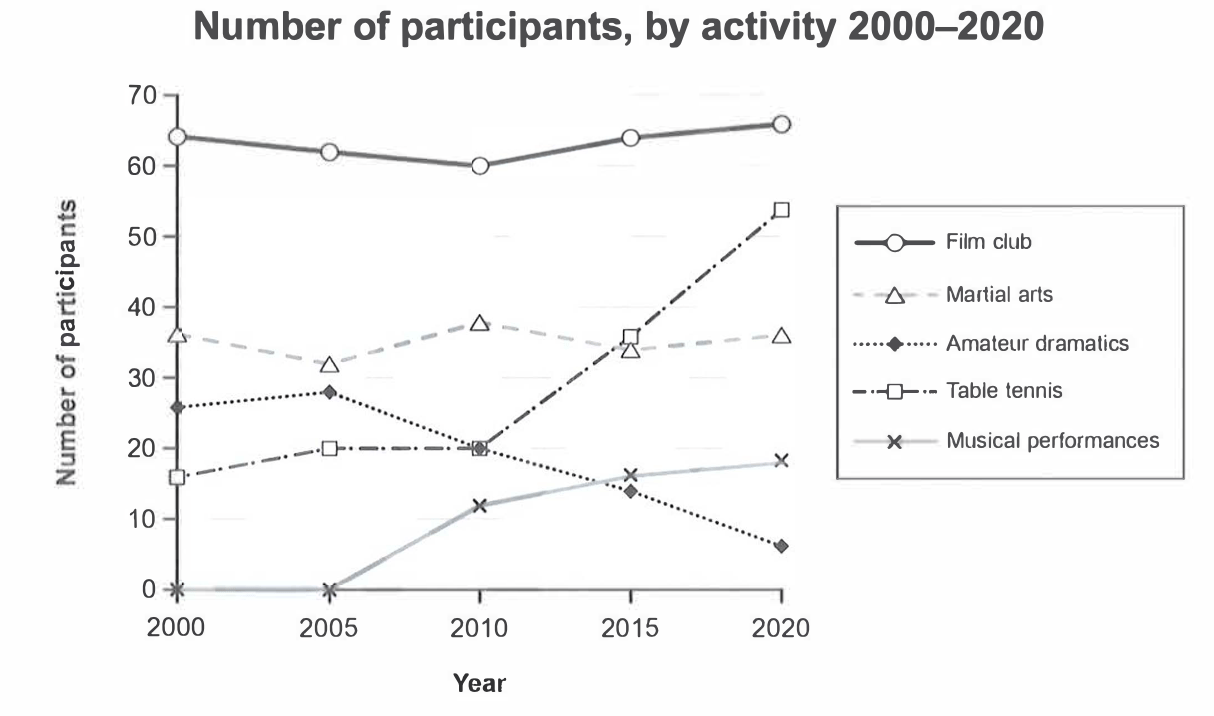
The graph below gives information on the numbers of participants for different activities at one social centre in Melbourne, Australia for the period 2000 to 2020.
Summarise the information by selecting and reporting the main features, and make comparisons where relevant.
Student answer (Band 7.0)
The line chart illustrates the change in the number of people participating in various activities between 2000 and 2020, at a community centre in Melbourne, Australia
Overall, table tennis has seen a major increase in popularity from 2010, while the other clubs of activities have mostly been steady with slight fluctuations. The exception is amateur dramatics, where the number of participants have plummeted to less than 10 in 2020.
Film club has the highest number of participants at the centre, where it declined slightly until 2010 and then rose again to below 70 people in 2020. The martial arts group had slight fluctuations throughout the years and have around 45 people participating in 2020.
Table Tennis players have risen from around 15 people to more than 50 in the twenty years from 2000 with a sharp incline from 2010 onwards. Musical performances started from 2005 and have surpassed amateur dramatics in participants in 2015, which is the only club to have experienced such a massive drop from 30 participants in 2000 to only around 5 participants in 2020
AI examiner evaluation
| Criterion | Band |
|---|---|
| Task Achievement / Task Response | 7.0 |
| Coherence and Cohesion | 6.5 |
| Lexical Resource | 7.0 |
| Grammatical Range and Accuracy | 6.5 |
| Overall | 7.0 |
Task Achievement / Task Response: Band 7.0
The response selects the main patterns and gives a clear overview: table tennis rises markedly, film club remains the largest activity, and amateur dramatics declines to a very low level. Most figures and comparisons are grounded in the chart, including the fall in amateur dramatics to around six and table tennis reaching above 50. There are, however, a few inaccuracies: martial arts ends at about 36, not around 45, and musical performances begin in 2010 rather than 2005. The claim that the other clubs are mostly steady also over-generalises, since musical performances rise and amateur dramatics falls substantially. More precise reporting of these trends would make the account more fully supported.
Coherence and Cohesion: Band 6.5
The response is organised into an introduction, an overview and two detail paragraphs, and the information generally progresses from the broad trends to individual activities. Linking expressions such as “Overall,” “while,” and “The exception” help signal relationships between ideas. The final paragraph, however, combines musical performances and amateur dramatics in a long sentence, making the comparison less easy to follow; the reference in “which is the only club” is also unclear. Some linking is therefore effective, but cohesion is not consistently controlled. Separate the two trends and use explicit references, such as “Amateur dramatics was the only activity to decline so sharply,” to improve clarity and progression.
Lexical Resource: Band 7.0
There is a useful range of vocabulary for describing trends, including “slight fluctuations,” “sharp incline,” “surpassed,” and “plummeted.” These choices allow the writer to compare activities and convey the scale of change, supporting a flexible response. Some expressions are less precise or natural in this context: “clubs of activities” is awkward, “started from 2005” does not accurately describe the chart, and “massive drop” is somewhat informal for an academic summary. “Popularity” also interprets participant numbers rather than simply reporting them. Aim for more exact, neutral collocations, such as “participation increased sharply” and “the number of participants fell substantially,” while retaining the effective trend vocabulary already used.
Grammatical Range and Accuracy: Band 6.5
The response uses a mix of simple and more complex structures, including contrast clauses with “while” and “where,” and most sentences communicate the intended trends. Some grammatical errors remain. In “the number of participants have plummeted,” the singular subject “number” requires “has”; similarly, “the martial arts group … have” should be “has.” The opening sentence also lacks a final full stop, and the final sentence is long enough that its clause structure and reference become difficult to control. Review subject–verb agreement and punctuation, and divide the final sentence into shorter units. These adjustments would make the varied sentence forms more consistently accurate.
See this exact question answered at other band scores. The same prompt compared across bands.
Browse more IELTS Writing model answers or get your own writing scored by the same AI examiner.