Band 5.5 IELTS Writing Task 1 Model Answer
Overall Band Score: 5.5 · Cambridge IELTS 16 · 2026-11-05
IELTS Writing Task 1 question
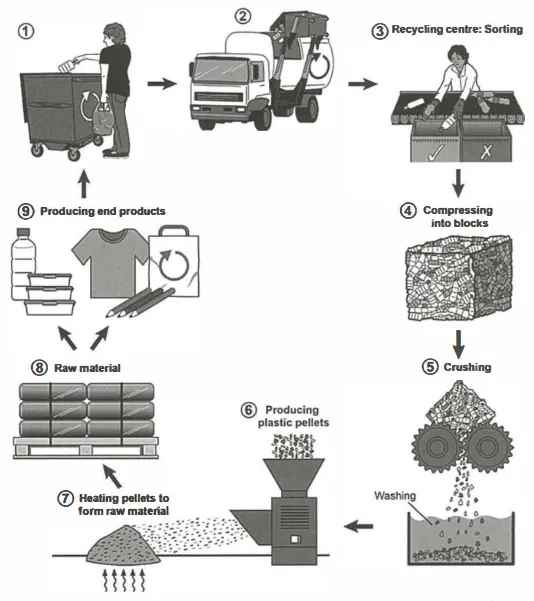
The diagram below shows the process for recycling plastic bottles.
Summarise the information by selecting and reporting the main features, and make comparisons where relevant.
How plastic bottles are recycled
Student answer (Band 5.5)
This process figure illustrates the procedure of refining plastic bottles into the occurance of end products such as clothes, shopping bags and pencils etc.
Overall, we can witness that this whole experiment is divided into nine stages.Starting from the garbage boxes and resultantly producing end products.
Moreover, when individuals threw the useless plastic bottles into the garbage tins. Subsequently, a truck came and collected this garbage. Afterwards, this vehicle came into the recycling organization where employees started separating the plactic substances from this garbage. Then these plastic material compressed into the square shape. After that these blocks crushed into tiny substances and then they washed them in the container that filled with clean water.
Furthermore, these washed material is used to produce plastic pellets with the assistance of a machine. Subsequently, they heated this pellets to surge its temperature. Consequently, a raw material is generated from this into a solid form. After that this raw substance is used to create the usefull products in cheap price which are beneficial for population.
AI examiner evaluation
| Criterion | Band |
|---|---|
| Task Achievement / Task Response | 6.0 |
| Coherence and Cohesion | 6.0 |
| Lexical Resource | 5.5 |
| Grammatical Range and Accuracy | 5.0 |
| Overall | 5.5 |
Task Achievement / Task Response: Band 6.0
You cover the main sequence from disposal and collection through sorting, processing, and the production of new goods, and your overview correctly identifies nine stages and the end products. Most stages are reported in the right order, including compressing, crushing, washing, pellet production, and heating. However, some details are incomplete or imprecise: the diagram shows sorting into accepted and rejected items, but this distinction is not explained, and the final products are only partly specified. The overview also calls the process an “experiment,” which does not accurately describe a recycling process. To strengthen the response, give a clearer overview of the closed loop and report the key stages and outputs more precisely, without adding unsupported claims such as products being made “in cheap price.”
Coherence and Cohesion: Band 6.0
The response has a clear overall arrangement: an introduction and overview are followed by the early collection stages and then the later processing stages. Sequencing words such as “Subsequently,” “Afterwards,” and “After that” help the reader follow the process. This gives the account a coherent progression. However, the connectors are somewhat mechanical and repetitive, and the overview sentence “Starting from the garbage boxes and resultantly producing end products” is a fragment rather than a complete summary. Some references are also unclear, particularly “this” in “this into a solid form.” Use fewer repeated transition words, connect related stages more smoothly, and make each paragraph’s progression explicit with clear references to the material or stage being described.
Lexical Resource: Band 5.5
You use a reasonable range of process vocabulary, including “compressed,” “crushed,” “pellets,” and “raw material,” which helps describe the stages. There are also attempts at more formal wording, such as “procedure” and “Consequently.” However, several choices are inaccurate or unnatural for this diagram: “experiment” for a process, “garbage tins” for recycling bins, and “recycling organization” for a recycling centre. Spelling errors such as “occurance,” “plactic,” and “usefull,” along with phrases like “surge its temperature” and “in cheap price,” reduce precision. Aim for standard process collocations and check spelling; accurate, straightforward terms are more effective than formal-sounding but unsuitable alternatives.
Grammatical Range and Accuracy: Band 5.0
You attempt both simple and more complex sentences, including clauses beginning with “when” and “where,” and the sequence is generally understandable. However, errors in verb forms, agreement, articles, and sentence construction occur across the response. For example, “Then these plastic material compressed” needs a passive form and plural agreement, while “they heated this pellets” has a tense and number mismatch. “This washed material is used” also shifts tense from the past-tense sequence, and “the container that filled with clean water” is missing a verb form such as “was filled.” The overview fragment after “nine stages” also needs to be joined into a complete sentence. Practise consistent past passive forms for process descriptions and check each sentence for a complete clause and matching subjects and verbs.
See this exact question answered at other band scores. The same prompt compared across bands.
Browse more IELTS Writing model answers or get your own writing scored by the same AI examiner.