Band 5.0 IELTS Writing Task 1 Model Answer
Overall Band Score: 5.0 · Cambridge IELTS 16 · 2026-11-05
IELTS Writing Task 1 question
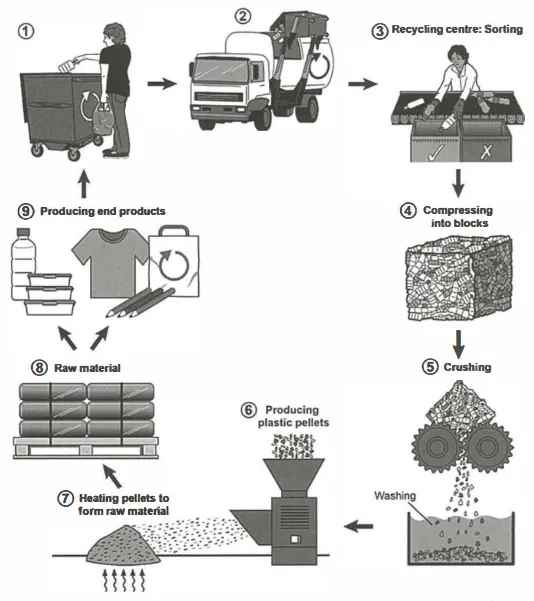
The diagram below shows the process for recycling plastic bottles.
Summarise the information by selecting and reporting the main features, and make comparisons where relevant.
How plastic bottles are recycled
Student answer (Band 5.0)
The given diagram illustrates the steps involved in producing recycled plastic bottles.
Overall, the process consists nine major steps, beginning with the disposal of plastic bottles and ending with the production of various types of recycled items.
At frist , consumers place plastic bottles into designed recycling bin and a truck pick them and transports them to a recycling centre. In the recycling centre , the wastes are sorted based on their usefulness. After that, the selected bottle are compressed into large blocks and then they are crushed into small peices and washed .
The small peices has undergo some machanical process
AI examiner evaluation
| Criterion | Band |
|---|---|
| Task Achievement / Task Response | 4.0 |
| Coherence and Cohesion | 5.5 |
| Lexical Resource | 5.5 |
| Grammatical Range and Accuracy | 5.0 |
| Overall | 5.0 |
Task Achievement / Task Response: Band 4.0
You identify the process as recycling and give a relevant opening and overview, including its start with bottle disposal and its circular nature. You also accurately describe collection, sorting, compression, crushing and washing. However, the account stops before explaining the later stages: producing pellets, heating them into raw material, making end products, and returning to the cycle. The overview also says the process ends with recycled items, although the diagram shows a loop. The response is substantially below the required minimum length, which contributes to the limited coverage. To improve, report the full sequence and clarify that the finished products can re-enter the recycling process.
Coherence and Cohesion: Band 5.5
The response has a basic, understandable progression: an introduction and overview are followed by the early stages in sequence. Connectors such as “Overall,” “After that,” and “then” help the reader follow the process. However, the final sentence is incomplete in its information, and the description ends abruptly rather than bringing the stages to a conclusion. Paragraphing is also limited, with the process details grouped into one paragraph. Organise the account into clear stages or paragraphs, use transitions to signal the later processing steps, and finish by linking the end products back to the beginning of the cycle.
Lexical Resource: Band 5.5
You use some task-relevant vocabulary, including “recycling centre,” “compressed,” “crushed,” and “washed,” which makes the early stages recognisable. There is some variation in how you describe the process, but the range is limited because the response covers only part of it. Several spelling errors—“frist,” “peices,” and “machanical”—are noticeable, and phrases such as “designed recycling bin” and “based on their usefulness” are not precise descriptions of the diagram. Use accurate process terms and check spelling carefully. Vocabulary for the omitted stages, such as “pellets,” “raw material,” and “end products,” would also help you describe the full sequence precisely.
Grammatical Range and Accuracy: Band 5.0
You attempt both simple sentences and a longer sequence joined with “and then,” but the range of structures is limited, and errors occur in basic sentence patterns. For example, “the process consists nine major steps” needs “consists of,” while “a truck pick them” has a subject–verb agreement error. In “the selected bottle are compressed,” the noun and verb do not agree, and “The small peices has undergo” contains errors in both the verb form and agreement. These problems sometimes make the final sentence difficult to interpret. Practise accurate present-simple descriptions of processes, checking articles, plurals, agreement and verb forms before adding more complex clauses.
See this exact question answered at other band scores. The same prompt compared across bands.
Browse more IELTS Writing model answers or get your own writing scored by the same AI examiner.