Band 4.0 IELTS Writing Task 1 Model Answer
Overall Band Score: 4.0 · Cambridge IELTS 16 · 2026-11-06
IELTS Writing Task 1 question
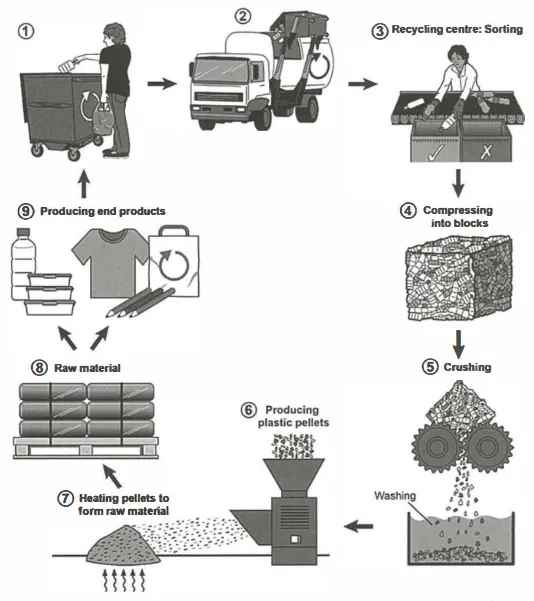
The diagram below shows the process for recycling plastic bottles.
Summarise the information by selecting and reporting the main features, and make comparisons where relevant.
How plastic bottles are recycled
Student answer (Band 4.0)
The given diagram demonstrates the process for renewing the plastic bottles,showing different procedures are required for recycling the plastic bottles.
Overall,it requires different procedures for recycling the plastic bottles.For instance,some of the compulsory things are recycling center,compressing into blocks,crushing,producing plastic pellets,washing and raw material.This shows the necessary needs that are required for recycling the bottles.
AI examiner evaluation
| Criterion | Band |
|---|---|
| Task Achievement / Task Response | 3.0 |
| Coherence and Cohesion | 4.5 |
| Lexical Resource | 4.5 |
| Grammatical Range and Accuracy | 4.5 |
| Overall | 4.0 |
Task Achievement / Task Response: Band 3.0
The response identifies the topic as plastic-bottle recycling and mentions several genuine stages, including sorting at a recycling centre, compressing, crushing, washing, pellet production and raw material. However, it does not summarise the process as a whole: the opening and overview repeat the same general point, while the collection, production of end products and return to the recycling bin are omitted. The claim that these are “compulsory things” does not explain the sequence or the closed-loop nature of the diagram. The response is also substantially below the required minimum length, leaving too little detail to select and report the main features. To improve, describe the stages in order and include the loop from discarded bottles to new products and back to recycling.
Coherence and Cohesion: Band 4.5
There is a basic overall structure: an introductory sentence is followed by a sentence beginning “Overall,” and the ideas remain related to the recycling process. The use of “For instance” also signals an example. However, the two sentences largely repeat one another rather than progressing through the stages, and the list of processes has no clear sequence or grouping. The overview does not distinguish the main stages or explain how they connect. Organise the response into an introduction, a concise overview of the complete cycle, and a chronological description using links such as “first,” “next,” and “finally.” This would create clearer progression and make relationships between stages easier to follow.
Lexical Resource: Band 4.5
The response uses relevant topic vocabulary, including “recycling center,” “compressing into blocks,” “crushing,” and “plastic pellets,” so the reader can recognise the subject. However, the range is narrow and several expressions are repetitive or imprecise. “Renewing the plastic bottles” is not a natural description of the process, while “necessary needs that are required” repeats the same idea without adding information. The repeated phrase “different procedures for recycling the plastic bottles” also limits variety. Use precise process vocabulary and verbs to describe what happens at each stage, such as bottles being collected, sorted, washed, processed into pellets and made into new products.
Grammatical Range and Accuracy: Band 4.5
The response communicates its general topic through two complete sentences, and the opening uses a participle clause in “showing different procedures are required.” However, sentence structures are limited, with no clear range of forms for describing a sequence or connecting stages. Punctuation spacing is also inconsistent: there is no space after commas in “bottles,showing” and “Overall,it.” The phrase “some of the compulsory things are…” is grammatically possible but does not form a clear, well-controlled description of the process. Practise writing accurate passive constructions suited to process diagrams, for example, “The bottles are collected and taken to a recycling centre,” and combine these with sequencing clauses.
See this exact question answered at other band scores. The same prompt compared across bands.
Browse more IELTS Writing model answers or get your own writing scored by the same AI examiner.