Band 6.0 IELTS Writing Task 1 Model Answer
Overall Band Score: 6.0 · Cambridge IELTS 16 · 2026-11-07
IELTS Writing Task 1 question
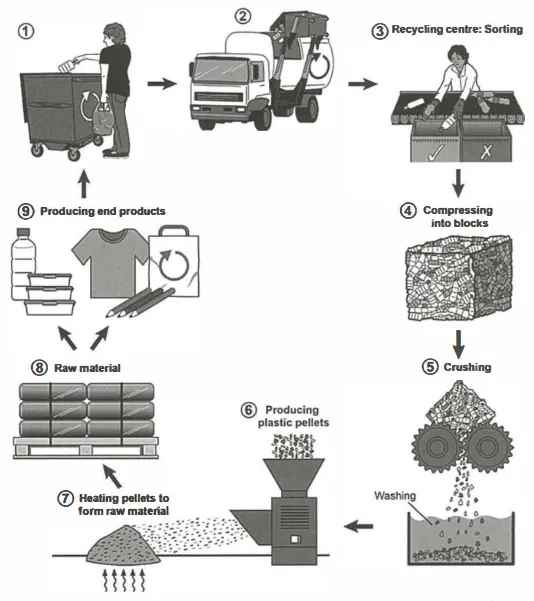
The diagram below shows the process for recycling plastic bottles.
Summarise the information by selecting and reporting the main features, and make comparisons where relevant.
How plastic bottles are recycled
Student answer (Band 6.0)
A very positive development which is recycling plastic bottles rising allover the world. The given chart shows the detailed process of bottle recycling.
Total of nine steps are shown in this framework of recyclation of plastic bottles. Some need machines to be completed and few require human hands.
Firstly, bottles are collected from trash bins. Afterwards in recycling centre a process called sorting is done. Then plastic is compressed into blocks which laterly, crushed and washed through machines. Good working machines plays an important role in entire process.
In addition, machines then produce plastic pellets which later on heated with specified temperature to form raw material. When raw material is completely made and ready for production of different products. It is deleivered to facotries for further fabrication. Specialization is also a vital measure for accomplishment of the process. As a result, different types of end products are crafted which fulfill the needs of society.
AI examiner evaluation
| Criterion | Band |
|---|---|
| Task Achievement / Task Response | 6.0 |
| Coherence and Cohesion | 6.0 |
| Lexical Resource | 5.5 |
| Grammatical Range and Accuracy | 5.5 |
| Overall | 6.0 |
Task Achievement / Task Response: Band 6.0
You identify the diagram as a nine-step recycling process and report several central stages in the correct order, including sorting, compressing, crushing, washing, pellet production and heating to create raw material. This gives the reader a generally accurate account of the main sequence. However, some details are unclear or not supported by the diagram: bottles are put into a recycling bin before collection by truck, rather than simply collected from “trash bins,” and the text does not say the raw material is delivered to factories. The opening claim about recycling “rising allover the world” describes a trend that the process diagram does not show. The final products are mentioned generally, but the overview could more clearly explain that they can re-enter the recycling cycle.
Coherence and Cohesion: Band 6.0
The response follows the process in a broadly logical order, and sequencing expressions such as “Firstly,” “Afterwards,” “Then” and “In addition” help guide the reader through the stages. The paragraphing also separates the introduction and overview from the process description. However, some links are mechanical or do not clarify the relationship between ideas. For example, “Good working machines plays an important role” interrupts the sequence without adding a specific stage, while “When raw material is completely made and ready for production of different products” is left as an incomplete thought before the next sentence. Grouping the stages into a clearer beginning, middle and end, and using transitions that show the actual process links, would make the progression easier to follow.
Lexical Resource: Band 5.5
You use relevant process vocabulary, including “sorting,” “compressed,” “crushed,” “washed,” “pellets” and “raw material,” which helps communicate the diagram’s main stages. There are also attempts at more formal wording, such as “fabrication” and “accomplishment.” However, several choices are inaccurate or unnatural for this task: “recyclation” is not the appropriate noun, “specified temperature” adds unsupported detail, and “specialization” does not describe a stage in the diagram. Spelling errors such as “deleivered” and “facotries,” along with “allover,” reduce accuracy. Aim for precise process terms and natural collocations rather than adding general claims or technical details not shown.
Grammatical Range and Accuracy: Band 5.5
The response attempts a mixture of simple and more complex sentence forms, including a relative clause in “which later on heated” and a time clause beginning “When.” The sequence is usually understandable, but some grammatical errors affect clarity. The opening, “A very positive development which is recycling plastic bottles rising,” is not a complete, well-formed sentence. In “Good working machines plays,” the plural subject requires a plural verb, and “When raw material is completely made…” is a dependent clause without a complete main clause. There are also problems with articles and sentence construction, as in “in recycling centre a process called sorting is done.” Build complete sentences around each stage and check subject–verb agreement, articles and clause boundaries.
See this exact question answered at other band scores. The same prompt compared across bands.
Browse more IELTS Writing model answers or get your own writing scored by the same AI examiner.