Band 5.5 IELTS Writing Task 1 Model Answer
Overall Band Score: 5.5 · Cambridge IELTS 16 · 2026-11-07
IELTS Writing Task 1 question
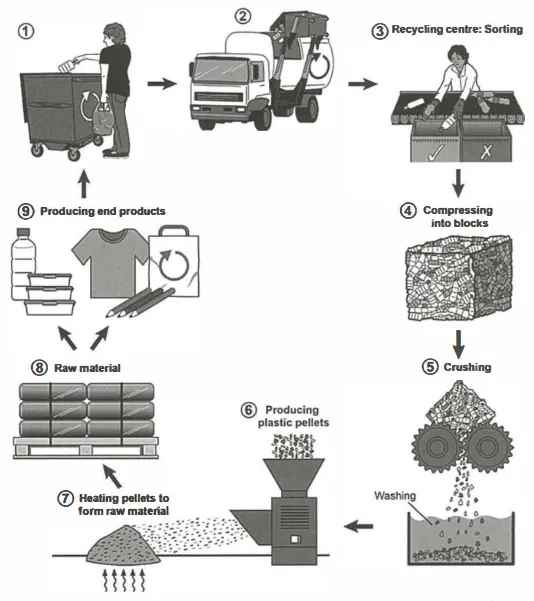
The diagram below shows the process for recycling plastic bottles.
Summarise the information by selecting and reporting the main features, and make comparisons where relevant.
How plastic bottles are recycled
Student answer (Band 5.5)
The diagram depicts the way how the plastic bottles are recycled for the products.
Overall, the process consists of nine stages, beginning with collecting used bottles and ending up with production and products.
First of all, The used bottles are collecting from a dustbin to use as a raw material, After that, a truck has shipped it to a recycling centre for sorting which has decided that which bottled can be used or not. Next, all the bottles put to compressing into blocks. Then it put them in a crushing machine , it has directly go for washing.
In the next stage, all those crushed bottles are producing plastic pellets by a machine and send those pellets for heating to use it as form of raw material. Following this, It has formed into raw material. Finally, by using the raw material, it undergo for production and products ,and it has made clothes, bottles and boxes also paper bag and pencils.
AI examiner evaluation
| Criterion | Band |
|---|---|
| Task Achievement / Task Response | 6.0 |
| Coherence and Cohesion | 6.0 |
| Lexical Resource | 5.5 |
| Grammatical Range and Accuracy | 5.0 |
| Overall | 5.5 |
Task Achievement / Task Response: Band 6.0
You cover the main stages and give a clear overall outline: the process has nine stages, starts with collecting bottles and ends with making products. The account also includes sorting, compression, crushing, washing, pellet production and heating, so it is relevant and broadly follows the diagram. However, some details are unclear or inaccurate. The opening says bottles are collected “from a dustbin to use as a raw material,” which skips the recycling bin and collection truck as distinct steps. The sorting decision is described vaguely, and the final products are not reported precisely: the diagram shows food containers and a carrier bag, rather than boxes and a paper bag. To strengthen the response, describe the stages more accurately and make the closed-loop return from products to the recycling bin explicit.
Coherence and Cohesion: Band 6.0
The response has a recognisable overall structure: an introduction, an overview and a chronological account of the process. Sequencing expressions such as “First of all,” “Next,” “In the next stage” and “Finally” help the reader follow the stages. However, the progression becomes less clear in places because several steps are compressed into long sentences, and the links between them are not always precise. For example, “Then it put them in a crushing machine, it has directly go for washing” combines crushing and washing without a clear grammatical or logical connection. The overview also says the process ends with production, without signalling that the diagram loops back to the start. Use clearer sentence boundaries and group the stages into a more deliberate sequence, including the return arrow.
Lexical Resource: Band 5.5
You use relevant process vocabulary, including “recycling centre,” “sorting,” “compressing,” “crushing,” “washing,” “pellets” and “raw material.” This gives the response an adequate range for describing the diagram. Some choices, however, are imprecise or unnatural, such as “the way how,” “a dustbin,” “which has decided,” and “production and products.” “Paper bag” also does not accurately name the carrier bag shown. Repetition of “bottles,” “raw material” and “products” limits flexibility, while phrases such as “it undergo for production” make the meaning harder to follow. Aim for accurate process collocations and vary references where possible, for example by using “the plastic” or “the material” after the bottles have been crushed.
Grammatical Range and Accuracy: Band 5.0
You attempt both simple and more extended sentences, and the sequence is generally understandable. However, some errors in verb forms, agreement, articles and sentence construction reduce accuracy. Examples include “The used bottles are collecting,” “a truck has shipped it,” and “it has directly go for washing”; these need passive forms such as “are collected,” “is transported” and “is sent.” The sentence “which has decided that which bottled can be used or not” also has an unclear clause structure and agreement. Capitalisation and punctuation are inconsistent, including the capitalised “The” after a comma and spaces before commas. To improve, use a consistent present simple passive for this process and check each sentence for a clear subject, verb and punctuation.
See this exact question answered at other band scores. The same prompt compared across bands.
Browse more IELTS Writing model answers or get your own writing scored by the same AI examiner.