Band 5.0 IELTS Writing Task 1 Model Answer
Overall Band Score: 5.0 · Cambridge IELTS 16 · 2026-11-12
IELTS Writing Task 1 question
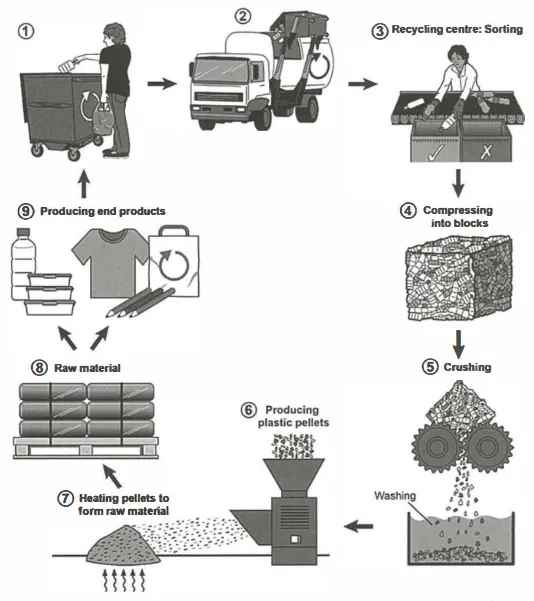
The diagram below shows the process for recycling plastic bottles.
Summarise the information by selecting and reporting the main features, and make comparisons where relevant.
How plastic bottles are recycled
Student answer (Band 5.0)
The given process chart shows how plastic is recycled and again used by individuals.
Overall, this process is complete in nine steps.
Firstly, the waste plastic is thrown into bin. Then all plastic is collected by the garbage van, after that plastic thrown in plastic center, and good plastic and bad plastic is seprated. Good plastic is compressed by the machine, convert into a box.After that it crushed with the machine, washed with clean water. Then crushed plastic put into the machine, it sperate good plastic. Then the plastic it heated and converted into raw material. Then from the new material produced new products.
AI examiner evaluation
| Criterion | Band |
|---|---|
| Task Achievement / Task Response | 5.0 |
| Coherence and Cohesion | 5.5 |
| Lexical Resource | 5.0 |
| Grammatical Range and Accuracy | 4.5 |
| Overall | 5.0 |
Task Achievement / Task Response: Band 5.0
You identify the diagram as a recycling process and report several central stages, including collection, sorting, compression, crushing, washing, heating and the production of new products. However, the account is only partial: it does not clearly describe the full closed loop, including how the end products return to consumers and can be recycled again. Some details are inaccurate or unclear, such as saying the crushed plastic is put into a machine that “separate[s] good plastic”; the diagram shows plastic pellets being produced at this point. The overview, “complete in nine steps,” gives a count but does not summarise the process’s main pattern. The response is also below the required 150 words, limiting the detail and coverage. Add a fuller overview and explain the stages and loop accurately.
Coherence and Cohesion: Band 5.5
The stages are presented in a broadly chronological order, and sequencing words such as “Firstly,” “Then” and “After that” help the reader follow the process. This gives the response some organisation. However, nearly all the information is placed in one paragraph, and the repeated use of “Then” makes the progression mechanical rather than smoothly connected. Some links between stages are unclear, particularly “Then crushed plastic put into the machine, it sperate good plastic,” where the relationship between the machine and pellet production is difficult to follow. Use separate paragraphs for the overview and process details, and vary linking expressions while making each transition explicit—for example, explain that washing is followed by pellet production, then heating.
Lexical Resource: Band 5.0
You use relevant process vocabulary, including “compressed,” “crushed,” “washed,” “raw material” and “products,” so the reader can recognise the general subject and several stages. However, the range is limited and some word choices are imprecise or repetitive. “Garbage van” is less suitable than “collection truck,” while “plastic center” does not clearly name the recycling centre. “Converted into a box” also misrepresents the diagram’s “blocks,” and “separate good plastic” is not an accurate description of producing pellets. Spelling errors such as “seprated” and “sperate” further reduce control. Build a more precise set of process terms and check spelling; accurate labels such as “sort,” “compress into blocks,” “pellets” and “end products” would make the account clearer.
Grammatical Range and Accuracy: Band 4.5
The response mainly uses simple sentences and attempts to connect stages with time clauses, as in “Then all plastic is collected … after that plastic thrown in plastic center.” These attempts show an effort to describe sequence, but the range is limited and errors occur frequently. Missing verbs and articles appear in phrases such as “plastic thrown” and “thrown into bin”; other clauses lack a clear subject or correct verb form, as in “Then crushed plastic put into the machine, it sperate good plastic.” The sentence “Good plastic is compressed by the machine, convert into a box” also shifts from a passive construction to an incomplete verb phrase. Practise complete passive sentences for process descriptions, such as “The bottles are sorted, compressed into blocks and then crushed,” and check articles, agreement and punctuation.
See this exact question answered at other band scores. The same prompt compared across bands.
Browse more IELTS Writing model answers or get your own writing scored by the same AI examiner.