Band 6.0 IELTS Writing Task 1 Model Answer
Overall Band Score: 6.0 · Cambridge IELTS 16 · 2026-11-12
IELTS Writing Task 1 question
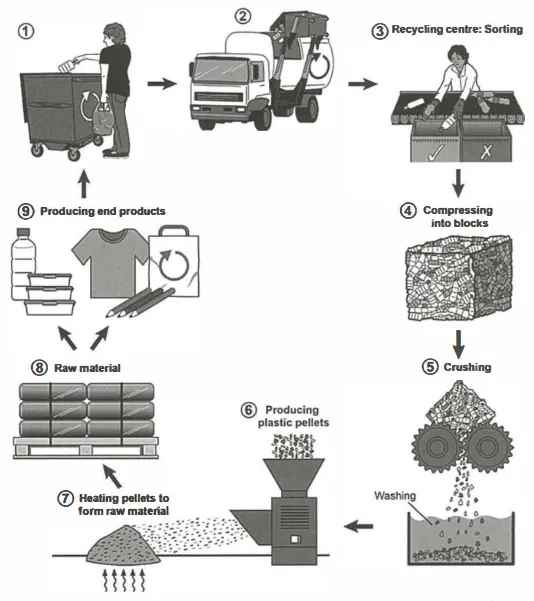
The diagram below shows the process for recycling plastic bottles.
Summarise the information by selecting and reporting the main features, and make comparisons where relevant.
How plastic bottles are recycled
Student answer (Band 6.0)
The digram illustrates the linear process by which used plastic bottles are collected and recycled into new products. Overall, there are nine main stages in this procedure, begining with the disposal of bottles by consumers and ending with the production of new items for sale
First, people throw their used plastic bottles into a recycling bin. A rubbish truck then collects these bottles by hand to seperate the suitable ones from other rubbish. Next, the selected bottles are compressed into large square blocks.
In the following stage, a machine crushes these blocks into small pieces, which are then washed in winter to remove dirt. After being cleaned, the plastic pieces are placed into a machine that turns them into small plastic pellets. These pellets are then heated to form raw material. Finally, this raw material is used in factorise to manufacture new products, such as clothes, bags, pencils, and new bottles, ready to be used again.
AI examiner evaluation
| Criterion | Band |
|---|---|
| Task Achievement / Task Response | 6.0 |
| Coherence and Cohesion | 6.5 |
| Lexical Resource | 6.0 |
| Grammatical Range and Accuracy | 6.0 |
| Overall | 6.0 |
Task Achievement / Task Response: Band 6.0
The response identifies the process as recycling used bottles into new products and gives a clear overall start and end point. It also reports most central stages in sequence, including sorting, compression, crushing, washing, pellet production and heating. However, some details are inaccurate or incomplete: the truck collects the bottles rather than separating them “by hand,” and the sorting stage—where unsuitable items are rejected—is not clearly described. The account also calls the process “linear,” although the diagram shows a closed loop, with end products returning to consumers for disposal. The examples of products are relevant, but the final stage could be explained more precisely as producing a range of end products from the raw material.
Coherence and Cohesion: Band 6.5
The information is arranged in a generally clear sequence, and the paragraphing separates the overview from the stage-by-stage account. Sequencing expressions such as “First,” “Next,” “In the following stage,” and “Finally” help the reader follow the process. This coherent progression meets the lower-band expectations well and shows some features of stronger organisation. However, the account presents the process as linear and does not connect the final products back to the recycling bin, so the diagram’s circular organisation is not fully conveyed. Some transitions also feel mechanical because the stages are mainly listed in order. A clearer overview of the loop, followed by grouped stages, would make the progression more complete and cohesive.
Lexical Resource: Band 6.0
The response uses an adequate range of process vocabulary, including “compressed,” “crushes,” “pellets,” and “raw material,” and these choices communicate the main stages. There are also attempts at more specific language, such as “large square blocks.” Some word-choice and spelling errors reduce precision: “digram,” “begining,” “seperate,” and “factorise” are misspelled, while “collected ... by hand” does not accurately describe the truck’s role. “Washed in winter” is an inappropriate phrase for the washing stage, and “new items for sale” adds a detail not shown in the diagram. More accurate collocations and careful proofreading would strengthen the vocabulary while preserving the clear meaning.
Grammatical Range and Accuracy: Band 6.0
The response uses a mix of simple and complex sentence forms, and several structures are handled effectively. For example, “After being cleaned, the plastic pieces are placed into a machine that turns them into small plastic pellets” combines a participle clause with a relative clause, while the passive forms suit a process description. Some grammatical and punctuation issues remain. The overview says “there are nine main stages ... begining,” where the participle should be “beginning”; the opening sentence also lacks a full stop after “sale.” The phrase “used in factorise to manufacture” has an incorrect grammatical form, and “ready to be used again” has an unclear reference. These errors rarely obstruct understanding, but more consistent sentence editing would improve accuracy.
See this exact question answered at other band scores. The same prompt compared across bands.
Browse more IELTS Writing model answers or get your own writing scored by the same AI examiner.