Band 6.5 IELTS Writing Task 1 Model Answer
Overall Band Score: 6.5 · Cambridge IELTS 16 · 2026-11-14
IELTS Writing Task 1 question
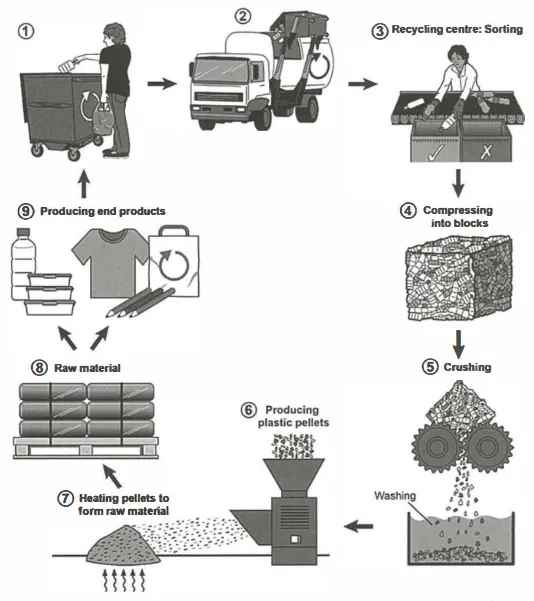
The diagram below shows the process for recycling plastic bottles.
Summarise the information by selecting and reporting the main features, and make comparisons where relevant.
How plastic bottles are recycled
Student answer (Band 6.5)
This process diagram illustrates the steps of recycling plastic bottles.
Overall, it goes through total nine steps to get the final product. It starts with storage and collection of plastic bottles, then crushing, washing and producing raw material into recycling centres.
Firstly, users discard their used plastic bottles into the recycled bins and waste trucks carry them from the collection points. After reaching recycling centres, these are manually separted by workers: the reusable bottles are stored in a box and in another box distorted ones are collected. Then all these reusable bottles are compressed into blocks, and later this block passes through crushing machine. The crushed pieces are collected into a water tank and consequently they are washed throughly into this tank. Following the washing, these pieces are entered into a processor and converted to plastic pellets. These plastic pelletes are heated and converted raw materials. Subsequently, we get the final end products like tshirt, statationary items from the raw materials.
AI examiner evaluation
| Criterion | Band |
|---|---|
| Task Achievement / Task Response | 6.5 |
| Coherence and Cohesion | 7.0 |
| Lexical Resource | 6.0 |
| Grammatical Range and Accuracy | 5.5 |
| Overall | 6.5 |
Task Achievement / Task Response: Band 6.5
You identify the process as having nine stages and describe most of its main sequence, from putting bottles in bins through sorting, compressing, crushing, washing, pellet production and heating. The examples of end products also match the diagram. This gives the report a clear, relevant overview. However, the overview is not fully accurate: the process does not simply end with products; it forms a loop, with end products leading back to the start. The sorting description also suggests that reusable bottles are stored while “distorted ones” are collected, whereas the diagram shows accepted and rejected items being separated. To strengthen the response, make the circular nature explicit and describe the raw-material stage and return to the beginning more precisely; some later stages are currently less fully reported than the earlier ones.
Coherence and Cohesion: Band 7.0
The response is organised in a clear order: an introduction and overview are followed by a chronological account of the stages. Sequencing expressions such as “Firstly,” “After reaching,” “Then,” “Following the washing,” and “Subsequently” help the reader follow the process. The progression is generally logical, and the use of a separate overview paragraph is effective. Some links are less precise, however. “Then all these reusable bottles” is unclear because the previous sentence distinguishes accepted bottles from rejected ones, and “into this tank” repeats information without adding much. The final sentence also stops at the products rather than linking them back to the first stage. Clearer referencing and a final link that reflects the diagram’s loop would make cohesion more flexible and complete.
Lexical Resource: Band 6.0
You use an adequate range of process vocabulary, including “compressed,” “crushing machine,” “water tank,” “processor,” and “plastic pellets,” so the stages are usually understandable. There are also useful attempts at more specific wording, such as “manually separated” and “converted.” However, several choices are inaccurate or unnatural: “storage” does not describe the first stage, “waste trucks” is not the same as recycling collection trucks, and “distorted ones” is unclear for rejected bottles. Spelling errors in “separted,” “throughly,” “pelletes,” and “statationary” also reduce accuracy. Choose precise process terms and check spelling; for example, use “collection truck,” “rejected bottles,” and “stationery” where appropriate.
Grammatical Range and Accuracy: Band 5.5
You attempt a mix of simple and more complex sentences, including clauses beginning “After reaching recycling centres” and “Following the washing,” and the overall meaning is generally clear. Some grammatical errors remain, particularly with articles, verb forms and sentence construction. For example, “it goes through total nine steps” needs an article or a different structure, while “these pieces are entered into a processor” uses an awkward passive pattern. In “These plastic pellets are heated and converted raw materials,” the second verb needs “into” before its complement. The overview phrase “producing raw material into recycling centres” also has an unclear grammatical relationship. Review articles and prepositions in process descriptions, and check that each passive verb has a complete, accurate complement.
See this exact question answered at other band scores. The same prompt compared across bands.
Browse more IELTS Writing model answers or get your own writing scored by the same AI examiner.