Band 5.5 IELTS Writing Task 1 Model Answer
Overall Band Score: 5.5 · Cambridge IELTS 16 · 2026-11-15
IELTS Writing Task 1 question
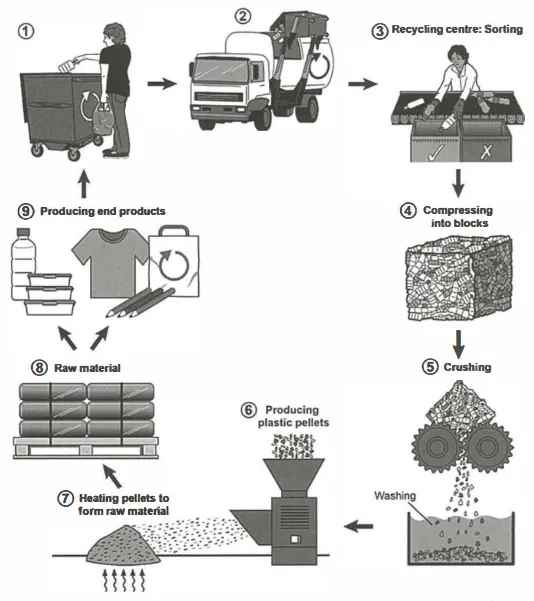
The diagram below shows the process for recycling plastic bottles.
Summarise the information by selecting and reporting the main features, and make comparisons where relevant.
How plastic bottles are recycled
Student answer (Band 5.5)
The diagram illustrates the process for recycling plastic bottles.
Overall, the process has nine distinct stages, beginning with the people throw the plastic bottles into garage bin and ending with producing make different raw materials.
initially, the plastic bottles throw into garage bin, after that recycle bin loading into truck.The plastic bottles send to recycling center.Next process the individuals sorting the bottles into boxes.After that the four process starting comprehensive into bloock, subsequently the cutting machine crusting the bottles into small pieces.
Secondly, the bottles pieces is wasting into water,after that send into the plastic pallets are producling.A few time plastic pallets provide heating into small bottle pieces.ultimately, the bottle pieces are packing to make various form of raw materials. finally, the raw materials are producing different products, such shirts, pencils, lunch boxes, plastic bags and plastic bottles.These products utilize again in supermarket, hospitals,companies, factories and even in the houses
AI examiner evaluation
| Criterion | Band |
|---|---|
| Task Achievement / Task Response | 6.0 |
| Coherence and Cohesion | 5.5 |
| Lexical Resource | 5.0 |
| Grammatical Range and Accuracy | 4.5 |
| Overall | 5.5 |
Task Achievement / Task Response: Band 6.0
You cover the main stages of the recycling cycle, including collection, sorting, compression, crushing, washing, pellet production, heating, and the creation of new products. The overview also identifies a beginning and an end, although it inaccurately says the process ends with “producing make different raw materials”; the diagram shows raw material being made before end products, and the cycle then returns to bottle disposal. Some details are reported unclearly: for example, the diagram shows bottles sorted into accepted and rejected groups, but this distinction is not explained. The final claim that products are used in supermarkets, hospitals, companies, factories, and homes is not shown in the visual. A more accurate overview and closer selection of diagram-supported details would make the account more complete.
Coherence and Cohesion: Band 5.5
The response follows the general order of the process and uses sequencing expressions such as “initially,” “after that,” “subsequently,” and “ultimately.” This gives the reader a basic sense of progression. However, the stages are crowded into one long paragraph after the overview, and several transitions are repetitive or awkward, including “after that” and “finally.” The shift from “Secondly” to “ultimately” does not clearly mark the sequence, while the final sentence about where products are used feels detached from the process. Separate the description into clear stages or paragraphs, and use precise links to show how each material changes and moves to the next step.
Lexical Resource: Band 5.0
You attempt vocabulary relevant to the process, including “recycling center,” “sorting,” “raw materials,” and “various form of raw materials.” However, inaccurate word choice and spelling sometimes make the process difficult to understand. For example, “garage bin” does not describe the recycling bin shown, “comprehensive” appears to be intended as “compressing,” and “crusting” is used where “crushing” is needed. “Plastic pallets” is also confused with “plastic pellets,” and “wasting into water” does not clearly express washing. These errors show that the vocabulary range is not yet controlled consistently. Prioritise accurate process terms and check spelling and collocations; repeating a correct technical term is better than using an uncertain substitute.
Grammatical Range and Accuracy: Band 4.5
The response attempts both simple and longer sentences, but control of sentence structure and verb forms is weak. For example, “the people throw the plastic bottles” and “the plastic bottles throw into garage bin” omit the grammatical forms needed to describe the process; passive constructions such as “bottles are thrown into a recycling bin” would be appropriate. Agreement and verb forms are also problematic in “the bottles pieces is wasting” and “the raw materials are producing different products.” Several sentences run together without reliable punctuation, as in “after that recycle bin loading into truck.The plastic bottles send to recycling center.” These errors often make relationships between actions unclear. Practise consistent present-simple passive forms and punctuate each stage as a complete sentence.
See this exact question answered at other band scores. The same prompt compared across bands.
Browse more IELTS Writing model answers or get your own writing scored by the same AI examiner.