Band 5.5 IELTS Writing Task 1 Model Answer
Overall Band Score: 5.5 · Cambridge IELTS 16 · 2026-11-17
IELTS Writing Task 1 question
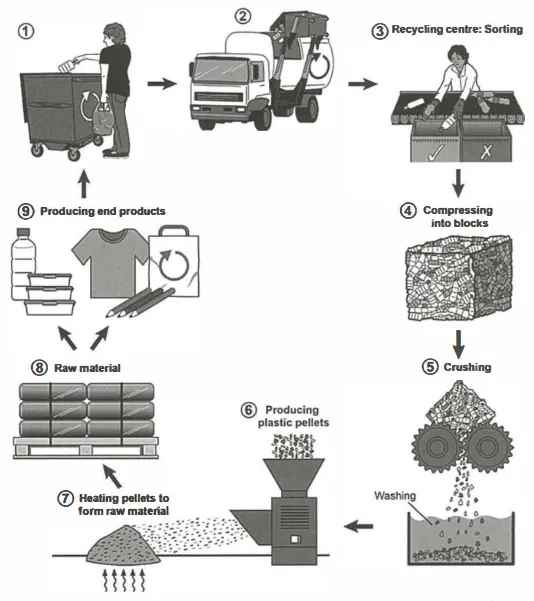
The diagram below shows the process for recycling plastic bottles.
Summarise the information by selecting and reporting the main features, and make comparisons where relevant.
How plastic bottles are recycled
Student answer (Band 5.5)
The process diagram illustrates the process for recycling plastic materials.
Overall, it is a linear process and its contain nine steps strating from waste into bins, then crushing with the help of cutter and the last, it is used to made products.
Looking at the diagram in more detail, collecting all waste materials from bin and then, moved into recycling centers with the help of vehicles. At the third stage, recyling center seprate plastic bottle from all waste. Subsequently, the plastic waste compressing into blocks ant at the next stage, washed all tiny particles which are crushing by two blades.
At the six stage, all the tine wash particles put into machine and produced plastic pellets by machine. Following by, give heat to pellets which is used to make raw material and then pack all raw material into packing and at the last stage, raw materials is use to producing end products like, lunch boxes, clothes, stationary things etc.
AI examiner evaluation
| Criterion | Band |
|---|---|
| Task Achievement / Task Response | 6.0 |
| Coherence and Cohesion | 6.0 |
| Lexical Resource | 5.5 |
| Grammatical Range and Accuracy | 5.0 |
| Overall | 5.5 |
Task Achievement / Task Response: Band 6.0
You cover the main stages, from placing bottles in a bin and collection to sorting, compressing, washing, pellet production, heating, and making end products. The examples of final products also reflect the diagram. However, the overview says the process is “linear,” whereas the diagram shows a closed loop, with end products returning to the first stage for recycling. This is a significant misreading of the overall process. Some details are also unclear or inaccurate: the diagram shows sorting bottles into accepted and rejected groups, but this distinction is not explained, and the account of washing and crushing is difficult to follow. A more accurate overview and clearer description of the sorting and loop would strengthen the response.
Coherence and Cohesion: Band 6.0
The response has a recognisable structure: an introduction, an overview, and a paragraph describing the stages in sequence. Sequencing expressions such as “At the third stage,” “Subsequently,” and “At the six stage” help the reader follow the process. However, cohesion is sometimes mechanical, with several stages linked by repeated “and then” or “at the next stage.” Some connections are unclear, particularly “washed all tiny particles which are crushing by two blades,” where the relationship between crushing and washing is hard to establish. The overview’s description of a “linear process” also conflicts with the later sequence and weakens the overall progression. Use clearer stage-to-stage links and organise the process into meaningful phases.
Lexical Resource: Band 5.5
You use relevant process vocabulary, including “compressing into blocks,” “plastic pellets,” “raw material,” and “end products,” which allows you to describe the main stages. There is also some variety in the verbs used to report the sequence. However, spelling and word-choice errors are noticeable, for example “strating,” “recyling,” “seprate,” and “stationary things.” Some phrases are imprecise or unnatural, such as “tiny wash particles,” “give heat to pellets,” and “pack all raw material into packing.” These choices sometimes make the process difficult to picture. Aim for accurate technical wording and natural collocations, such as “washed plastic fragments,” “the pellets are heated,” and “packaged raw material.”
Grammatical Range and Accuracy: Band 5.0
You attempt both simple and more extended sentence forms, and the sequence is generally understandable. However, errors in verb forms, agreement, and sentence construction occur in several places. For example, “its contain nine steps” needs a correctly formed verb, while “the plastic waste compressing into blocks” lacks an appropriate passive verb form. In “raw materials is use to producing end products,” the verb does not agree with the plural subject and the following verb pattern is incorrect. Some sentences also omit necessary articles or use unclear clause structures, as in “collecting all waste materials from bin and then, moved into recycling centers.” Practise consistent passive constructions for process descriptions and check subject–verb agreement and complete sentence structure.
See this exact question answered at other band scores. The same prompt compared across bands.
Browse more IELTS Writing model answers or get your own writing scored by the same AI examiner.