Band 5.5 IELTS Writing Task 1 Model Answer
Overall Band Score: 5.5 · Cambridge IELTS 16 · 2026-11-18
IELTS Writing Task 1 question
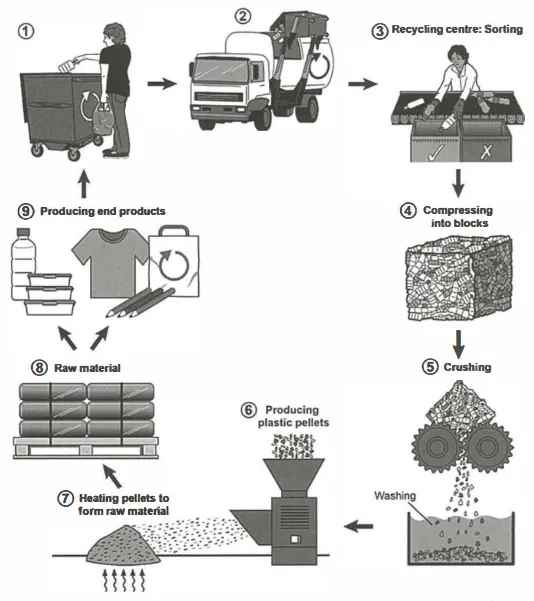
The diagram below shows the process for recycling plastic bottles.
Summarise the information by selecting and reporting the main features, and make comparisons where relevant.
How plastic bottles are recycled
Student answer (Band 5.5)
The diagram here shows the process of recycling plastic bottles.
It is correct to state that recycling of plastic products is environmentally friendly and also good for economy.
The diagram shows a man is collecting the bottles from the dustin. This bottles are then transported to the factories where the recycling of these products are being done. Here, in the recycling centre the process of sorting of these plastic bottles are done. The bottles which are in good condition to recycle are taken to further process and which are not in good condition are taken to another route. Further, these bottles are compress into blocks for smooth and handleable process ahead. These blocks then go through the crushing process where the bottles transfers into small granual particles. The particles of the bottles are poured into water for washing. These washed particles of the plastic bottles are grind into machine to produce plastic pellets. Moreover, heating of these pellets are done to form the raw material. The raw material which is now ready to make or produce another plastic bottle or plastic bag or anything . Which is again reused and collected from the bin to produce another one. Like the process continues, so called it as cycle.
AI examiner evaluation
| Criterion | Band |
|---|---|
| Task Achievement / Task Response | 5.5 |
| Coherence and Cohesion | 5.5 |
| Lexical Resource | 5.5 |
| Grammatical Range and Accuracy | 5.0 |
| Overall | 5.5 |
Task Achievement / Task Response: Band 5.5
You cover the main sequence from putting bottles in a bin through sorting, compressing, crushing, washing, pellet production and heating, and you recognise that the process repeats. However, some details are inaccurate or unclear: the diagram shows a collection truck transporting bottles, not a man collecting them, and the sorting stage separates recyclable items from those rejected rather than simply bottles in good or poor condition. The overview is also weakened by the unrelated claim that recycling is environmentally friendly and good for the economy, which is not shown in the diagram. The account omits the final stage of producing a range of end products before the loop returns to the bin. A concise overview and more precise coverage of the complete cycle would strengthen the response.
Coherence and Cohesion: Band 5.5
The stages are generally presented in the correct order, and phrases such as “These blocks then” and “Moreover” help connect some steps. The reader can follow the broad process, but the response is written as one long paragraph and lacks a clear overview separated from the detailed stages. Some links are awkward or unclear, particularly “which are not in good condition are taken to another route” and the fragment beginning “The raw material which is now ready”. The ending repeats the idea of reuse rather than clearly explaining how end products return to the recycling bin. Organise the response into an overview and a chronological description, and use references that make each stage’s connection explicit.
Lexical Resource: Band 5.5
You use several relevant process terms, including “sorting”, “compress into blocks”, “crushing”, “washing”, “plastic pellets” and “raw material”, so the reader can identify many stages. However, vocabulary is sometimes imprecise or incorrectly formed, which makes parts of the process harder to understand. For example, “dustin” is not the appropriate term for the recycling bin, “granual particles” is unclear, and “handleable process” is an unnatural description. “Grind into machine” also does not clearly express that the plastic is processed to produce pellets. Aim for accurate, natural collocations and check spelling and word forms. More precise terms for the rejected items and the final products would also help you report the diagram faithfully.
Grammatical Range and Accuracy: Band 5.0
The response attempts both simple and longer sentences, including clauses with “where” and “which”, but the longer structures are often faulty and errors occur throughout. Examples include “This bottles are then transported”, “the process … are done”, and “these bottles are compress into blocks”, which show problems with agreement, articles, plurals and verb forms. The sentence “The raw material which is now ready to make or produce another plastic bottle…” is incomplete, while several sentences use passive constructions inconsistently. Punctuation and spacing also make some sentences difficult to read. Practise forming complete sentences with a clear subject and verb, and check agreement and tense in each clause. Shorter, accurate sentences would make the process easier to follow.
See this exact question answered at other band scores. The same prompt compared across bands.
Browse more IELTS Writing model answers or get your own writing scored by the same AI examiner.