Band 5.0 IELTS Writing Task 1 Model Answer
Overall Band Score: 5.0 · Cambridge IELTS 16 · 2026-11-19
IELTS Writing Task 1 question
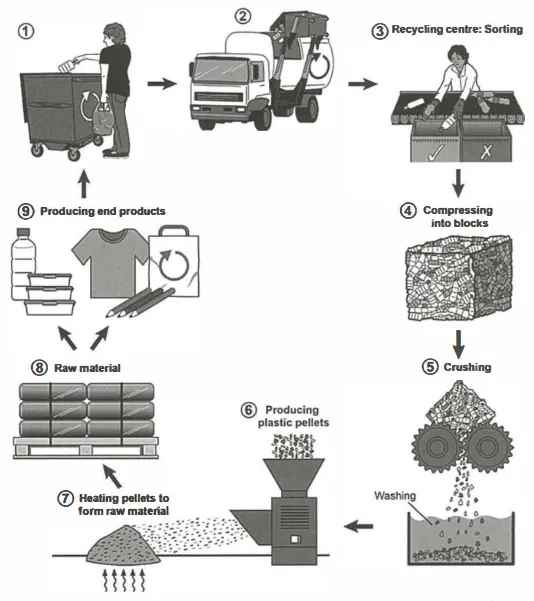
The diagram below shows the process for recycling plastic bottles.
Summarise the information by selecting and reporting the main features, and make comparisons where relevant.
How plastic bottles are recycled
Student answer (Band 5.0)
The given diagram illustrates information about the process for recycling plastic bottles.
Overall, it is clear that the diagrams there are shows the nine stages for the process of recelling bottles.First man was collection the bottle of dustbin and shift to the collecting van to transfer another place.After that van transfer the bottles recycling center man collecting the bottle in sorting box,then bottles shift to the compressing blocks bottle were collecting the a big box.moving the next step a big weight crashing the bottles two blades crush the bottle and made the shape or powder then a big tank fill up the water and washing the material.moving on the next step crush material moving the next mechine producing plastic pellets and small pieces of crush bottles material shift the heating zoon and made the raw material.After that made the raw material in good shapes then raw material use the different things pencils shirts and again made the plastic bottles.
AI examiner evaluation
| Criterion | Band |
|---|---|
| Task Achievement / Task Response | 5.5 |
| Coherence and Cohesion | 5.5 |
| Lexical Resource | 5.0 |
| Grammatical Range and Accuracy | 4.5 |
| Overall | 5.0 |
Task Achievement / Task Response: Band 5.5
You identify the subject and attempt to describe the process from bottle disposal through collection, sorting, processing and the creation of new products. The reference to “nine stages” and the final return to making plastic bottles show awareness of the overall cycle. However, the overview is unclear, and several important details are incomplete or inaccurate: the sorting stage separates acceptable bottles from rejected items, while the response says only that bottles are collected “in sorting box.” The sequence of compressing, crushing, washing, pellet production and heating is partly reported, but the raw material stage and the range of end products are not clearly explained. To strengthen the summary, give a concise overview of the closed loop and describe each major stage accurately, without adding unclear details such as a “big weight.”
Coherence and Cohesion: Band 5.5
The response follows the broad order of the diagram, moving from disposal and collection to sorting, processing and new products. This gives the reader some sense of progression, and phrases such as “After that” and “moving on the next step” attempt to connect stages. However, the writing is presented as one long paragraph, and the repeated transitions make the sequence feel mechanical rather than clearly organised. Several links between ideas are difficult to follow, especially “then a big tank fill up the water” and “After that made the raw material in good shapes.” Use separate paragraphs for the overview and process details, and group related stages into clear sentences. More precise linking expressions and clearer references to the material at each stage would improve the flow.
Lexical Resource: Band 5.0
You use some relevant process vocabulary, including “recycling center,” “compressing blocks,” “crushing,” “washing,” “plastic pellets” and “raw material.” These terms show that you can identify several key stages. However, the range is limited, and repeated general words such as “bottle,” “material” and “made” reduce precision. Some choices are inaccurate or unclear: “dustbin” does not describe the recycling bin precisely here, “a big weight” is not the crushing equipment shown, and “heating zoon” is difficult to understand. Spelling and word-form errors, including “recelling” and “mechine,” also affect clarity. Build a more accurate process vocabulary and check spelling; for example, describe bottles being compressed into blocks and then crushed into small pieces.
Grammatical Range and Accuracy: Band 4.5
The response attempts to connect stages using longer sequences, but most sentences rely on simple patterns, and attempts to form more complex sentences are often faulty. Errors in verb forms and agreement appear throughout, as in “the diagrams there are shows,” “First man was collection,” and “a big tank fill up the water.” Articles and sentence boundaries are also inconsistent, making some relationships hard to follow; for example, “then raw material use the different things” does not clearly show what happens to the material. Use a consistent present simple for process descriptions, with a clear subject and verb in each clause: “The bottles are collected and taken to a recycling centre.” Practise accurate passive forms and divide long sequences into complete sentences.
See this exact question answered at other band scores. The same prompt compared across bands.
Browse more IELTS Writing model answers or get your own writing scored by the same AI examiner.