Band 6.0 IELTS Writing Task 1 Model Answer
Overall Band Score: 6.0 · Cambridge IELTS 16 · 2026-11-21
IELTS Writing Task 1 question
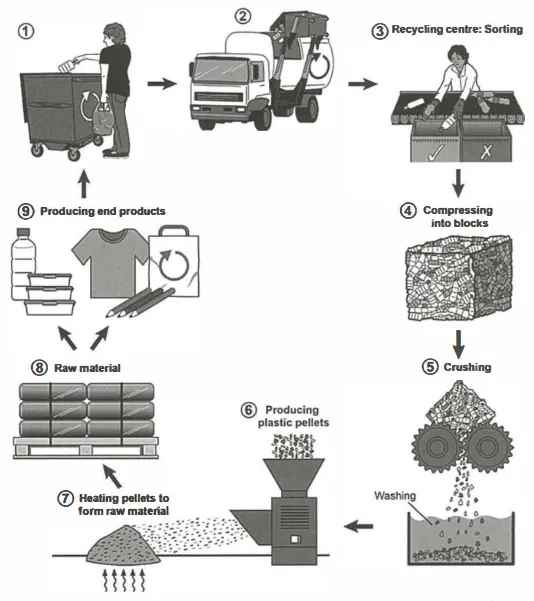
The diagram below shows the process for recycling plastic bottles.
Summarise the information by selecting and reporting the main features, and make comparisons where relevant.
How plastic bottles are recycled
Student answer (Band 6.0)
The given diagram represents the process of recycling plastic bottles. There are a total of nine steps.
Firstly, plastic bottles are dumped in garbage bags or garbage carts. Then a truck comes to pick up the garbage. It is taken to the recycling centre to sort plastic items on one side and items which cannot be recycled on the other side. Then, the plastic bottles are taken out they are compressed into blocks. Later, they are crushed by a crushing machine. They form into small pieces which are washed to make sure all the dirt has gone. Later, the washed pieces are kept in a machine to produce plastic pallets which are then heated to form raw materials. End products like pencils, tshirts, bags, etc. are produced from raw materials.
To conclude, the nine step process starts from throwing out garbage to producing end materials. The process is very smooth and eco-friendly.
AI examiner evaluation
| Criterion | Band |
|---|---|
| Task Achievement / Task Response | 6.0 |
| Coherence and Cohesion | 6.5 |
| Lexical Resource | 5.5 |
| Grammatical Range and Accuracy | 5.5 |
| Overall | 6.0 |
Task Achievement / Task Response: Band 6.0
You identify the diagram as a nine-step recycling process and report most of its main stages in a generally accurate order, including sorting, compressing, crushing, washing, pellet production and heating. The examples of end products also reflect the diagram. However, some details are inaccurate or omitted: bottles are put into a recycling bin, not “garbage bags or garbage carts,” and the account skips the stage where the heated material becomes raw material before it is used to make new products. The overview is also limited: “starts from throwing out garbage to producing end materials” does not clearly explain that the process forms a loop, with new products returning to use. A more precise overview and fuller coverage of this circular feature would make the report more complete.
Coherence and Cohesion: Band 6.5
The stages are presented in a mostly logical sequence, and time markers such as “Firstly,” “Then,” and “Later” help the reader follow the process. The opening and concluding sentences also give the response a recognisable structure. This is a coherent overall arrangement, though the repeated use of “Then” and “Later” makes the progression somewhat mechanical. Some links between stages could be clearer: for example, “Then, the plastic bottles are taken out they are compressed into blocks” joins two actions without a clear connector or punctuation. The final sentence about the process being “smooth and eco-friendly” adds an unsupported evaluation rather than summarising the cycle. Use clearer paragraphing and varied, precise links to show how each stage leads to the next.
Lexical Resource: Band 5.5
You use enough process-related vocabulary to communicate the main sequence, including “recycling centre,” “compressed,” “crushed,” “washed,” and “raw materials.” However, several choices are imprecise or inaccurate for this diagram. “Garbage bags or garbage carts” does not describe the recycling bin shown, and “plastic pallets” appears to be a mistaken word for “plastic pellets.” “End materials” is also less precise than “end products,” while “dirt has gone” is informal compared with “dirt has been removed.” The range is adequate for the topic, but repeated general words such as “pieces” and “produced” limit precision. Aim for accurate process terminology and more formal collocations, checking spelling carefully where a single letter changes the meaning.
Grammatical Range and Accuracy: Band 5.5
The response includes both simple sentences and some longer structures, such as “It is taken to the recycling centre to sort plastic items…” and “plastic pallets which are then heated…”. Most of the process remains understandable, but some sentence boundaries and clause structures need better control. In “Then, the plastic bottles are taken out they are compressed into blocks,” two independent clauses are joined without punctuation or a linking word. “It is taken to the recycling centre to sort…” also leaves the reference of “it” unclear and makes the purpose structure awkward. The final sentence, “The process is very smooth and eco-friendly,” is grammatically sound but does not add useful process information. Practise combining stages with accurate relative clauses and passive forms, while checking punctuation between complete clauses.
See this exact question answered at other band scores. The same prompt compared across bands.
Browse more IELTS Writing model answers or get your own writing scored by the same AI examiner.