Band 5.5 IELTS Writing Task 1 Model Answer
Overall Band Score: 5.5 · Cambridge IELTS 16 · 2026-11-21
IELTS Writing Task 1 question
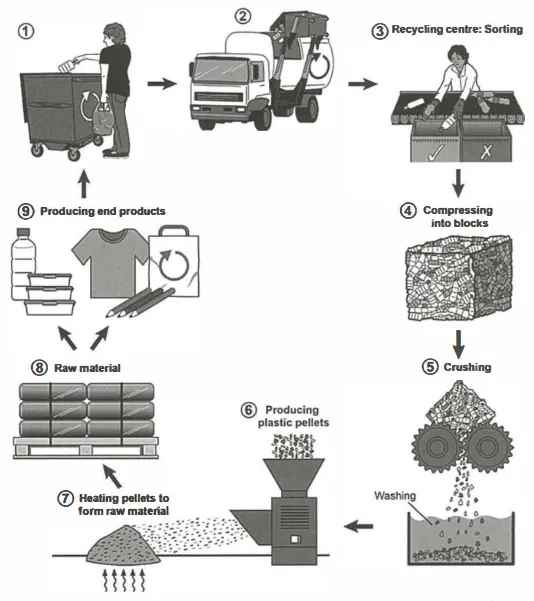
The diagram below shows the process for recycling plastic bottles.
Summarise the information by selecting and reporting the main features, and make comparisons where relevant.
How plastic bottles are recycled
Student answer (Band 5.5)
The diagram below illustrate the procedure of recycling of plastic bottles and make new product from plastic like T shirts , pencils and plastic bags.
Overall, the recycling of plastic is a major process consisting of several step to complete its recycling and we made different useful item from plastic like T shirt, lunch boxes and plastic bags and new bottles. The recycling of bottles is very useful for future use.
The plastic bottles are collected from dust bin and basket to use it for further procedure. A big trash truck collected all the plastic. The next person starts sorting the bottles, after this the bottles are compressed into big blocks the blocks are then crushed and washed. After washing the their is a machine that produced plastic pellets.
The plastic pellets are heated in a moderate temperature to form raw material. Than the final steps is this raw material are than converted into different useful products like plastic bags, T shirts, pencils and lunch boxes etc.
AI examiner evaluation
| Criterion | Band |
|---|---|
| Task Achievement / Task Response | 6.0 |
| Coherence and Cohesion | 6.0 |
| Lexical Resource | 5.5 |
| Grammatical Range and Accuracy | 5.0 |
| Overall | 5.5 |
Task Achievement / Task Response: Band 6.0
You cover the main stages from collection and sorting through processing to the production of new goods, and your overview identifies the process as a cycle that creates useful items. The examples of “T shirts, pencils and plastic bags” are supported by the diagram. However, some details are imprecise or added without support: bottles are placed in a recycling bin, rather than collected from a “dust bin and basket,” and the diagram does not specify a “moderate temperature.” The overview could also make the closed-loop nature clearer by noting that end products can return to the recycling bin. Some stages, such as the collection truck and sorting out unsuitable bottles, are mentioned but not fully explained. A more precise overview and fuller coverage of the loop would strengthen the report.
Coherence and Cohesion: Band 6.0
The response has a clear overall arrangement: an introduction and overview are followed by the collection and processing stages, then the final conversion into products. Sequencing words such as “The next,” “after this,” and “After washing” help the reader follow the process. However, the progression is sometimes mechanical, and the final return arrow to the start is not explained, so the cycle is not fully connected in the account. Some references are also unclear, as in “after washing the their is a machine,” where the relationship between the washing stage and pellet production is difficult to follow. Grouping the stages into clearer sentences and using precise links such as “subsequently” or “finally, the cycle returns to…” would improve cohesion.
Lexical Resource: Band 5.5
You use a relevant range of process vocabulary, including “sorting,” “compressed,” “crushed,” “washed,” “plastic pellets,” and “raw material,” which allows the main stages to be understood. There are also suitable examples of end products. However, several word choices and collocations are inaccurate or informal, such as “dust bin and basket,” “big trash truck,” and “different useful item.” Repetition of “plastic” and “useful” also limits flexibility, while “procedure” is used where “process” would sound more natural. Aim for precise terms that match the diagram and vary descriptions of the stages and outputs. For example, “collection truck” and “a range of products” would be clearer and more appropriate for an academic process report.
Grammatical Range and Accuracy: Band 5.0
You attempt both simple and longer sentences, and the sequence of actions is generally understandable. However, errors in agreement, verb forms, articles, and sentence construction occur across the response. Examples include “The diagram below illustrate” and “several step,” where subject–verb agreement and plural forms are incorrect, and “A big trash truck collected,” which shifts into the past tense despite the process being described in the present. The sentence “the final steps is this raw material are than converted” contains several grammatical problems that obscure the relationship between the stages. There are also punctuation and spacing issues, such as “T shirts , pencils.” Practise consistent present passive forms, for example, “the bottles are collected” and “the material is converted,” and proofread each sentence for agreement.
See this exact question answered at other band scores. The same prompt compared across bands.
Browse more IELTS Writing model answers or get your own writing scored by the same AI examiner.