Band 6.0 IELTS Writing Task 1 Model Answer
Overall Band Score: 6.0 · Cambridge IELTS 19 · 2026-11-12
IELTS Writing Task 1 question
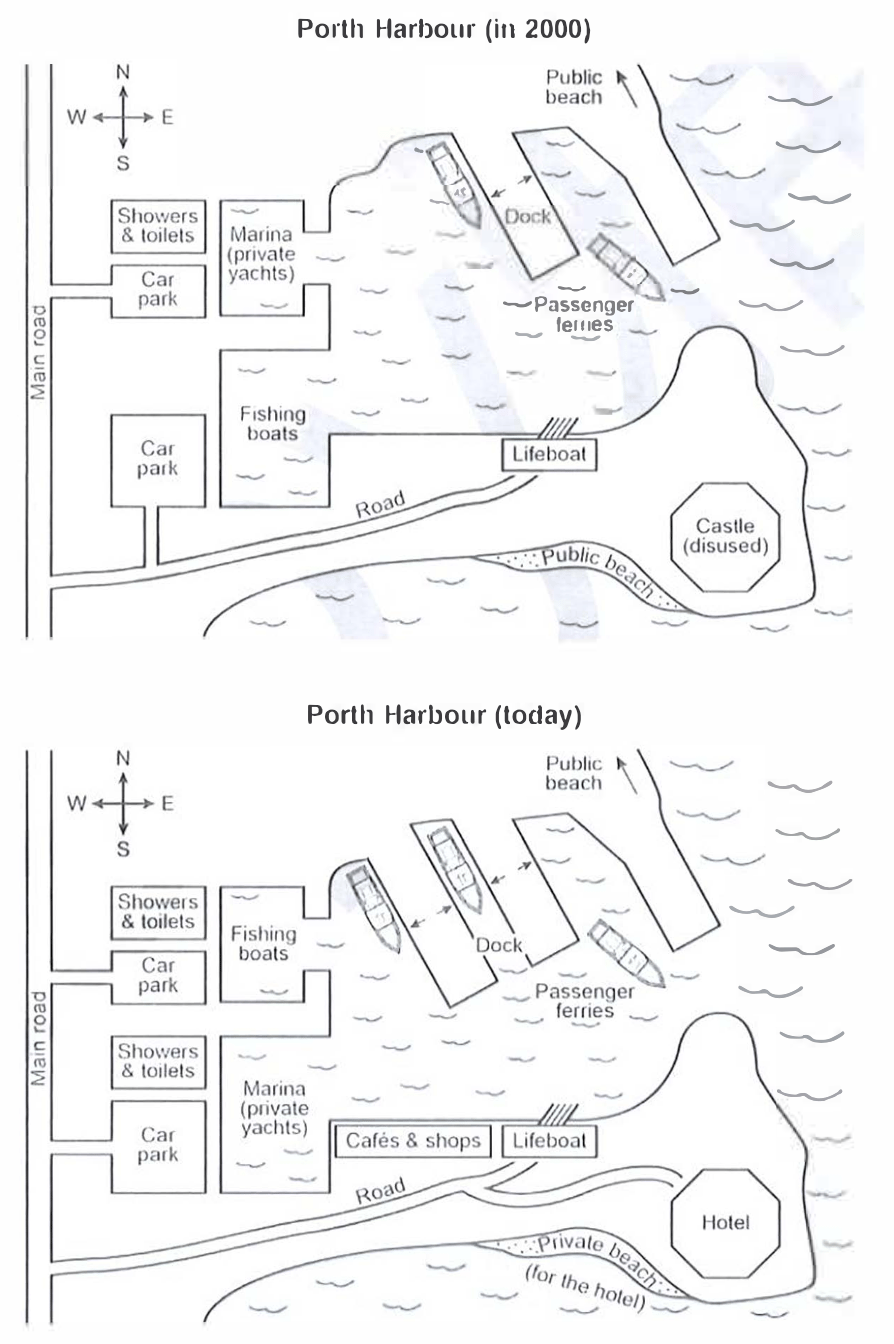
The plans below show a harbour in 2000 and how it looks today.
Summarise the information by selecting and reporting the main features, and make comparisons where relevant.
Student answer (Band 6.0)
The given plans shows the comparison between porth harbour in 2000 and in today's porth harbour. The porth harbour in 2000 was simple whereas today's harbour is more developed,well planned and with better facilities. For instance, the new version has swaped the places of marina and fishing boats. Now fishing boats has smaller place while for private yachts the new location is more wider and bigger.
Furthermore, newer version has also place for the showers and the toilets which previous version didn't had. Also, the newer version connected the bigger car parking directly with the main road and facilitate the visitors. Moreover, today's harbour has utilized the unused land of caste and built a hotel on it which is indeed a great decision and a facility for visitors. But now the beach which was public in previous version have became a private beach and owned by the hotel. The newer version also have cafes and shops which are the great places for the family.
However, some places didn't changed with the passage of time and remained same such as public beache,passenger ferries,lifeboat,road and the smaller car parking which is connected to the main road in both versions.
AI examiner evaluation
| Criterion | Band |
|---|---|
| Task Achievement / Task Response | 6.5 |
| Coherence and Cohesion | 6.5 |
| Lexical Resource | 5.5 |
| Grammatical Range and Accuracy | 5.5 |
| Overall | 6.0 |
Task Achievement / Task Response: Band 6.5
You identify the main overall change—that the harbour has become more developed—and report several important transformations, including the exchange of the marina and fishing-boat areas, the hotel replacing the castle, and the former public beach becoming private. You also note features that remain, such as the north-eastern public beach and lifeboat. This gives the response a relevant overview and covers the main comparison. However, some details are inaccurate or unclear: the plans show showers and toilets in both periods, with an additional facility added today, rather than none previously. The car-park change is also not clearly described, and the dock’s extra jetty and boats are omitted. More precise reporting of these changes, without evaluative comments such as calling the hotel a “great decision,” would strengthen the summary.
Coherence and Cohesion: Band 6.5
The response has a generally clear progression: it introduces the overall development, describes several changes, and ends by identifying features that stayed the same. Linking expressions such as “Furthermore,” “Moreover,” and “However” help signal relationships between points, and the reader can follow the comparison. At times, though, the sequence feels like a list rather than a carefully grouped account. For example, facilities, the car park, the hotel, and the beach are presented one after another without a clear spatial or thematic structure. Some references are also imprecise, as in “the newer version” and “the smaller car parking.” Organising the body into changes to harbour facilities and changes to the southern area, then using clearer references, would make the progression more controlled.
Lexical Resource: Band 5.5
You use a relevant range of vocabulary for describing change, including “swapped the places,” “utilized,” “replaced,” and “remained same,” so the main ideas are usually understandable. There are also attempts at more descriptive language, such as “more developed” and “better facilities.” However, several word choices and collocations are inaccurate or informal for an academic map summary: “more wider and bigger,” “connected the bigger car parking,” and “great decision” are examples. Spelling and word forms also need attention, including “swaped,” “caste,” and “beache.” These errors do not prevent the reader from understanding the overall comparison, but they limit precision and naturalness. Prefer concise, conventional terms such as “relocated,” “expanded,” and “additional facilities.”
Grammatical Range and Accuracy: Band 5.5
You attempt a mixture of simple and more complex sentences, including clauses introduced by “whereas,” “which,” and “such as.” This allows you to compare the two plans and connect related information. However, errors in agreement, tense, articles, and verb forms recur. For example, “The given plans shows” should use a plural verb, while “fishing boats has” and “the newer version also have” need subject–verb agreement. “Which previous version didn’t had” has an incorrect verb form, and “the beach … have became” combines an incorrect auxiliary with the wrong participle. Some sentence punctuation and spacing also need editing. These issues rarely obscure the intended meaning, but more accurate control of basic forms and a wider range of reliably formed sentences would improve the response.
See this exact question answered at other band scores. The same prompt compared across bands.
Browse more IELTS Writing model answers or get your own writing scored by the same AI examiner.