Band 5.5 IELTS Writing Task 1 Model Answer
Overall Band Score: 5.5 · Cambridge IELTS 19 · 2026-11-23
IELTS Writing Task 1 question
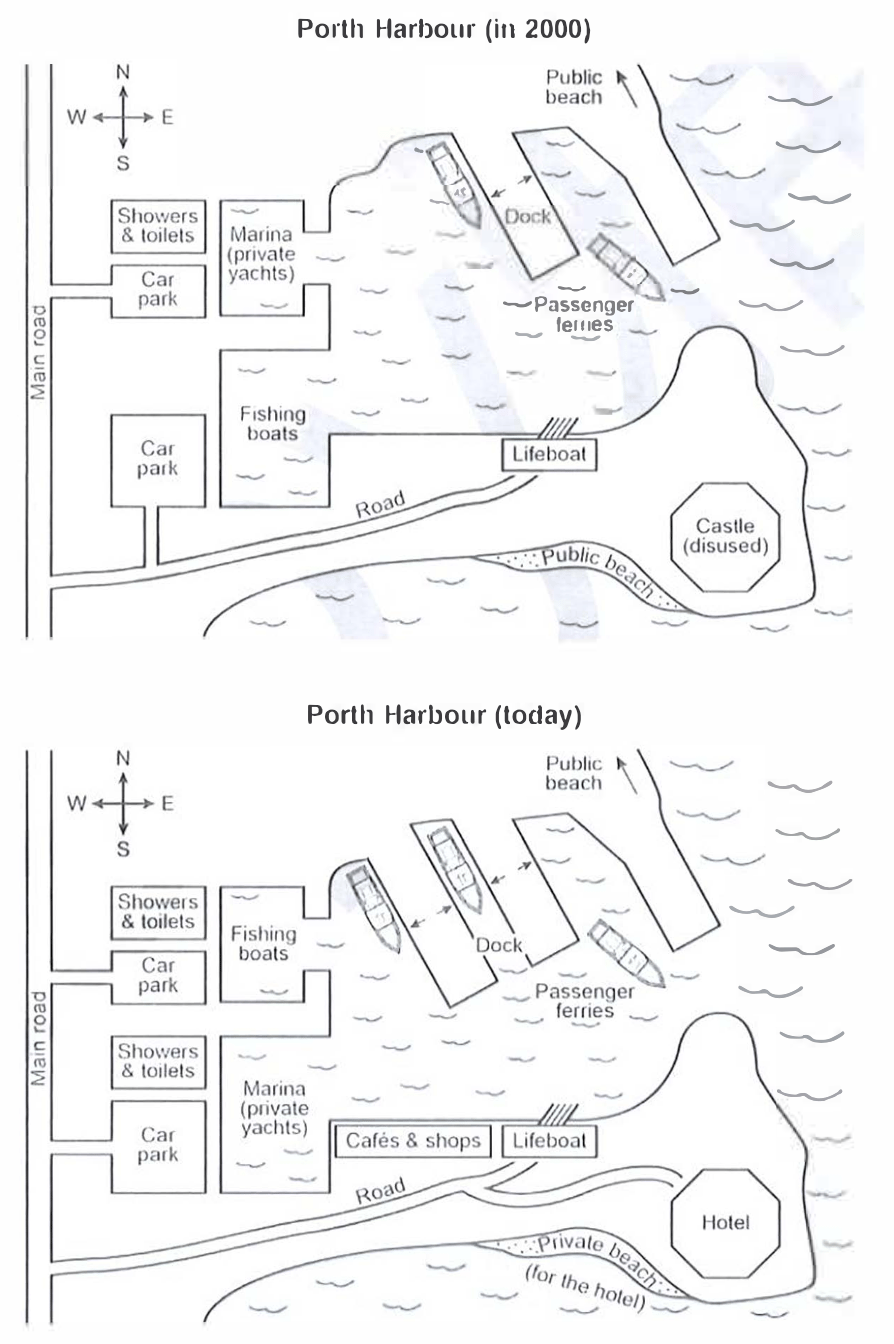
The plans below show a harbour in 2000 and how it looks today.
Summarise the information by selecting and reporting the main features, and make comparisons where relevant.
Student answer (Band 5.5)
The given map illustrates, the comparison of the porth harbour from 2000's to today. Earlier, Main road had one car parking area near showers and toilets but now there are two car parking areas and toilets connected to the main road. Moving forward, In 2000's from main road there was a large parking space in the south and there was a road leading to lifeboat area. In the east corner there was a disused castle attached to a public beach. On the other hand, currently the road leading to lifeboat now has cafe's and shops opened in the corner. They built a hotel in east with a private beach for the hotel. In 2000s, there was a dock, in the south-west corner there were fishing boats which has now transformed into a Marine private yachts. The dock got expanded with three boat areas.
Overall it is clear from all the aspects that there has been major changes in the porth harbour and it is clearly visible in the new map.
AI examiner evaluation
| Criterion | Band |
|---|---|
| Task Achievement / Task Response | 5.5 |
| Coherence and Cohesion | 5.5 |
| Lexical Resource | 5.5 |
| Grammatical Range and Accuracy | 5.5 |
| Overall | 5.5 |
Task Achievement / Task Response: Band 5.5
You identify several important changes, including the hotel replacing the disused castle, the southern beach becoming private, and cafés and shops being added near the lifeboat. However, the account only partly covers the plans, and some details are inaccurate or unclear. For example, the fishing boats were in the southern basin in 2000, not the “south-west corner”; they moved to the northern dock basin, while the marina moved south. The dock has two boats today, rather than “three boat areas.” Your overview says there were “major changes” but does not summarise the main pattern of redevelopment. To strengthen the response, compare the locations and uses of the harbour areas more precisely and include the changes to the beaches and facilities in a clear overview.
Coherence and Cohesion: Band 5.5
The response has a recognisable sequence, moving from earlier features to current changes, and phrases such as “On the other hand” signal comparison. However, the progression is not consistently clear: the opening combines several changes, then “Moving forward” introduces past details, which makes the time sequence confusing. The final overview is separated from the details but repeats the general idea of change rather than bringing the main comparisons together. Some linking phrases are also used mechanically or do not fit the relationship between ideas. Organise the report into a brief overview followed by clearly grouped comparisons—for example, changes to the water areas and dock, then changes to land facilities and beaches—and use time references consistently.
Lexical Resource: Band 5.5
You use some relevant map vocabulary, including “car parking area,” “disused castle,” “private beach,” and “lifeboat,” so the reader can understand the broad subject. However, the range is limited and several choices are imprecise or awkward. “Marine private yachts” appears to be an incorrect form of “marina,” while “three boat areas” does not clearly describe the dock’s two berthed boats. “Opened” is also less suitable for describing facilities being added to a plan. Repetition of “road,” “beach,” and “area” limits precision. Aim to use accurate location and change vocabulary, such as “relocated,” “converted,” “adjacent to,” and “berths,” while checking the exact labels and spelling shown on the map.
Grammatical Range and Accuracy: Band 5.5
You attempt a mixture of simple and longer sentences, and most of the intended meaning can be followed. However, errors in sentence construction, tense, agreement, and punctuation are noticeable. The opening, “The given map illustrates, the comparison,” has an unnecessary comma and an awkward structure. In “there were fishing boats which has now transformed,” the verb does not agree with its subject and the tense is inconsistent. Capitalisation is also inconsistent after commas, as in “Moving forward, In 2000's.” Use a clear present-tense introduction, then past tense for 2000 and present tense for today. Check subject–verb agreement and form complete sentences when describing each change; this will make your comparisons easier to follow.
See this exact question answered at other band scores. The same prompt compared across bands.
Browse more IELTS Writing model answers or get your own writing scored by the same AI examiner.