Band 5.0 IELTS Writing Task 1 Model Answer
Overall Band Score: 5.0 · Cambridge IELTS 19 · 2026-11-26
IELTS Writing Task 1 question
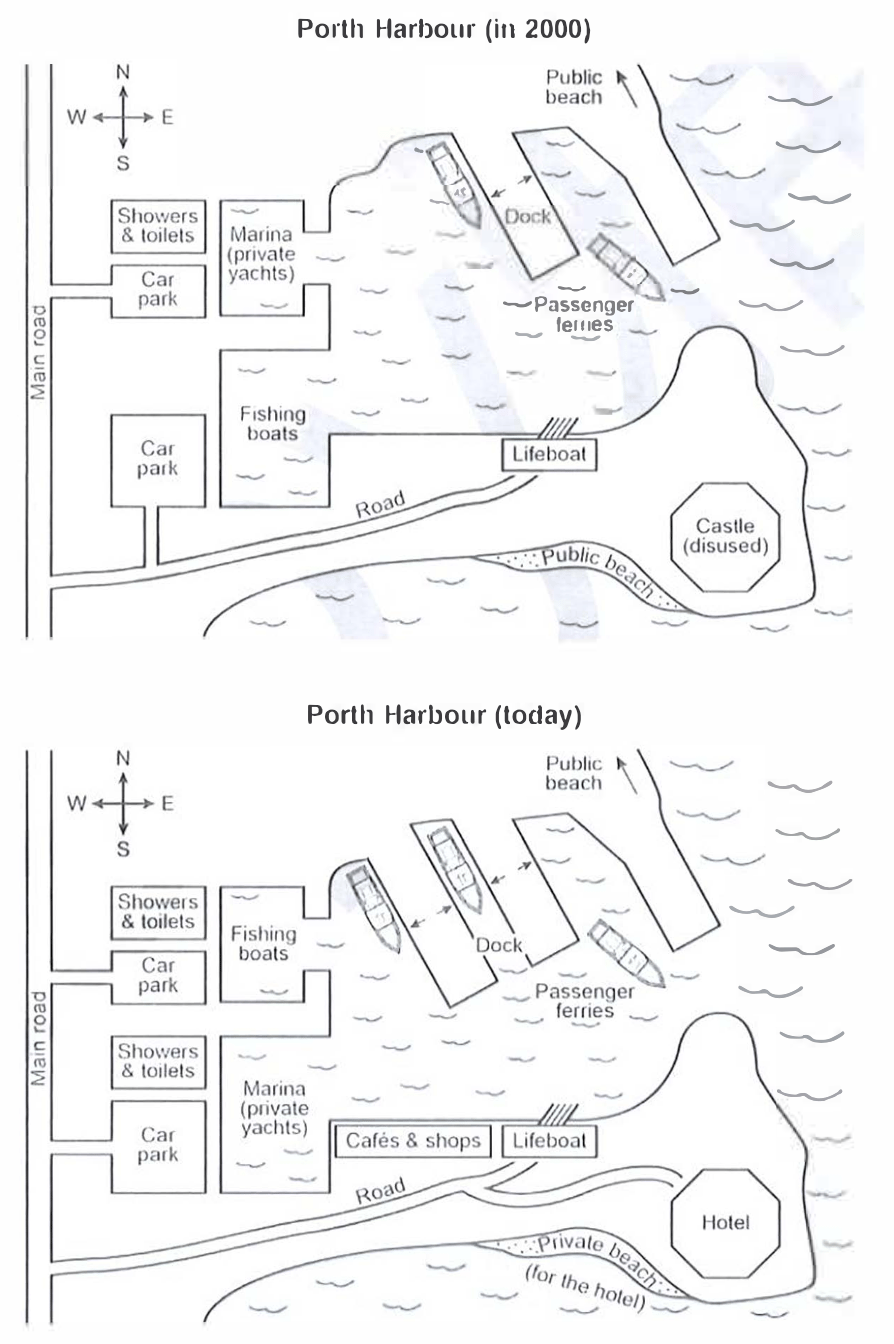
The plans below show a harbour in 2000 and how it looks today.
Summarise the information by selecting and reporting the main features, and make comparisons where relevant.
Student answer (Band 5.0)
The diagram illustrate the changing of porth harbour in 2000 to today.
Overall, Porth harbous are changed too much but still something are same as well as in 2000 .
First, We see main road in 2000 People go straight and turn left to see car park , showers&toilet and marina (private yacts). In front of marina there are dock and passengers ferries and public beach Now we discuss The first half side of poth harbous and changing of porth harbous. So , today people go straight from main road and turn left to see car park showers&toilets and then fishing boats instead of marina in front of marina same as well as like docks, passengers ferries and public Beach.
On the other side of the map people go straight and turn left in 2000 to see car park and then fishing boats then people was gone straight and saw lifeboats on the right side there was a public beach and catle discussed now we compare this side of map in today. people was go straight and turn left to saw car parks and showers&toilets and they finsihes fishing boat and upgrade to Marina ( (private yacts) and then we saw cafe and shops store in front there are life boats
AI examiner evaluation
| Criterion | Band |
|---|---|
| Task Achievement / Task Response | 5.0 |
| Coherence and Cohesion | 5.0 |
| Lexical Resource | 5.0 |
| Grammatical Range and Accuracy | 4.5 |
| Overall | 5.0 |
Task Achievement / Task Response: Band 5.0
You identify that the harbour has changed and mention several relevant features, including the marina, fishing boats, car parks, lifeboats, cafés and shops, and the former castle. However, the account only partially reports the main changes, and the overview is unclear: “changed too much but still something are same” does not specify what changed or remained. Some locations are also misreported. For example, the dock and passenger ferries are at the northern harbour entrance, not “in front of” the marina, and the southern public beach becomes a private hotel beach rather than simply remaining public. The hotel replacing the castle and the additional dock jetty are omitted. Give a clear overview, then accurately compare the key changes in both areas.
Coherence and Cohesion: Band 5.0
There is an attempt to organise the response by discussing the northern and southern sides in separate sections, and phrases such as “Overall,” “First,” and “now we compare” signal stages in the description. However, progression is difficult to follow because the first section repeats the same route-based wording and the second shifts between 2000 and today without consistently marking the comparison. Long, loosely connected sentences—particularly the final sentence—combine several locations and changes, making relationships unclear. The opening also includes an unnecessary explanation about how people travel from the main road. Use a clear overview paragraph followed by one paragraph for each map or area, and connect each old feature directly to its present-day replacement.
Lexical Resource: Band 5.0
The response uses some task-relevant vocabulary, including “main road,” “car park,” “marina,” “fishing boats,” and “lifeboats,” so the reader can recognise the subject. However, the range is limited and several expressions are imprecise or repetitive, such as “go straight and turn left,” “in front of,” and “changed too much.” These describe imagined movement rather than the locations and developments shown on a plan. Spelling errors such as “harbous,” “yacts,” “catle,” and “finsihes” also make parts harder to understand. Build a more precise set of map-description terms, including “located,” “relocated,” “replaced by,” and “adjacent to,” and check spelling of labels before finishing.
Grammatical Range and Accuracy: Band 4.5
You attempt to form connected sentences and use some present and past references, but the range of accurate structures is limited, and errors frequently make the description difficult to follow. Examples include “The diagram illustrate,” “Porth harbous are changed,” and “people was go,” where subject–verb agreement and verb forms are not controlled. Tense shifts also occur within comparisons, as in “people was gone straight and saw lifeboats” followed by “now we compare.” Sentence boundaries and punctuation are often missing, producing run-on sequences. Practise simple, reliable comparison patterns first, such as “In 2000, X was located…; today, it has been replaced by Y,” then check agreement, tense consistency, articles, and full stops.
See this exact question answered at other band scores. The same prompt compared across bands.
Browse more IELTS Writing model answers or get your own writing scored by the same AI examiner.