Band 5.5 IELTS Writing Task 1 Model Answer
Overall Band Score: 5.5 · Cambridge IELTS 19 · 2026-11-26
IELTS Writing Task 1 question
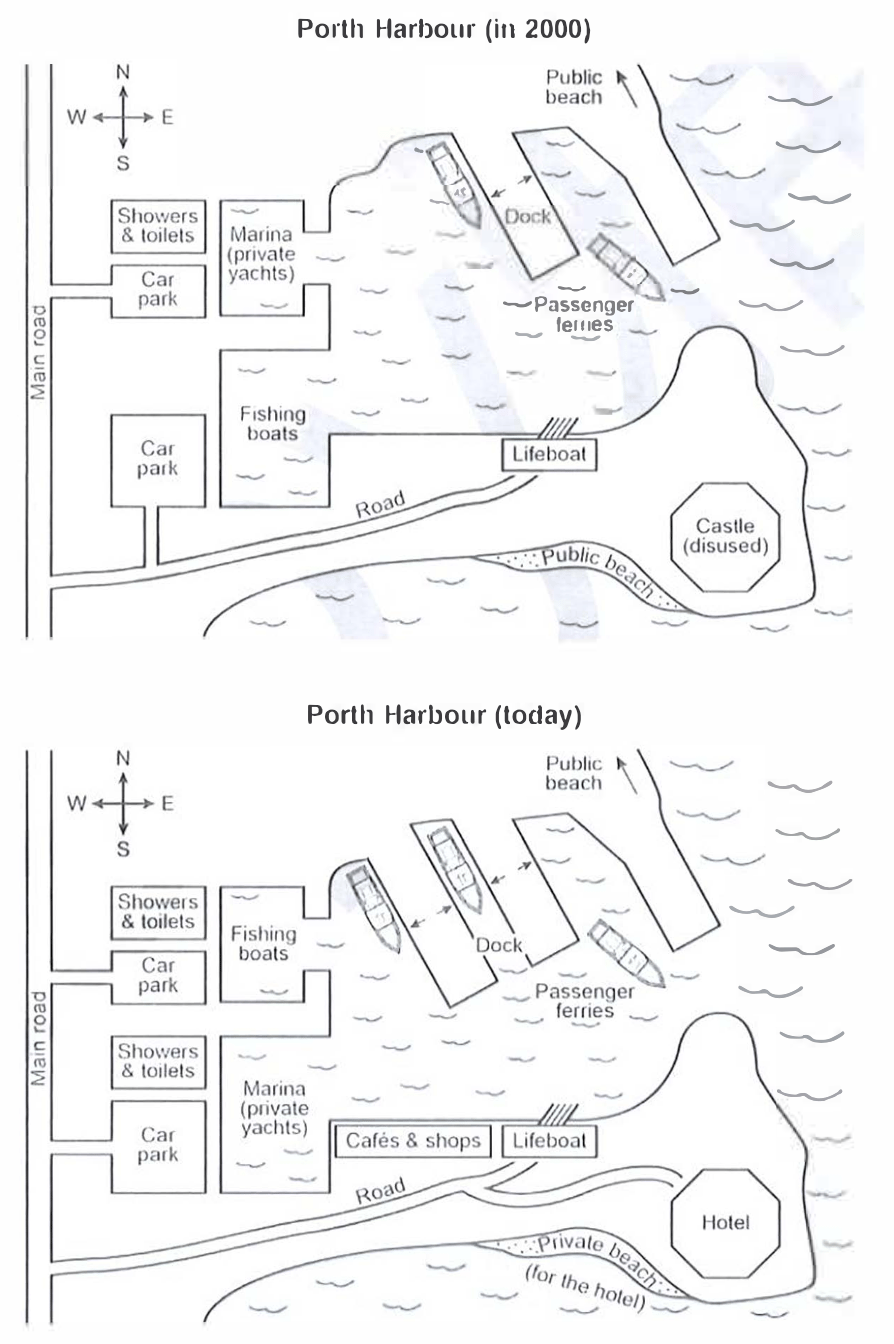
The plans below show a harbour in 2000 and how it looks today.
Summarise the information by selecting and reporting the main features, and make comparisons where relevant.
Student answer (Band 5.5)
The given two maps illustrate the structural development take places in porth harbor in 2000 and how it look back and how it looks present dayas.
overall, the Harbour undergoes significant development ,with the introduction of tourist facilities like cafes,shops and hotel are newly build wheare as retained several areas have been modified .
In 2000, The westen side feature a main road moving towards north to south Haebour provide acess to two car parking one in the north west its seem beside showers and toilets, Another to south which could reach via side of the road that also lead to lifeboard station. Near the upper car parking stood a marine for private yachts ,Directly to its south was an area used by fishing boats .on the eastern side a dock served passenger ferries with public beach to the north a further south a disused castle stood on the headland beside another public beach. Futhermore, Today the south care parking been upgraded with own shower and toilet facilities and the marina yachts change the location with previous fishing boats, Whereas new cafa and shops was constructed beside the lifeboad station.
AI examiner evaluation
| Criterion | Band |
|---|---|
| Task Achievement / Task Response | 5.5 |
| Coherence and Cohesion | 5.5 |
| Lexical Resource | 5.0 |
| Grammatical Range and Accuracy | 5.0 |
| Overall | 5.5 |
Task Achievement / Task Response: Band 5.5
You identify the harbour’s overall development and mention several relevant changes, including the new cafés and shops, the hotel replacing the disused castle, and the marina and fishing boats changing locations. These details show a reasonable understanding of the maps. However, the summary is only partial: the overview does not clearly capture the main pattern of change, and important features are omitted or unclear, such as the hotel’s private beach, the additional facilities near the marina, and the changes to the dock. Some locations are also misreported: the dock and passenger ferries are at the northern entrance, not simply on the eastern side. To strengthen the response, give a clearer overview and select the most significant changes, describing their locations accurately.
Coherence and Cohesion: Band 5.5
The response has a basic overall structure, moving from an overview to a description of the 2000 map and then to changes today. This gives the reader some sense of organisation. However, progression is uneven: the final section begins with “Furthermore, Today” and combines several changes in a long, difficult-to-follow sequence, while the present-day description is much less complete than the earlier account. Linking words such as “Another,” “Directly to its south,” and “Whereas” are attempted, but some are awkwardly attached or do not clearly show the relationship between ideas. Use separate, clearly focused paragraphs for the overview, the original layout, and the main changes, and connect each feature with precise location-based references.
Lexical Resource: Band 5.0
You use some relevant map vocabulary, including “main road,” “car parking,” “public beach,” “disused castle,” and “facilities,” so the topic is generally recognisable. However, the range is limited and several noticeable spelling and word-choice errors make parts harder to understand, for example “marine” for “marina,” “lifeboard” for “lifeboat,” and “care parking” for “car park.” Phrases such as “structural development take places” and “change the location with” are also unnatural. Aim for accurate, consistent labels from the map and practise common collocations for describing changes and positions. More precise verbs such as “relocated,” “replaced,” and “was added” would help you report the developments clearly.
Grammatical Range and Accuracy: Band 5.0
The response attempts both simple and more complex sentences, including a relative clause in “the road that also lead to lifeboard station.” However, complex constructions are often faulty, and frequent errors in tense, agreement, articles, and sentence boundaries sometimes make the meaning difficult to follow. Examples include “the structural development take places,” “how it look,” “the south care parking been upgraded,” and “new cafa and shops was constructed.” Capitalisation and punctuation are also inconsistent, with several ideas joined by commas or run together. Use the past simple for the 2000 map and the present perfect or present simple for current changes, and check subject–verb agreement and sentence boundaries. Shorter, accurately controlled sentences would improve clarity.
See this exact question answered at other band scores. The same prompt compared across bands.
Browse more IELTS Writing model answers or get your own writing scored by the same AI examiner.