Band 5.0 IELTS Writing Task 1 Model Answer
Overall Band Score: 5.0 · Cambridge IELTS 19 · 2026-11-05
IELTS Writing Task 1 question
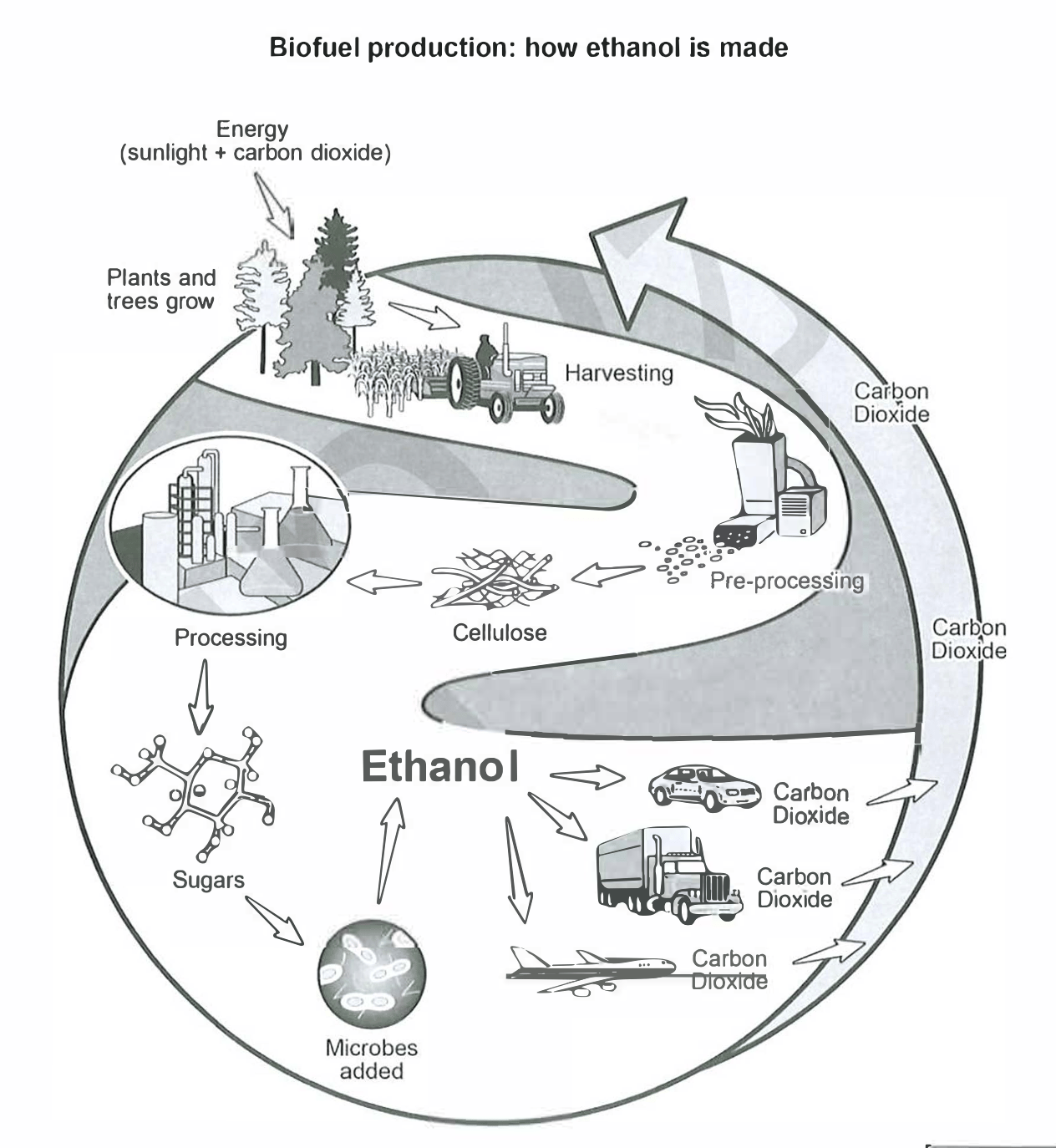
The diagram below shows how a biofuel called ethanol is produced.
Summarise the information by selecting and reporting the main features, and make comparisons where relevant.
Student answer (Band 5.0)
The process diagram illustrated how ethanol which is a biofuel get produced.
Overall, The process of making ethanol is an industrial cyclical process which strat from harvesting plants and trees passing by 6 stages to end up as full for all transport methods.
After harvesting, the plants get a pre-processing using a machine to turn them into fin particals called cellulose, those particals get proccesed in laboratories before adding sugar to it.
As in the next step, with the last result of putting sugars now the time to add microbes wich will make a chimical reaction to end up with biofuel which is Ethanol.
AI examiner evaluation
| Criterion | Band |
|---|---|
| Task Achievement / Task Response | 4.5 |
| Coherence and Cohesion | 5.5 |
| Lexical Resource | 5.0 |
| Grammatical Range and Accuracy | 5.0 |
| Overall | 5.0 |
Task Achievement / Task Response: Band 4.5
You identify the subject and give a brief overview of ethanol production as a cycle, then describe several central stages: harvesting, pre-processing, cellulose, processing, sugars and microbes. However, the account is only partial. It omits the initial growth of plants using sunlight and carbon dioxide, the transport uses of ethanol, and the return of carbon dioxide to the plants, which are key features of the diagram’s cycle. Some details are also inaccurate or unsupported: the diagram does not specify a machine, laboratories, or that ethanol is fuel for “all transport methods.” The response is also below the required 150 words, limiting the detail you can report. To develop the summary, cover the full cycle and accurately describe the stages and outputs.
Coherence and Cohesion: Band 5.5
The stages you include are presented in a broadly sensible order, and “Overall” signals an attempt to distinguish the overview from process details. The sequence from harvesting through pre-processing, cellulose, processing, sugars and microbes is generally traceable. However, the response has only three short paragraphs and does not clearly guide the reader through the complete cycle; the opening and overview are not followed by a fully developed account. Linking phrases such as “As in the next step” are awkward, while “before” and “now” do not make the relationships between stages especially clear. Use a clear overview paragraph followed by a chronological description, with precise links such as “Next,” “The resulting cellulose is then…” and “Finally,” to improve progression.
Lexical Resource: Band 5.0
You use some relevant process vocabulary, including “pre-processing,” “cellulose,” “processed,” “sugars,” “microbes” and “chemical reaction,” so the reader can recognise the general subject. However, the range is limited and several word-choice, collocation and spelling problems make the description less clear or precise. “Full for all transport methods” does not express the intended idea naturally, and “fin particals” is unclear. There are also conspicuous misspellings such as “proccesed,” “wich” and “chimical.” Aim to use accurate terms from the diagram and check spelling carefully. More precise process language, such as “is converted into” and “is used as fuel,” would help explain the stages without relying on vague wording.
Grammatical Range and Accuracy: Band 5.0
The response attempts both simple and more extended sentence forms, including a relative clause in “ethanol which is a biofuel” and a sequence joined with “before.” However, control is uneven, and errors sometimes make the intended relationships difficult to follow. For example, “ethanol … get produced” has incorrect verb agreement and passive form, while “the plants get a pre-processing” uses an unclear grammatical construction. The overview sentence, “passing by 6 stages to end up as full,” is also difficult to parse, and the final sentence beginning “As in the next step” is not a complete, well-formed construction. Practise accurate passive forms (“is produced,” “are processed”) and build complete sentences with clear subjects and verbs.
See this exact question answered at other band scores. The same prompt compared across bands.
Browse more IELTS Writing model answers or get your own writing scored by the same AI examiner.