Band 7.0 IELTS Writing Task 1 Model Answer
Overall Band Score: 7.0 · Cambridge IELTS 19 · 2026-11-07
IELTS Writing Task 1 question
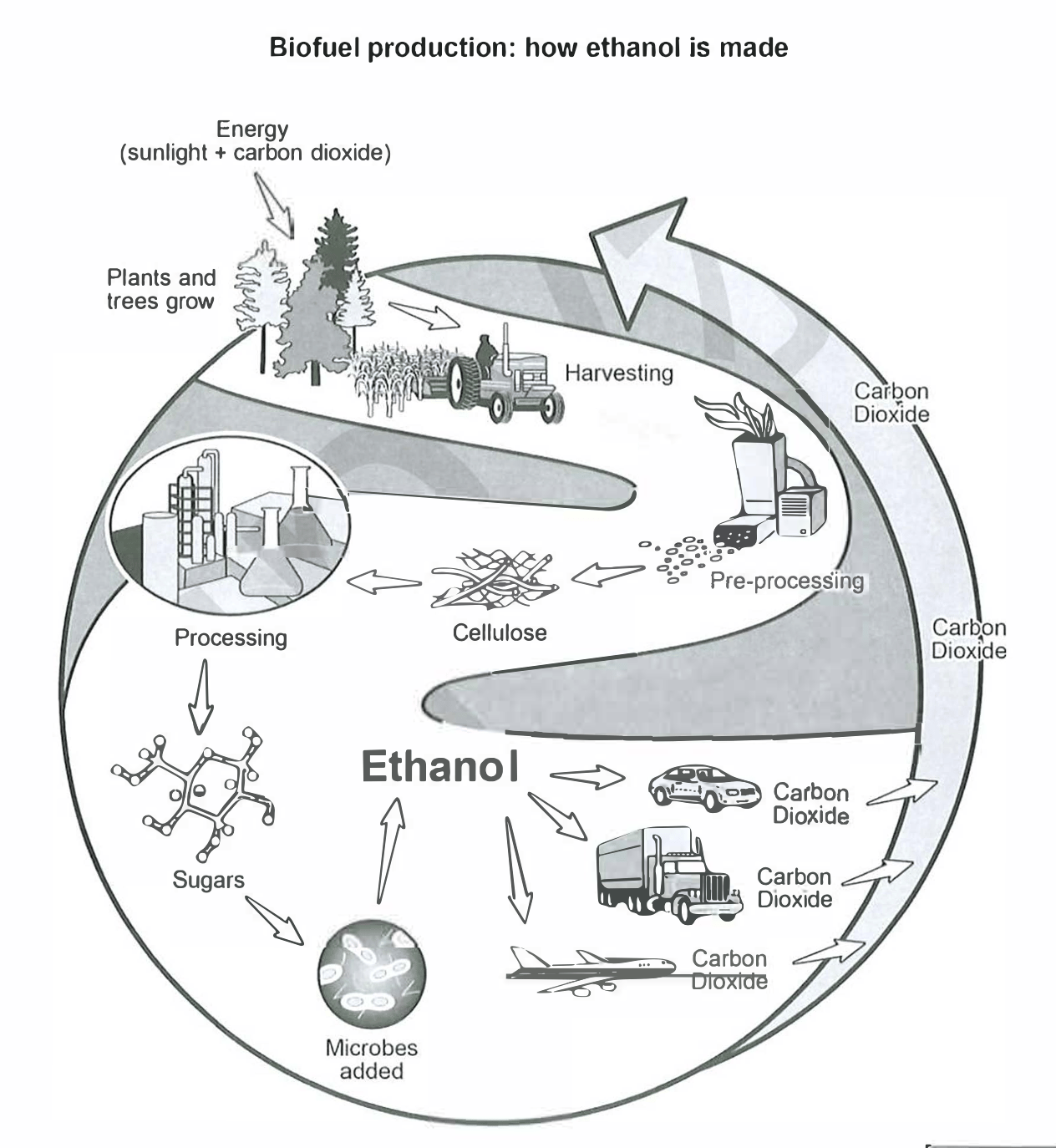
The diagram below shows how a biofuel called ethanol is produced.
Summarise the information by selecting and reporting the main features, and make comparisons where relevant.
Student answer (Band 7.0)
The process diagram illustrates the production of biofuel, better known as ethanol.
Overall, to obtain ethanol it needs, nine different stages and the process is cyclic. The global production consists of 3 different parts : agricultural growth, industrial changes and the final use.
Firstly, the agricultural land of the biofuel company is composed of plants and trees which grow thanks to sunlight and carbon dioxide in the air. When the plants have grown enough, they are then harvested and the industrial procedures begin. Subsequently, a machine pre-processes the plant by cutting it into several parts called cellulose.
Afterwards, in a laboratory, celluloses are processed by using chemical treatments to obtain sugar. The last touch is by adding microbes to finally obtain ethanol which is known to be used as fuel for vehicles such as cars, trucks and planes. These means of transport emit carbon dioxide which will be reabsorbed by plants and trees to, at the end, repeat this cycle.
AI examiner evaluation
| Criterion | Band |
|---|---|
| Task Achievement / Task Response | 7.0 |
| Coherence and Cohesion | 7.0 |
| Lexical Resource | 6.5 |
| Grammatical Range and Accuracy | 6.5 |
| Overall | 7.0 |
Task Achievement / Task Response: Band 7.0
The response covers the main stages and gives a clear overview that the process is cyclical, with agricultural growth, processing and final use. It accurately describes sunlight and carbon dioxide supporting plant growth, harvesting, conversion through cellulose and sugars, the addition of microbes, and transport use followed by carbon dioxide returning to plants. This is a well-selected account of the diagram. Some details, however, are presented as facts without support: the diagram does not specify that the company owns agricultural land, that a machine cuts the plants into parts, or that chemical treatments are used in a laboratory. For a stronger account, describe only the labelled stages and avoid adding explanations that the visual does not provide; also make clear that ethanol is used by the three transport modes shown.
Coherence and Cohesion: Band 7.0
The information is organised in a clear sequence: an overview is followed by the growth and processing stages, then the fuel’s use and the return of carbon dioxide. Linking expressions such as “Firstly,” “Subsequently,” “Afterwards” and “These means of transport” help the reader follow the cycle, and the paragraphing separates the overview from the detailed account. The progression is generally easy to follow, although the sequence markers are somewhat formulaic and the overview’s division into “3 different parts” is not developed consistently in the body. To improve, use transitions that express the actual relationships between stages, and connect each stage more directly to the next rather than relying mainly on time-order adverbs.
Lexical Resource: Band 6.5
The response uses a suitable range of process vocabulary, including “harvested,” “pre-processes,” “cellulose,” “microbes,” “reabsorbed” and “cyclic.” These choices make the stages and the overall cycle clear, and the writer attempts more specific language than a basic list of steps. Some wording is imprecise or unnatural for this diagram: “industrial changes” is vague, “the last touch” is informal, and “celluloses” is not the natural form for the material shown. “Chemical treatments” also adds a process detail not given in the visual. Greater precision and more natural collocations would strengthen the description; choose terms that name the diagram’s stages without inventing methods or settings.
Grammatical Range and Accuracy: Band 6.5
There is a mix of simple and more complex sentence forms, including the relative clause in “which grow thanks to sunlight and carbon dioxide” and the passive construction “they are then harvested.” Most sentences communicate the process clearly. Some grammatical and punctuation errors remain, however. In “to obtain ethanol it needs, nine different stages,” the subject and punctuation are faulty; a clearer form is “The production of ethanol involves nine stages.” The colon-like spacing in “parts :” is also incorrect, and “celluloses are processed” uses an awkward plural form in this context. Review sentence boundaries, articles and number agreement, while retaining the useful range of clauses and passive forms already attempted.
See this exact question answered at other band scores. The same prompt compared across bands.
Browse more IELTS Writing model answers or get your own writing scored by the same AI examiner.