Band 5.5 IELTS Writing Task 1 Model Answer
Overall Band Score: 5.5 · Cambridge IELTS 19 · 2026-11-08
IELTS Writing Task 1 question
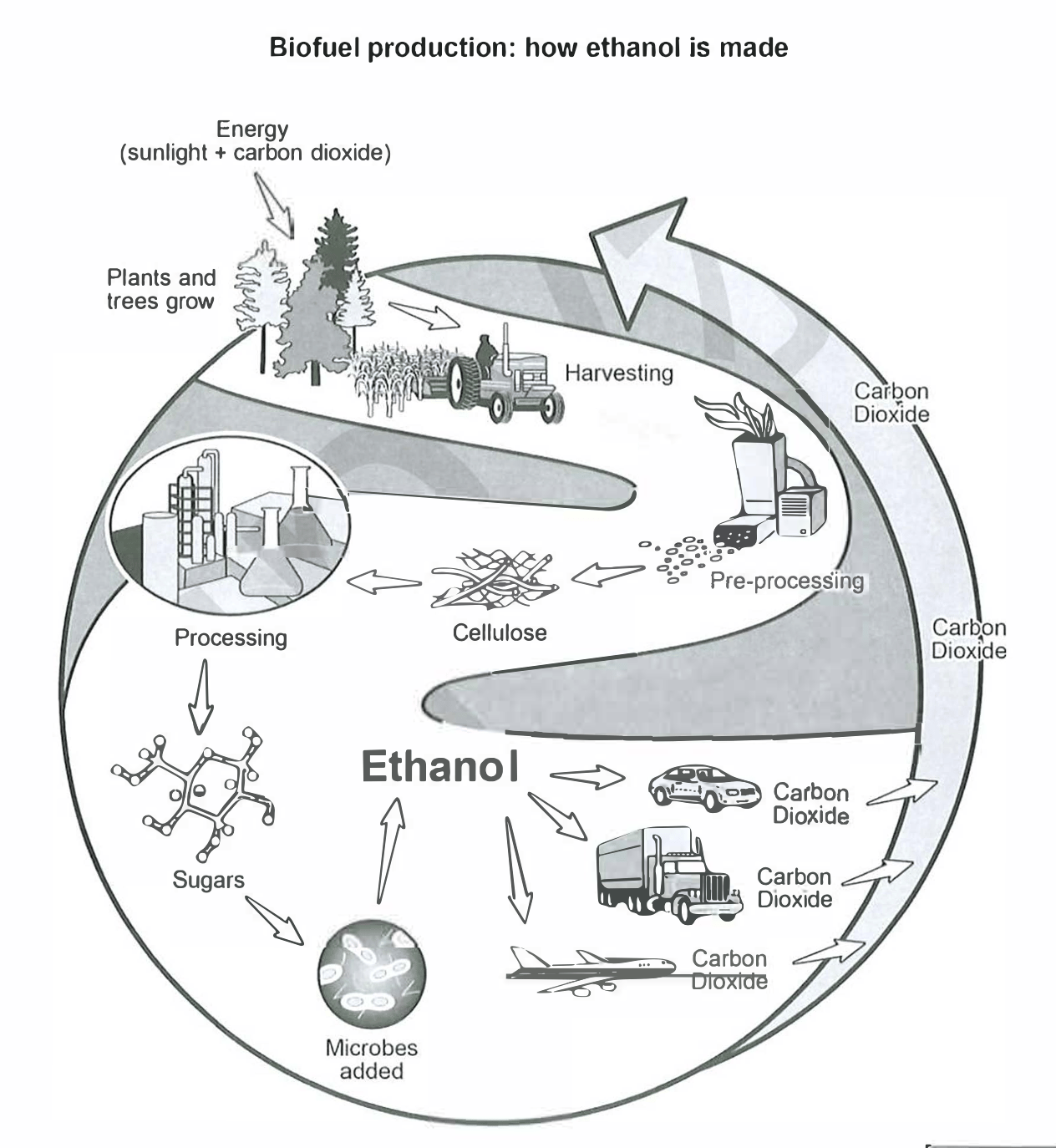
The diagram below shows how a biofuel called ethanol is produced.
Summarise the information by selecting and reporting the main features, and make comparisons where relevant.
Student answer (Band 5.5)
The diagram illustrates the production process of the biofuel which is called ethanol.
In essence, it’s a cyclical process which is started and ended on plants and trees. Furthermore, this process has multiple stages.
Apparently, plants and trees need carbon dioxide and sunlight from the environment. After harvesting of these plants the stage of pre process is began. Before reaching the stage of ethanol, the plants go through from further stages such as cellulose, processing of sugar and adding microbes respectively.
Moreover, the ethanol is transported in the environment in the form of carbon dioxide by following several ways.
AI examiner evaluation
| Criterion | Band |
|---|---|
| Task Achievement / Task Response | 4.5 |
| Coherence and Cohesion | 5.5 |
| Lexical Resource | 5.5 |
| Grammatical Range and Accuracy | 5.5 |
| Overall | 5.5 |
Task Achievement / Task Response: Band 4.5
You identify the diagram as ethanol production and recognise its cyclical nature, which captures an important overall feature. You also mention sunlight and carbon dioxide, harvesting, pre-processing, cellulose, processing, sugars and microbes. However, the account is very brief and leaves out key stages and relationships: it does not explain that ethanol is used by cars, trucks and aeroplanes, or that their carbon dioxide returns to support plant growth. The statement that ethanol is transported “in the form of carbon dioxide” misrepresents the cycle. The process is therefore only partially reported, with several details unclear or inaccurate. The response also falls 51 words short of the required minimum. To improve, describe the full sequence and explain the carbon cycle accurately.
Coherence and Cohesion: Band 5.5
The response has a basic, readable structure: an introduction, a brief overview and a description of stages, followed by a final comment. Sequencing words such as “After” and “Before” help show that the process has an order. However, the progression is incomplete, and the final paragraph introduces a confusing claim about ethanol becoming carbon dioxide rather than clearly connecting fuel use to carbon dioxide release and plant growth. “Respectively” also does not clearly link the listed stages to a matching set of items. Develop the stages in sequence and use clear links such as “Next,” “Following this,” and “Finally” to guide the reader through the entire cycle.
Lexical Resource: Band 5.5
You use some relevant process vocabulary, including “cyclical process,” “harvesting,” “cellulose” and “microbes,” and the main subject remains understandable. However, the range is limited for describing the diagram, and several phrases are imprecise or unnatural: “the stage of pre process,” “processing of sugar,” and “transported in the environment in the form of carbon dioxide.” These choices make important relationships difficult to understand. Use the diagram’s labels more precisely, for example, “pre-processing,” “sugars,” and “carbon dioxide is released when the fuel is used.” A broader set of accurate process verbs—such as “convert,” “produce,” “release” and “return”—would help you report each stage clearly.
Grammatical Range and Accuracy: Band 5.5
You attempt both simple sentences and more complex forms, including “Before reaching the stage of ethanol…” and “After harvesting…,” and most of the intended meaning can be followed. However, errors in verb forms and sentence construction remain noticeable. For example, “the stage of pre process is began” uses an incorrect passive form; write “pre-processing begins” or “the plants are pre-processed.” In “the plants go through from further stages,” the verb pattern is incorrect; use “go through further stages.” The opening overview, “it’s a cyclical process which is started and ended on plants and trees,” is also awkwardly constructed. Practise accurate passive forms and verb patterns, while varying sentence structures to describe the sequence.
See this exact question answered at other band scores. The same prompt compared across bands.
Browse more IELTS Writing model answers or get your own writing scored by the same AI examiner.