Band 5.0 IELTS Writing Task 1 Model Answer
Overall Band Score: 5.0 · Cambridge IELTS 19 · 2026-11-08
IELTS Writing Task 1 question
The diagram below shows how a biofuel called ethanol is produced.
Summarise the information by selecting and reporting the main features, and make comparisons where relevant.
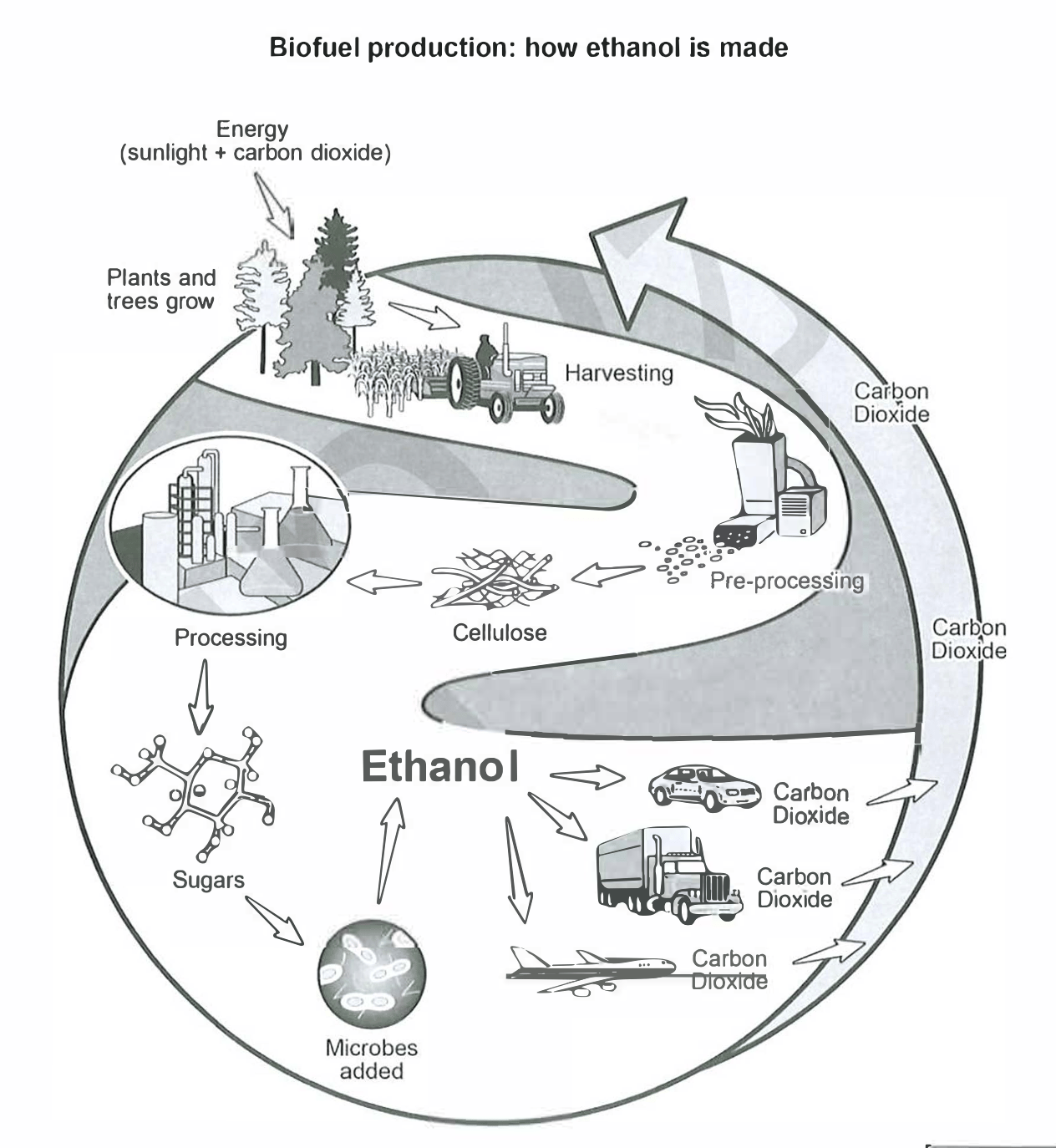
Student answer (Band 5.0)
In this diagram shows that how biofuel called ethanol is prodeced.
Firstly we see the energy such as sunlight and carbon dioxide provided to plants. These plants are make grow.
Secondly these plants are harvested and these are transported for pre-processing.
In these process it convert into celluose and they are transported for processing.
After processing it can be converted into the sugar particles.
These sugar are converted into microbes and these microbes are added into the ethanol.
These ethanol used into the cars trucks and air-planes.
These planes cars and trucks discharge the carbon dioxide
Now they are discharge the carbon dioxide and they make reverse process these carbon dioxide provided to plants and make the same process.
Now by this process biofuel called ethanol is produced.
AI examiner evaluation
| Criterion | Band |
|---|---|
| Task Achievement / Task Response | 4.5 |
| Coherence and Cohesion | 5.5 |
| Lexical Resource | 5.0 |
| Grammatical Range and Accuracy | 4.5 |
| Overall | 5.0 |
Task Achievement / Task Response: Band 4.5
You identify the main stages, from plant growth and harvesting through processing, sugar, microbes and ethanol, and you recognise the cycle in which carbon dioxide returns to the plants. However, the account is brief and some key relationships are inaccurate or unclear: microbes are added to the sugars to produce ethanol, rather than the sugars being converted into microbes, and the diagram shows ethanol being used by cars, trucks and aeroplanes. The overview is not clearly separated from the stage-by-stage description, and the final sentence repeats the opening rather than summarising the cycle. The response also falls 22 words short of the required minimum, limiting the detail available to explain the process fully. Add a concise overview and clarify the inputs and outputs at each stage.
Coherence and Cohesion: Band 5.5
The stages are presented in a broadly chronological order, and sequencing words such as “Firstly” and “Secondly” help the reader follow the process. Separate short paragraphs also give the response some organisation. However, progression becomes repetitive and mechanical: several sentences begin with “These” or “Now,” and the final two sentences repeat the idea that carbon dioxide returns to the plants and the process starts again. Some references are unclear, particularly “these are transported” and “they are transported,” because the reader must infer what “these” and “they” refer to. Group the stages into a clear introduction/overview and process paragraphs, and use more precise linking and referencing to show how each stage connects.
Lexical Resource: Band 5.0
You use some relevant process vocabulary, including “harvested,” “pre-processing,” “processing,” “carbon dioxide” and “produced,” so the topic is generally recognisable. However, the range is limited and several word choices or forms make the description imprecise, such as “sugar particles,” “converted into microbes” and “discharge the carbon dioxide.” Spelling errors, including “prodeced” and “celluose,” also reduce accuracy. Aim for precise terms that describe the diagram’s materials and actions, and avoid repeating “plants,” “process” and “carbon dioxide” without variation where a clear reference is possible. More accurate collocations would make the stages easier to understand.
Grammatical Range and Accuracy: Band 4.5
The response mainly uses short, simple sentences, with a few attempts to connect ideas, but grammatical control is weak and errors occur frequently. For example, “In this diagram shows” lacks a clear subject, “These plants are make grow” has an incorrect verb construction, and “In these process it convert” has problems with both number agreement and verb form. There are also errors in sentence structure in “These sugar are converted into microbes and these microbes are added into the ethanol.” These patterns sometimes make the intended relationships difficult to follow. Practise accurate present-simple descriptions of processes, including passive forms such as “is harvested” and “is converted,” and check subject–verb agreement and sentence boundaries.
See this exact question answered at other band scores. The same prompt compared across bands.
Browse more IELTS Writing model answers or get your own writing scored by the same AI examiner.