Band 5.5 IELTS Writing Task 1 Model Answer
Overall Band Score: 5.5 · Cambridge IELTS 19 · 2026-11-09
IELTS Writing Task 1 question
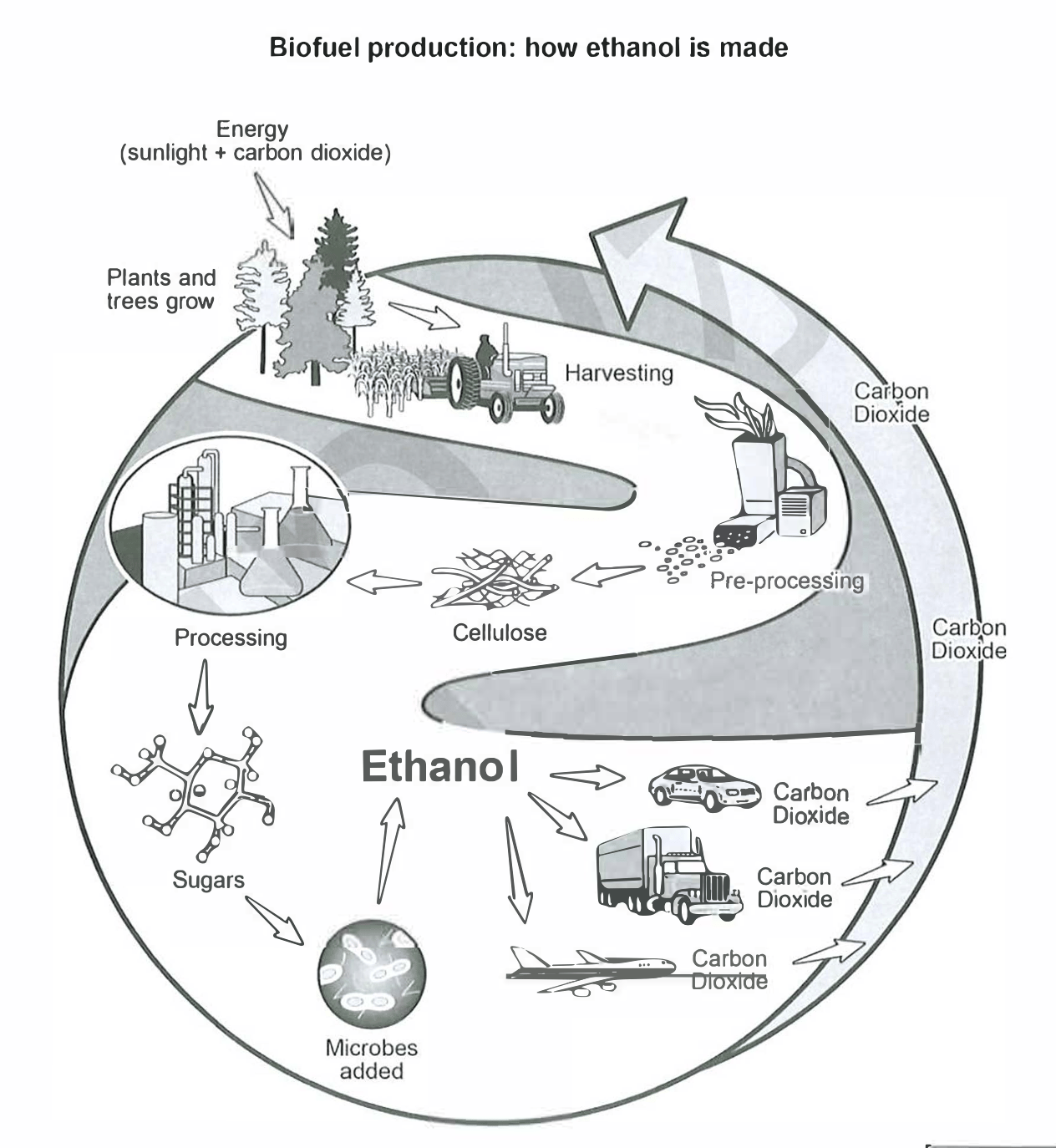
The diagram below shows how a biofuel called ethanol is produced.
Summarise the information by selecting and reporting the main features, and make comparisons where relevant.
Student answer (Band 5.5)
The diagram illustrates the proccess of making biofuel speacially ethanol how it is made with the raw materials.
Overall, the plants and trees are harvest and than passed from different procedures to the companies to create ethanol which are later used by the transport vehicles.
Initially, the plants and the trees aborb the carbondioxide to grow, when they are matured get harvested and proccessed by different procedure to make cellulose.
At the processing facility the cellulose are processed to make them in sugar form and subsequently the microbes are added in it to make a ethanol, which are later used in the transportaion and than the carbondioxide released from the vehicles is again absorbed by the plants and the trees to get matured. It is a whole process of biofuel production that is running in a cycle.
AI examiner evaluation
| Criterion | Band |
|---|---|
| Task Achievement / Task Response | 5.5 |
| Coherence and Cohesion | 6.0 |
| Lexical Resource | 5.5 |
| Grammatical Range and Accuracy | 5.0 |
| Overall | 5.5 |
Task Achievement / Task Response: Band 5.5
You identify the main stages and give a relevant overview that ethanol is produced from plant material and that carbon dioxide returns to the growing plants, capturing the diagram’s cyclical nature. The sequence from harvesting through cellulose and sugars to the addition of microbes is also broadly represented. However, some stages are compressed or unclear: “processed by different procedure to make cellulose” does not explain pre-processing, and the account does not mention ethanol being used by three transport types (cars, trucks and aeroplanes). The response also contains 137 words, below the required 150, so the process is not described in enough detail. To develop the report further, distinguish the stages more precisely and include the transport uses and carbon-dioxide loop.
Coherence and Cohesion: Band 6.0
The response has a recognisable overall progression: an introduction, an overview, and a description beginning with plant growth and ending with the cycle returning to the plants. Sequencing expressions such as “Initially,” “subsequently,” and “later” help the reader follow the process. However, most of the stages are packed into two long body sentences, so the relationships between steps are not always easy to follow. The repeated use of “and” and “which” also makes the final sentence feel crowded. Organise the process into shorter, clearly sequenced sentences or paragraphs, and use precise links such as “Next” and “Finally” to show each transition without overloading a sentence.
Lexical Resource: Band 5.5
You use relevant process vocabulary, including “harvested,” “cellulose,” “processing facility,” “microbes,” and “absorbed,” which helps communicate the diagram’s subject. There is some repetition of general terms such as “process” and “make,” however, and several word-choice or spelling problems reduce precision: “companies” is not shown in the diagram, while “transportaion” and “proccess” are misspelled. Phrases such as “make them in sugar form” are also unnatural. Aim for accurate process collocations and vary the verbs used to describe conversion and production. Proofreading spelling and choosing terms that match the diagram will make the description clearer and more appropriate for an academic report.
Grammatical Range and Accuracy: Band 5.0
You attempt both simple and complex sentences, including a sequence linked with “when” and a concluding clause describing the cycle. However, complex structures are often faulty, and errors occur frequently enough to make some sentences difficult to read. For example, “the plants and trees are harvest” has an incorrect passive form, while “when they are matured get harvested” lacks a clear grammatical structure. There are also agreement and article errors in “the cellulose are processed” and “make a ethanol,” as well as tense and clause-control problems in the long final sentence. Practise forming accurate passive constructions (“are harvested,” “is processed”) and divide multi-stage descriptions into shorter sentences.
See this exact question answered at other band scores. The same prompt compared across bands.
Browse more IELTS Writing model answers or get your own writing scored by the same AI examiner.