Band 5.5 IELTS Writing Task 1 Model Answer
Overall Band Score: 5.5 · Cambridge IELTS 19 · 2026-11-09
IELTS Writing Task 1 question
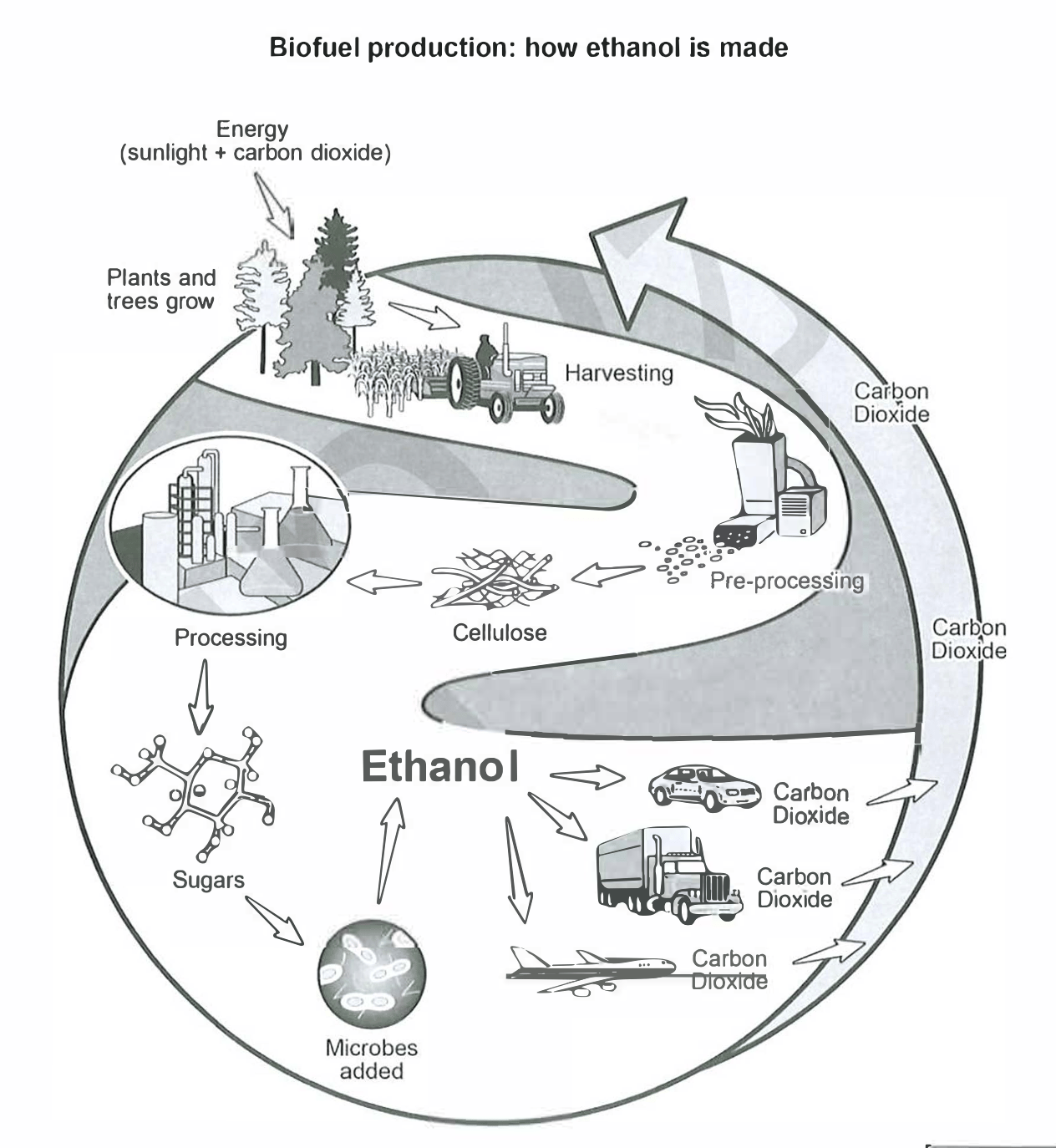
The diagram below shows how a biofuel called ethanol is produced.
Summarise the information by selecting and reporting the main features, and make comparisons where relevant.
Student answer (Band 5.5)
the key ingredient of ethanol is the natural plants and trees which grows through the photosynthesis process involving of sunlight and carbon dioxide which they recieve from the emission of planes, trucks and cars and when the crop of plants and trees grow at their full potential, they are harvested by the farmers and then the harvested crop goes through a pre processing machine which process them into cellulose form, then the processed cellulose goes into another processing unit plant where the raw cellulose gets processed and shape out in form of sugar, then the sugars are added with the microbes and their combine mixture provide us biofuel known as ethanol which is used for the running of multiple transports around us and this cycle continues on that these transport produce emission in form of carbon dioxide completing the cycle and repeating the same process all over again for the production of ethanol completing the cycle in loop.
AI examiner evaluation
| Criterion | Band |
|---|---|
| Task Achievement / Task Response | 6.0 |
| Coherence and Cohesion | 5.5 |
| Lexical Resource | 6.0 |
| Grammatical Range and Accuracy | 5.0 |
| Overall | 5.5 |
Task Achievement / Task Response: Band 6.0
You cover the main stages, from plant growth and harvesting through cellulose, sugars, microbes and ethanol, and you recognise that carbon dioxide from transport returns to the plants. This gives the response a relevant account of the cycle. However, some details are unclear or not fully supported by the diagram: it shows sunlight and carbon dioxide supporting plant growth, but does not say the plants receive carbon dioxide specifically from vehicle emissions. The overview is also embedded in a long description rather than clearly identifying the process as a cycle. To strengthen the report, state the overall cycle first, then describe the stages accurately and distinguish the diagram’s labels from added explanations.
Coherence and Cohesion: Band 5.5
The stages are generally presented in the correct order, so the reader can follow the broad process from plant growth to fuel use and carbon-dioxide return. However, the response is one extended sentence linked mainly by repeated uses of “and” and “then”. This makes the progression feel mechanical and obscures the boundaries between stages; the final idea about the cycle is also repeated. Organise the account into a brief overview and a logically sequenced description, using sentence breaks and a small range of precise links such as “after harvesting” and “finally”. Clearer referencing would also help, particularly where “they” and “their” refer to plants, sugars or microbes.
Lexical Resource: Band 6.0
You use relevant process vocabulary, including “harvested”, “cellulose”, “microbes” and “carbon dioxide”, and the reader can understand the general subject. There is also an attempt to use more specific terms such as “photosynthesis” and “pre-processing”. Some choices are inaccurate or awkward, however: “the key ingredient” is not a precise description of the plants, “shape out in form of sugar” is unclear, and “running of multiple transports” is an unnatural collocation. Spelling errors such as “recieve” also reduce accuracy. Aim for concise, conventional process language and check spelling; this will make the description more precise without requiring more elaborate vocabulary.
Grammatical Range and Accuracy: Band 5.0
The response attempts to connect stages using subordinate clauses and sequencing, but nearly all the information is packed into one sentence, limiting the range and control of the structures. Some errors are noticeable, including “plants and trees which grows”, where the verb does not agree with the plural subject, and “the sugars are added with the microbes”, which has an incorrect grammatical pattern. The long chain of clauses also needs clearer punctuation and sentence boundaries. Use a mixture of shorter accurate sentences and a few controlled complex ones. For example, separate plant growth and harvesting from the later processing stages, and check agreement and verb patterns when revising.
See this exact question answered at other band scores. The same prompt compared across bands.
Browse more IELTS Writing model answers or get your own writing scored by the same AI examiner.