Band 5.5 IELTS Writing Task 1 Model Answer
Overall Band Score: 5.5 · Cambridge IELTS 19 · 2026-11-11
IELTS Writing Task 1 question
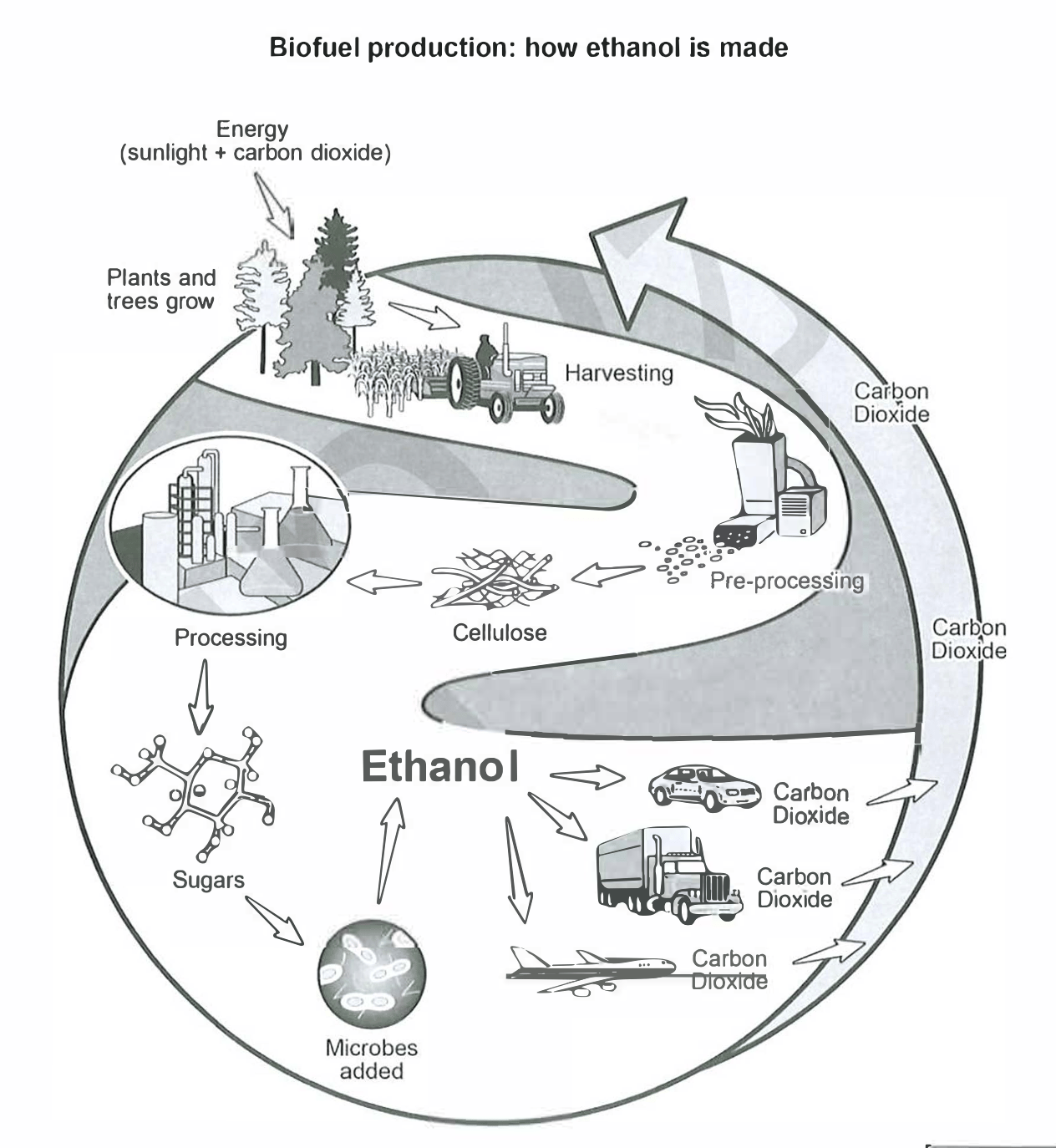
The diagram below shows how a biofuel called ethanol is produced.
Summarise the information by selecting and reporting the main features, and make comparisons where relevant.
Student answer (Band 5.5)
The diagram illustrates how ethanol is made from plants.
Overall, it can be seen that the total process consists several significant stages. To start with, growing plnats and trees on the field and ending with ethanol used different types of vehicals. Considerably, all process are re-cycle like start, ending and continue again.
To start with, mature trees are cuting by a harvesting tractors. Then collected plants pre-procesing by a special machine for creating small cellulose. After that, cellulose move to processing to lab for made sugars.
In addition, collected sugars from processing sectors, to transform a lab and adding microbes. Next, when all process are completed then finally made in Ethanol. Collected ethanol are used different types of mode's such as cars, trucks, airplane, and others sector. After that, the vehicals are release carbon dioxide emissions to the environment. The totall process are consists cyrcle and again the process continue.
AI examiner evaluation
| Criterion | Band |
|---|---|
| Task Achievement / Task Response | 6.0 |
| Coherence and Cohesion | 6.0 |
| Lexical Resource | 5.0 |
| Grammatical Range and Accuracy | 5.0 |
| Overall | 5.5 |
Task Achievement / Task Response: Band 6.0
You cover the main stages from plant growth through harvesting, pre-processing, cellulose, processing, sugars, microbes and ethanol, and you recognise that the process is cyclical. This gives the reader a relevant account of the diagram. However, some details are unclear or not fully accurate: the diagram shows sunlight and carbon dioxide supporting plant growth, and carbon dioxide from vehicles returning to the plants, but these links are only broadly described as emissions released “to the environment.” The claim that trees are cut and that processing happens “in a lab” is not shown. Your overview identifies the cycle, but could more clearly summarise the conversion stages and the carbon-recycling feature. Include only details supported by the diagram and explain the cycle more precisely.
Coherence and Cohesion: Band 6.0
The response has a recognisable structure: an introduction, an overview, and paragraphs describing the production stages and final use. Sequencing expressions such as “To start with,” “Then,” “After that,” and “Next” help the reader follow the process. However, the progression is sometimes mechanical, and the final paragraph repeats the idea that the process continues in a cycle without adding much. Some connections are also unclear, particularly “collected sugars from processing sectors, to transform a lab and adding microbes,” which makes the relationship between sugars, processing and microbes difficult to follow. Improve cohesion by grouping related stages and using precise references such as “the resulting sugars” and “this fuel.” A clearer paragraph sequence would make the account easier to follow.
Lexical Resource: Band 5.0
You use relevant process vocabulary, including “harvesting,” “cellulose,” “microbes,” “ethanol,” and “carbon dioxide,” so the topic is generally identifiable. However, the range is limited and several word-choice, collocation and spelling problems reduce precision. For example, “used different types of mode's” is an awkward way to describe transport, while “special machine” and “others sector” are vague. There are also misspellings such as “plnats,” “vehicals,” “pre-procesing,” and “totall.” Aim for accurate process terms and natural collocations, and check spelling carefully. More precise vocabulary would help distinguish the stages and describe the fuel’s use and the return of carbon dioxide.
Grammatical Range and Accuracy: Band 5.0
You attempt both simple sentences and longer constructions, and the sequence is usually understandable. However, errors in sentence structure, verb forms, agreement and articles occur in several places. For example, “the total process consists several significant stages” needs a preposition, and “mature trees are cuting by a harvesting tractors” has problems with the passive form, article and number agreement. In “all process are re-cycle,” the subject and verb do not agree, and the verb phrase is not formed correctly. Some sentences, especially the one beginning “collected sugars from processing sectors,” are incomplete or difficult to parse. Practise accurate passive constructions for process descriptions and check subject–verb agreement, articles and complete clauses.
See this exact question answered at other band scores. The same prompt compared across bands.
Browse more IELTS Writing model answers or get your own writing scored by the same AI examiner.