Band 6.5 IELTS Writing Task 1 Model Answer
Overall Band Score: 6.5 · Cambridge IELTS 19 · 2026-11-11
IELTS Writing Task 1 question
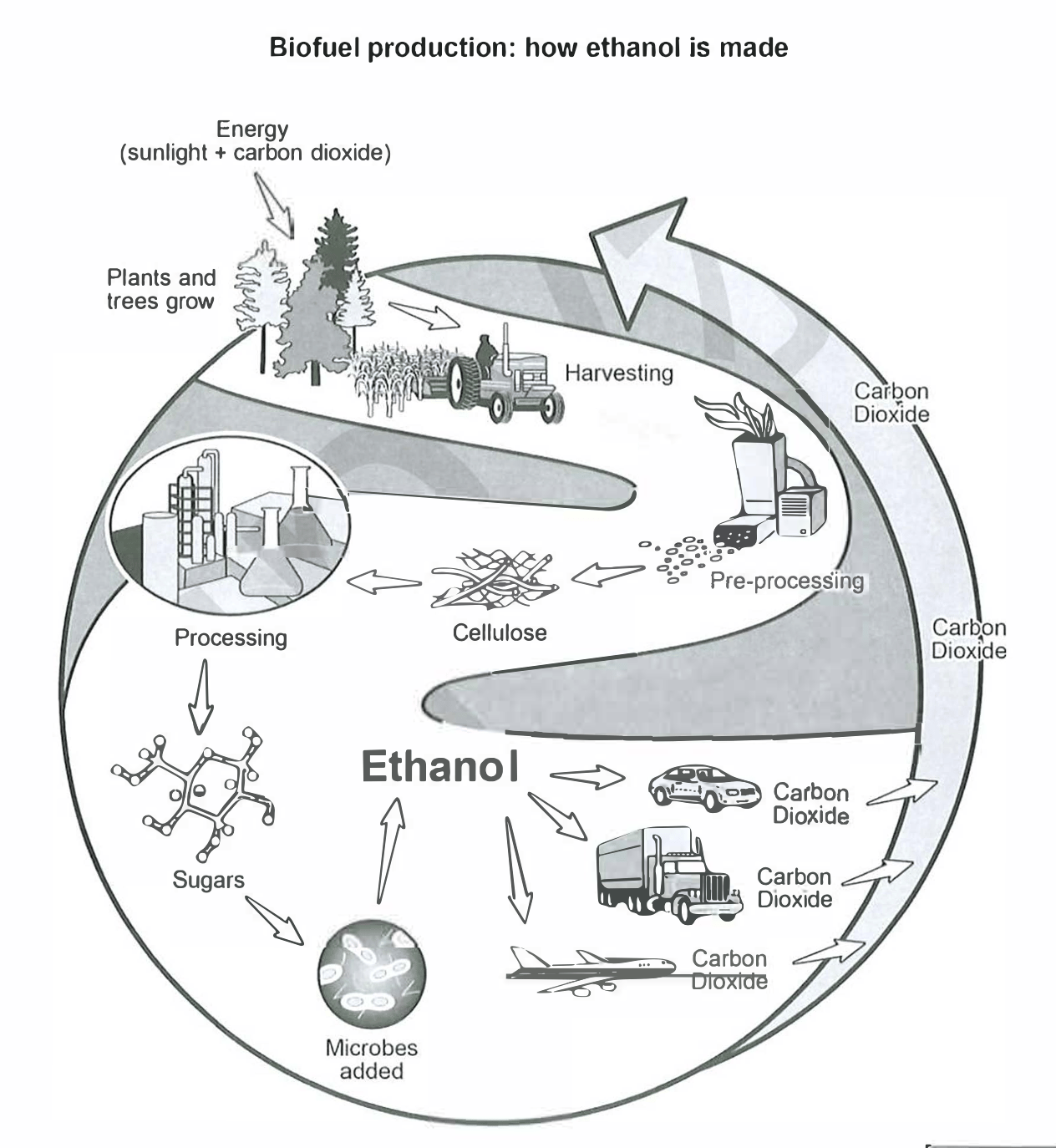
The diagram below shows how a biofuel called ethanol is produced.
Summarise the information by selecting and reporting the main features, and make comparisons where relevant.
Student answer (Band 6.5)
The diagram below illustrates how ethanol, a biofuel is produced in a step by step method.
Overall, it is seen that four major steps are included in producing ethanol. They are harvesting, pre-processing, processing in laboratory and adding of microbes. It is uses as a fuel in planes, trucks, cars and other vehicles.
With the help of sunlight and carbon dioxide plants and tress get enegy to grow. These trees are than harvested and pre processing done via a machine. Cellulose is than produced. It is again processed in the laboratory.
After laboratory process, sugars are formed. Later microbes are added to this sugar. The ultimate production is ethanol. It is a biofuel and used in several vehicles including aeroplanes. Theses vehicles produce carbon dioxide after using the fuel ethanol. Carbon dioxide is ultimately released into the air from which trees and plants absorb it and the ethanol producing cycle restarts.
AI examiner evaluation
| Criterion | Band |
|---|---|
| Task Achievement / Task Response | 7.0 |
| Coherence and Cohesion | 6.5 |
| Lexical Resource | 6.0 |
| Grammatical Range and Accuracy | 5.5 |
| Overall | 6.5 |
Task Achievement / Task Response: Band 7.0
The response covers the main stages and the overall cycle, including plant growth, harvesting, conversion to cellulose and sugars, the addition of microbes, ethanol use in transport, and carbon dioxide returning to plants. The overview identifies the production stages and the fuel’s use, while the final sentence makes the cyclical relationship clear. This gives a relevant account of the process, although the overview could better distinguish the two broad phases—production and subsequent use/recycling—and the description of pre-processing is vague: “done via a machine” is not specified in the diagram. Also, “processing in laboratory” adds a setting not shown. A more precise overview and closer adherence to the labels would make the key features more fully developed.
Coherence and Cohesion: Band 6.5
The response is arranged in a clear sequence: an introduction and overview are followed by the early production stages and then the later stages and carbon cycle. Connectors such as “After,” “Later,” and “ultimately” help the reader follow the process, and the final sentence links the end back to plant growth. This is a coherent overall arrangement. However, some links are mechanical or imprecise, particularly “It is again processed” and “It is a biofuel,” where the reference of “it” is not immediately clear. The overview also lists stages without clearly grouping them into production and fuel use. More precise referencing and a few clearer transitions between these phases would strengthen cohesion.
Lexical Resource: Band 6.0
The response uses a suitable range of process vocabulary, including “harvested,” “cellulose,” “sugars,” “microbes,” and “released,” so the stages are generally understandable. It also uses relevant terms such as “biofuel” and “carbon dioxide.” However, some choices are vague or unnatural for describing a diagram: “step by step method,” “done via a machine,” and “ultimate production” could be expressed more precisely. There are also spelling errors, including “tress,” “enegy,” and “Theses,” which reduce accuracy. Aim for concise process language and check spelling carefully; for example, describe materials as being “converted into” the next product rather than repeatedly saying they are “produced.”
Grammatical Range and Accuracy: Band 5.5
The response includes both simple sentences and some longer structures, such as “With the help of sunlight and carbon dioxide plants and tress get enegy to grow” and the final sentence explaining how carbon dioxide returns to plants. The sequence remains understandable, but grammatical control is uneven. Examples include “It is uses as a fuel,” where the verb form is incorrect, and “These trees are than harvested,” where the passive construction and sequencing word are faulty. “After laboratory process” also lacks an article, while “plants and tress get” has an agreement issue if the intended subject is “plants and trees.” Review passive forms, articles, and verb agreement, and use a wider range of accurately controlled sentence patterns.
See this exact question answered at other band scores. The same prompt compared across bands.
Browse more IELTS Writing model answers or get your own writing scored by the same AI examiner.