Band 6.0 IELTS Writing Task 1 Model Answer
Overall Band Score: 6.0 · Cambridge IELTS 19 · 2026-11-11
IELTS Writing Task 1 question
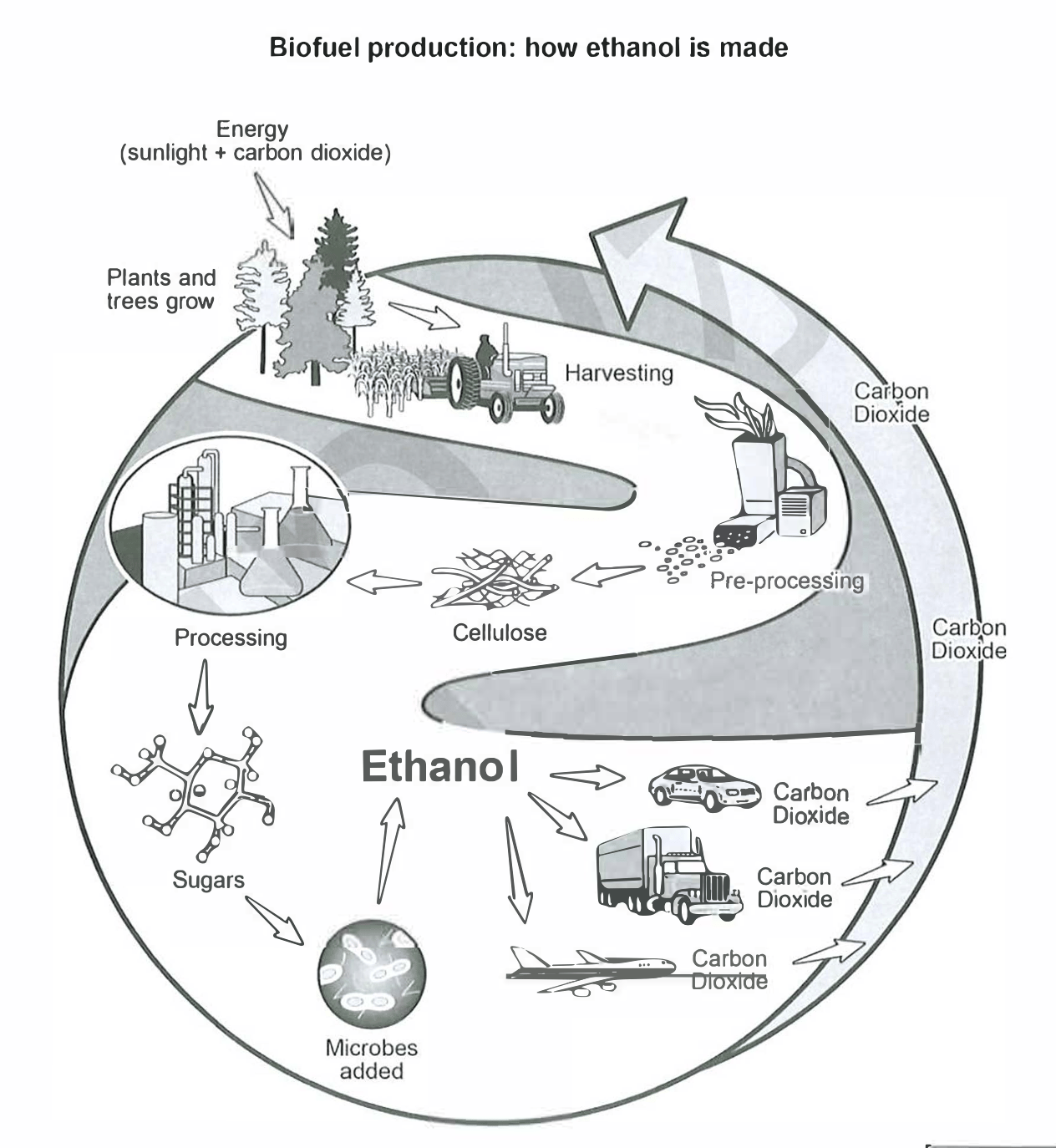
The diagram below shows how a biofuel called ethanol is produced.
Summarise the information by selecting and reporting the main features, and make comparisons where relevant.
Student answer (Band 6.0)
The diagram demonstrates the production of biofuel called ethanol.
Overall, the production includes several steps, starting from the cultivation of trees, which further undergo processing step and produce sugars. The final product is ethanol which is consumed by different types of vehicles, produce carbon dioxide gas which recycled from the atmosphere.
Plants and trees are grown with the help of energy include sunlight and carbon dioxide. After fully grown they are harvested through machinery. The next step is the pre-processing in which
plants are crushed and converted into cellulose. Then cellulose undergoes for further chemical processing and produces molecules of sugars. Finally, microbes added into sugars for the production of ethanol. Ethanol which is the last product is utilizes by different kinds of vehicles such as aeroplanes, cars and trucks, produce a gas in atmosphere called carbon dioxide. This gas is reused by plants and trees for cultivation in the presence of sunlight.
AI examiner evaluation
| Criterion | Band |
|---|---|
| Task Achievement / Task Response | 6.5 |
| Coherence and Cohesion | 5.5 |
| Lexical Resource | 6.0 |
| Grammatical Range and Accuracy | 5.5 |
| Overall | 6.0 |
Task Achievement / Task Response: Band 6.5
You cover the main stages and give a clear overall account of the cycle: plant growth, harvesting, conversion to sugars, ethanol production, transport use and the return of carbon dioxide. The overview identifies the beginning and end of the process, and most details match the diagram. The description of crushing plants and converting them into cellulose is a reasonable explanation of pre-processing, although the diagram itself only labels this stage. Your account could be more precise about the cycle: carbon dioxide is released by the vehicles and then returns to the plants, while sunlight is also shown as an input. The overview’s phrase “which further undergo processing step” is unclear, and the stages could be distinguished more fully. This is a solid, relevant summary, with some features less clearly developed than others.
Coherence and Cohesion: Band 5.5
The response has a useful overall structure: an introduction, an overview, and a paragraph that follows the process in sequence. Sequencing expressions such as “The next step,” “Then,” and “Finally” help the reader track the stages. However, progression is not consistently smooth, particularly in the overview, where the sentence about vehicles and recycled carbon dioxide combines several ideas without clear links. The final paragraph also shifts from production to vehicle use and back to plant growth in a way that could be signposted more clearly. The blank space within “in which plants” interrupts presentation, and repeated references to “the next step” style sequencing make cohesion somewhat mechanical. Use clearer sentence boundaries and explicit links to show the cycle’s return to the beginning.
Lexical Resource: Band 6.0
You use an adequate range of process vocabulary, including “cultivation,” “harvested,” “pre-processing,” “cellulose,” “molecules of sugars,” and “carbon dioxide.” These terms make the stages recognisable, and the response generally communicates the intended meaning. Some word choices and collocations are inaccurate or imprecise, however: “energy include sunlight” and “undergoes for further chemical processing” do not sound natural, while “a gas in atmosphere” is less precise than the diagram’s label. “Consumed” is understandable for ethanol use but “used as fuel” would be more exact. Aim for accurate process collocations and avoid adding technical descriptions such as “chemical” unless the diagram supports them. This would make the vocabulary more precise while retaining the useful range already shown.
Grammatical Range and Accuracy: Band 5.5
You attempt both simple and complex sentence forms, including clauses beginning “After fully grown” and “in which plants are crushed,” and the sequence is usually understandable. Some grammatical errors remain, especially with verb forms, agreement and sentence construction. For example, “which recycled from the atmosphere” needs a passive form (“which is recycled”), and “Ethanol … is utilizes” has an incorrect verb form. In “vehicles … produce a gas,” the subject and verb do not agree with the intended passive meaning; “vehicles … release a gas” would be clearer. The opening overview also contains an incomplete construction in “which further undergo processing step.” Work on complete clauses, passive forms and agreement, while keeping the complex structures you are attempting.
See this exact question answered at other band scores. The same prompt compared across bands.
Browse more IELTS Writing model answers or get your own writing scored by the same AI examiner.